
Proposal Would Waive Environmental Requirements
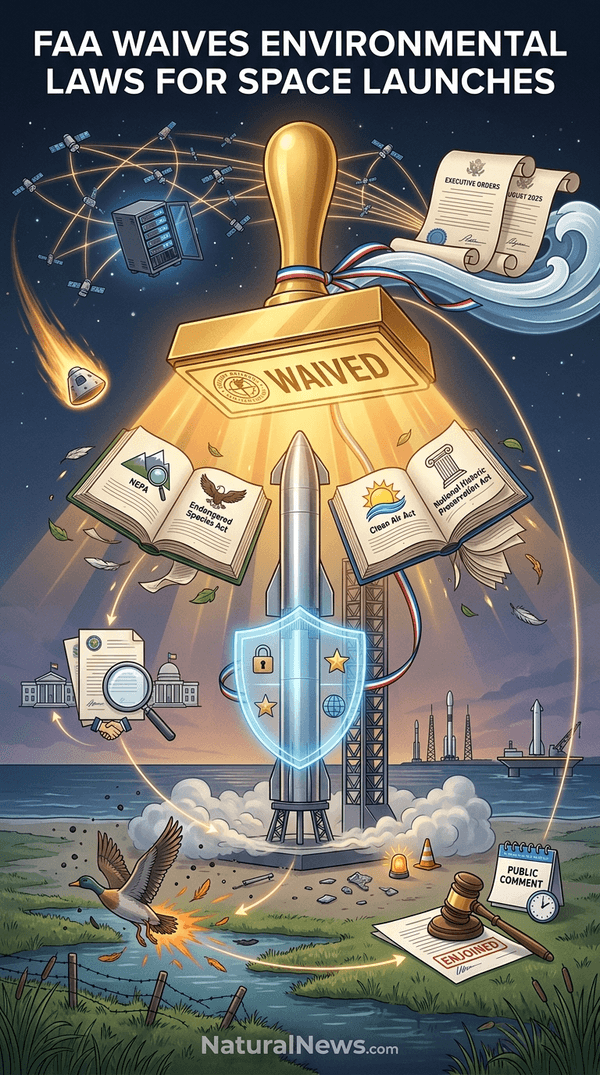
The Federal Aviation Administration (FAA) released a proposed rule on July 29 that would speed up commercial space licensing by waiving certain environmental requirements, according to the agency. The proposal would apply to rocket launches, re-entering spacecraft and the sites where launches and reentries take place. The rule will be open for a 30-day comment period, the agency said.
The rule text states that the FAA would “waive requirements of laws of the U.S. for a license or permit” after consulting with the head of the appropriate executive agency when the requirement is not necessary to protect public health and safety, property, national security, or foreign policy interests. The Department of Transportation (DOT) said the measure would allow the agency to waive what it called “unnecessary environmental laws and regulations” that are “slowing American innovation.”
Under the proposal, the FAA would still be required to ensure that launches do not impede public health and safety or U.S. national security and foreign policy interests, according to the agency.
Laws Targeted by the Proposal
The FAA plans to remove 13 federal laws from applying to certain commercial space licenses and permits, according to the proposal. Examples include the National Environmental Policy Act, the Endangered Species Act, portions of the Clean Water Act, the Clean Air Act and the National Historic Preservation Act.
Officials said the proposal retains a requirement that launches do not harm public health and safety, U.S. national security, or foreign policy interests. The report noted that peer-reviewed research has suggested a higher number of rocket launches could cause environmental issues.
The FAA has previously intervened in commercial launch operations over safety concerns. In January 2025, the agency diverted flights and established a debris response area after a SpaceX Starship broke apart over the Gulf of Mexico, according to NaturalNews.com [1].
Spaceport Demand and Executive Orders
The proposal comes as the United States faces unprecedented demand on its limited spaceports for commercial launches, driven by broadband satellite constellations such as SpaceX Starlink and emerging orbital data centers, according to the report. Satellite megaconstellations led by Starlink are transforming the night sky into “a commercial corridor of blinking satellites,” according to a book published on BrightLearn.ai [2]. Startups are also developing orbital data centers; Orbital, a firm that emerged from a16z’s accelerator program with a $5 million seed round, plans to perform AI inference in space, according to TechCrunch [3].
Earlier in July, the U.S. government proposed moving some launch operations offshore to ease the demand backlog, the report stated. The FAA proposal builds on two executive orders from the Trump administration. The first, signed in December 2025, aimed to boost the number of rocket launches and landings; the order, titled “Ensuring American Space Superiority,” also outlined priorities including returning humans to the Moon, according to ZeroHedge [4]. A second order, signed in August 2025, focused on streamlining launch licensing and accelerating spaceport construction, according to the report.
Commercial launch activity has grown alongside these policy changes. Richard Branson, in his book “Business Stripped Bare,” described SpaceX as “a commercial orbital transportation service” and noted the level of interest in commercial space ventures [5]. The U.S. system of federal ranges includes Poker Flat in Alaska, described in a NASA history as the world’s largest land-based rocket range [6].
SpaceX Land Swap and Legal Challenge
Separately, SpaceX is seeking a federal land swap in south Texas, mostly for Starship operations, according to the report. The company operates its Starbase facility in Boca Chica, Texas, where Starship prototypes have undergone testing, according to NaturalNews.com [7]. A coalition of conservation and tribal groups filed an emergency injunction last week against the proposal, alleging it would degrade the Lower Rio Grande Valley National Wildlife Refuge.
The groups have also raised legal implications, according to the report. The court has not yet ruled on a lawsuit the coalition filed in June. Despite recent test failures, the FAA has approved 25 annual Starship launches, according to a NaturalNews.com report [8].
Next Steps
The FAA will accept public comments on the proposed rule for 30 days, after which the agency may approve or modify it, according to the proposal. Any final rule would apply to future commercial space license and permit decisions, the DOT stated.
The pending SpaceX land swap litigation and ongoing consultations with executive agencies could affect how the rule is implemented, the report stated. The FAA has continued to issue large launch approvals; an environmental impact report released on Jan. 30 would allow SpaceX to launch Starship from Kennedy Space Center up to 44 times per year, according to ZeroHedge [9].
References
- NaturalNews.com. “SpaceX Starship Explodes Mid-Flight, Disrupts Air Traffic and Sparks FAA Probe”. NaturalNews.com. January 18, 2025.
- “The Starlink Effect: How Satellite Internet Reshapes Our World, Even for Those Who Never Use It”. BrightLearn.ai. July 29, 2026.
- “How an e-scooter founder raised $5 million to build space data centers”. TechCrunch. June 9, 2026.
- “How To Profit From Trump’s Space Race Executive Order”. ZeroHedge. December 19, 2025.
- Richard Branson. “Business Stripped Bare”.
- Sunny Tsiao. “Read You Loud and Clear: The Story of NASA’s Spaceflight Tracking and Data Network”. United States NASA History Division.
- NaturalNews.com. “SpaceX Starship Explodes in Fiery Test, Marking Fourth Straight Failure for Mars-bound Rocket”. NaturalNews.com. June 19, 2025.
- NaturalNews.com. “SpaceX’s Starship Finally Passes Key Test After String of Failures”. NaturalNews.com. August 27, 2025.
- T.J. Muscaro via The Epoch Times. “FAA To Allow 44 SpaceX Starship Launches From Kennedy Space Center Per Year”. ZeroHedge. February 2, 2026.
Explainer Infographic











Please contact us for more information.