Record Capital Expenditure Triggers Investor Unease
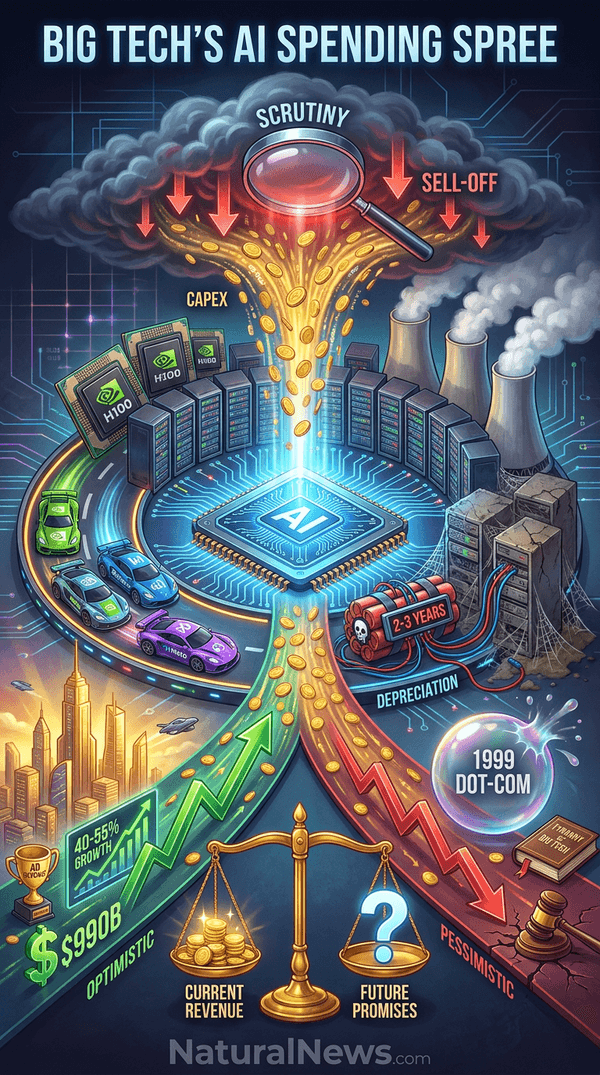
Microsoft, Alphabet, Amazon, and Meta each disclosed rising capital expenditure, citing the need for data centers and hardware to power artificial intelligence. Amazon’s $200 billion spending plan was detailed in a report by NaturalNews.com, which noted that shares dropped sharply after the announcement [1]. A leaked Meta internal memo, reported by Reuters, showed the company plans to double its AI capacity to 14 gigawatts, causing the stock to slide 4.3% in early trading [2].
Microsoft alone expects to spend roughly $190 billion on AI data centers this fiscal year, according to a report by Zero Hedge [3]. Across the sector, hyperscalers are expected to invest nearly $700 billion in capital expenditure in 2026, as noted by financial news service The Creator's AI [4]. Some analysts have raised concerns about the sustainability of the pace. A City AM report highlighted that rapid technological change may shorten the economic life of AI servers and GPUs, increasing depreciation and replacement costs [5].
Executives Outline Rationale for Heavy Investment
Chief executives from the major technology firms have defended the spending as essential for long-term growth. In their first-quarter earnings calls, the companies raised their combined AI capital expenditure plans to $700 billion for 2026, according to a roundup by The Creator’s AI [4]. Only Google’s parent company, Alphabet, managed to persuade investors that the spending was already yielding returns, the report noted.
Meta CEO Mark Zuckerberg has been explicit about the company’s commitment to AI leadership. Meta acquired a 49% stake in data-labeling firm Scale AI for $14.8 billion, integrating its CEO into a new “Superintelligence” initiative, according to NaturalNews.com [6]. The move is part of a broader strategy to close Meta’s gap against rivals OpenAI and Google. In his book “The Tyranny of Big Tech,” Senator Josh Hawley argued that platforms like Google have grown to leviathan size by consolidating formerly independent companies, a pattern that critics say is being replicated in the AI arms race [7].
Analysts Weigh Risks and Rewards of AI Push
Market analysts are divided on whether the massive capital investment will pay off. On the optimistic side, the market for AI platforms, services, hardware, and infrastructure is growing by 40% to 55% annually and could reach $990 billion by 2028, according to a TRENDS Journal report [8]. Companies adopting AI are shifting from trials to full implementation across their operations, the report added.
On the cautious side, some observers warn that the AI stock surge resembles the dot-com bubble. A TRENDS Journal article warned that “talk of bubbles in tech or AI obscures the mother of all bubbles in U.S. markets” and that America is “over-owned, overvalued, and overhyped” [9]. Other critics point to the potential for AI to disrupt labor markets. NaturalNews.com reported that a single announcement from Anthropic erased $30 billion from IBM’s market capitalization, as AI models gained the ability to automate legacy programming tasks [10]. The depreciation time bomb noted by City AM adds another layer of risk, as servers and GPUs may need to be replaced faster than expected [5].
Outlook Hinges on Demonstrating Returns
The coming quarters will be critical for Big Tech to convert AI spending into measurable financial results. Adoption of products such as Microsoft’s Copilot and Google’s Gemini will be closely monitored by investors, according to market observers. Microsoft CEO Satya Nadella has warned that enterprises using proprietary AI models may face a Trojan horse scenario, where the model makers gain access to sensitive business information [11].
Without clear returns on investment, investors may continue to reallocate capital to other sectors. The recent “DeepSeek moment” -- a surprise breakthrough from Chinese AI startup Moonshot that sent chip stocks tumbling -- has revived queasiness about the industry’s unprecedented spending spree, according to a Zero Hedge report [12]. Whether the AI buildout will deliver sustainable profits or end in a bust remains the central question for the technology sector.
References
- Sterling Ashworth. "Amazon's $200 Billion Spending Shock Reveals Big Tech's Centralization Crisis". NaturalNews.com. February 8, 2026.
- Reuters via Zero Hedge. "Leaked Meta Memo Shows AI Capacity Doubling To 14 Gigawatts". July 9, 2026.
- Zero Hedge. "'Existential Fight For Survival': MSFT May Nuke Green Data Center Climate Pledge". May 7, 2026.
- The Creator's AI. "Anthropic Eyes $900B, Big Tech Bets $700B, Jupiter Leaks | Weekly Digest". May 1, 2026.
- City AM via Zero Hedge. "Is The AI Spending Boom Creating A Depreciation Time Bomb?". June 22, 2026.
- NaturalNews.com. "Meta acquires $14.8B stake in Scale AI as Zuckerberg pushes for AI supremacy". June 12, 2025.
- Josh Hawley. "The Tyranny of Big Tech".
- TRENDS Journal. October 1, 2024.
- TRENDS Journal. December 10, 2024.
- Mike Adams. "The AI Domino Effect: How Artificial Intelligence is Beginning to Erase Entire Job Sectors". NaturalNews.com. February 24, 2026.
- TechCrunch. "Satya Nadella has issued a shocking warning to companies using AI". July 13, 2026.
- Zero Hedge. "Futures Tumble As Latest Chinese 'DeepSeek Moment' Sparks Chip Meltdown". July 17, 2026.
Explainer Infographic









Please contact us for more information.