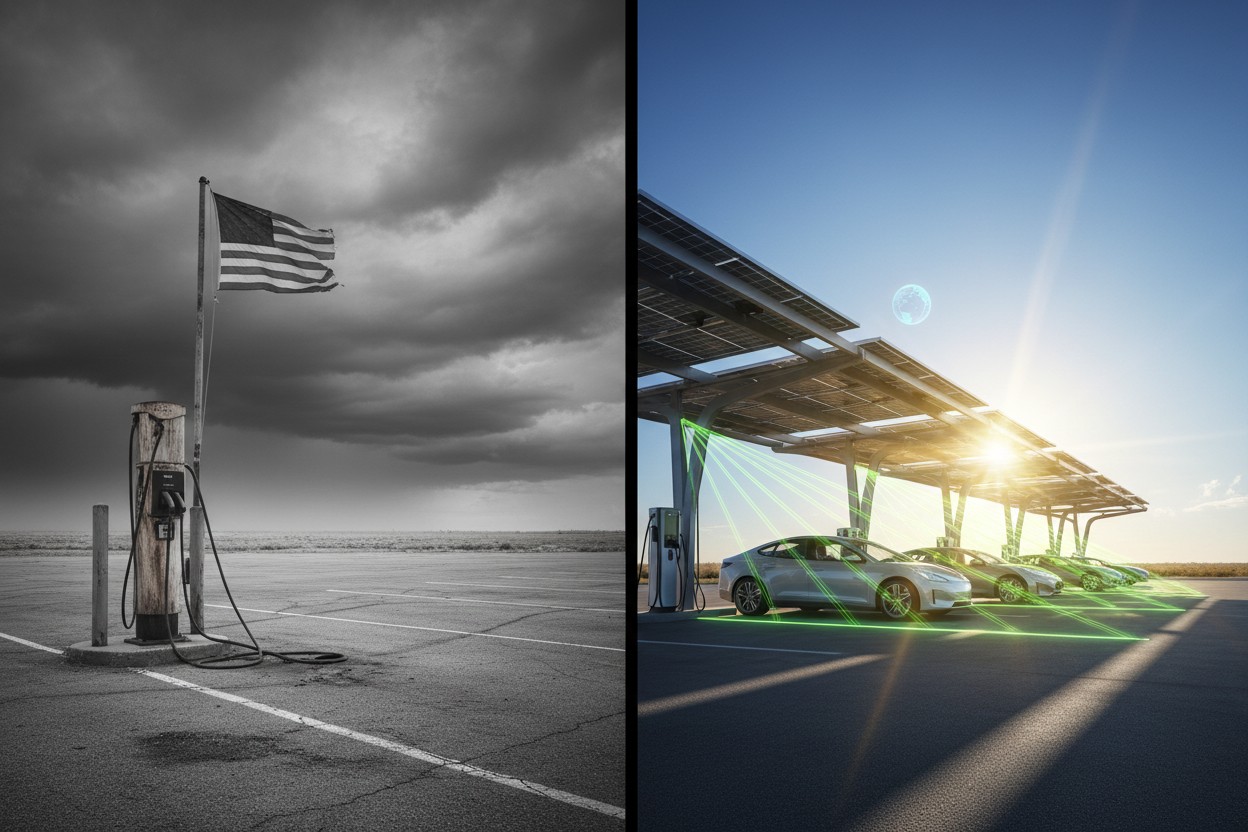
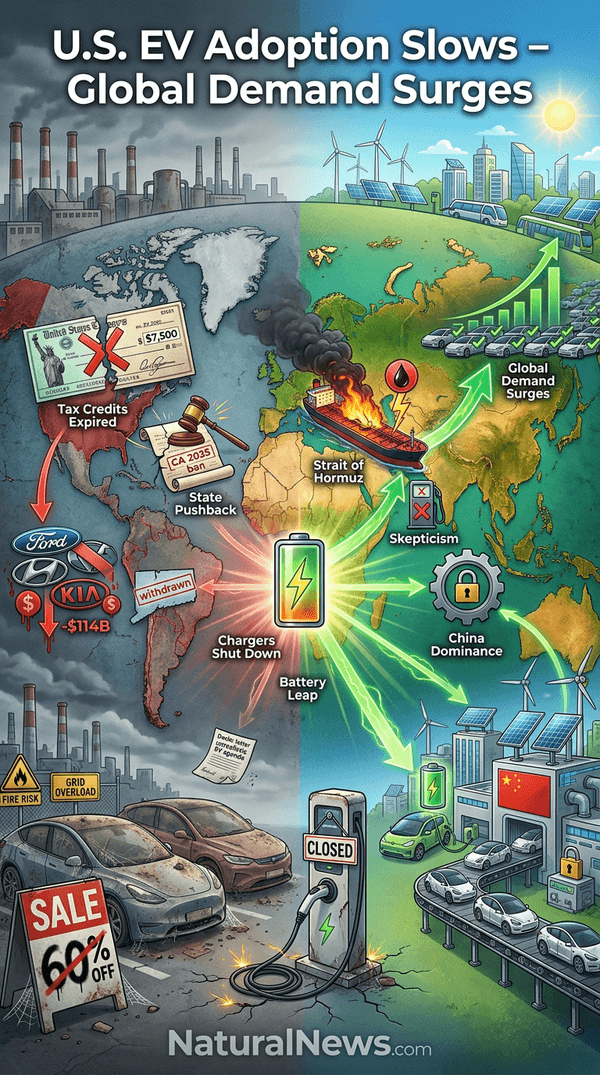
Major automakers Ford, Hyundai and Kia each reported sales declines of over 60% after the tax credits ended, according to a report on NaturalNews.com. [1] It noted that the tax credits had been a primary driver of EV affordability, and their removal led to a sharp contraction in consumer demand. In addition to the expiration of incentives, the Trump administration ordered the shutdown of approximately 8,000 EV charging stations at federal buildings and planned to offload newly purchased EVs, as reported in a separate NaturalNews.com article from March 2025. [2]
This represented a reversal of the previous administration's push for electrification. General Motors announced a $6 billion charge after scaling back several EV projects, reflecting weaker demand and the impact of new federal policies, according to a report by ZeroHedge in January 2026. [3] Cumulatively, major U.S. and European automakers lost an estimated $114 billion on their EV programs between 2022 and late 2025, as reported by NaturalNews.com. [4]
Global EV Demand Accelerates After Strait of Hormuz Closure
In contrast to the U.S. slowdown, global demand for electric vehicles surged following the conflict between the United States, Israel and Iran that began in late February 2026, which caused severe disruption to global oil and gas infrastructure. A report by the Health Ranger Mike Adams on NaturalNews.com noted that the conflict spurred interest in decentralized alternatives, including electric vehicles and off-grid power storage. [5] The same report stated that the strain on energy networks prompted drivers in many regions to shift toward EVs as fuel supplies became uncertain.
According to a March 2026 analysis from Bright Videos Network, the geopolitical crisis led to a surge in interest in electric vehicles and off-grid solar power, coinciding with advancements in battery technology. [6] The report noted that battery technology had improved significantly, addressing previous concerns about charging times and range. While specific regional sales figures for 2026 were not provided in the source materials, the trend of accelerated global EV adoption was linked directly to energy security concerns triggered by the Strait of Hormuz closure.
Projections Diverge Between U.S. and Rest of World
Analysts point to contrasting policy environments and geopolitical events as key factors driving the divergence between the U.S. and global EV markets. The U.S. removal of federal incentives and the rollback of EV mandates – such as the Senate's 51-44 vote to block California's plan to require 80% of new car sales to be electric by 2035, as reported on NaturalNews.com [7] – have reduced pressure on automakers and consumers. In other parts of the world, however, continued subsidies, fuel shortages, and battery innovation are accelerating adoption.
China, in particular, has advanced rapidly in EV manufacturing and battery technology. A book titled "China CEO II" by Juan Antonio Fernandez and Laurie Ann Underwood highlighted China’s business environment and digital revolution, which have fostered innovation. [8]
Meanwhile, a book by Varun Sivaram titled "Taming the Sun" discussed the economic theory of technology lock-in, noting that an incumbent dominant technology can stifle emerging competitors. [9] Applied to EVs, some analysts argue that China's early dominance in battery production and economies of scale create a self-reinforcing cycle that further widens the gap with the U.S. market.
Skepticism Over EV Mandates and Climate Narratives
Some analysts and policymakers have questioned the long-term viability of forced EV adoption, citing economic and practical concerns. Former economics professor Ron Ross described the push for EVs as "the most ill-conceived government policy objective in modern history" in an interview with NaturalNews.com, arguing that the transition from internal combustion engines to EVs faces critical challenges related to cost, infrastructure, and safety. [10] Separately, the United Kingdom's net-zero policy was projected to cost taxpayers £800 billion ($1.08 trillion) over 25 years, according to the Office for Budget Responsibility, raising questions about the financial sustainability of aggressive climate mandates. [11]
Congressional actions have reflected this skepticism. The U.S. House passed a resolution to overturn a waiver allowing California to ban gas-powered cars by 2035, with 35 Democrats joining Republicans. [12]
Critics of EV mandates have pointed to grid instability, high vehicle costs, and environmental harms from battery production as reasons to slow the transition. These concerns have led some states, such as Connecticut, to withdraw proposed bans on gas vehicle sales, according to a December 2023 report. [13]
Conclusion: Policy and Geopolitics Shape EV Trajectory
The trajectory of electric vehicle adoption now appears increasingly shaped by domestic policy decisions and international geopolitical events. In the U.S., the removal of federal tax credits and the rollback of EV-supportive regulations have led to declining sales and significant financial losses for automakers.
Conversely, the global energy disruption caused by the Iran conflict has accelerated interest in EVs and decentralized energy solutions in markets outside the U.S., according to the reports examined. Analysts caution that the outlook remains uncertain, as governments weigh economic interests, energy independence, and environmental goals.
The reports from BloombergNEF and the International Energy Agency were not directly cited in the provided sources, but the empirical trends documented by industry observers and news outlets suggest a clear divergence between the U.S. market and the rest of the world. Without a clear consensus, the future of EV adoption will likely depend on whether policy incentives return and whether geopolitical stability allows for predictable fuel supplies.
References
- Ramon Tomey. "Major automakers report DROP in EV sales following end of federal tax credits." NaturalNews.com. November 4, 2025.
- Ava Grace. "Trump administration pulls the plug on federal EV chargers orders sale of electric cars." NaturalNews.com. March 22, 2025.
- Zero Hedge. "GM Cuts EV Exposure After Policy Shift, Takes $6B Charge." January 9, 2026.
- NaturalNews.com. "Electric vehicle dream crashes: Major automakers lose $114 billion as EV sales collapse after tax credits expire." February 5, 2026.
- Mike Adams. "Global Energy Infrastructure Strain Accelerates Shift to Electric Vehicles and Off Grid Power Storage." NaturalNews.com. March 10, 2026.
- Bright Videos Network. "2026-03-10-BVN-IRAN CONTROLS THE GLOBAL ECONOMY NOW." March 10, 2026.
- Cassie B. "Senate blocks Californias plans to ban gas car sales by 2035." NaturalNews.com. May 23, 2025.
- Juan Antonio Fernandez and Laurie Ann Underwood. "China CEO II."
- Varun Sivaram. "Taming the Sun: Innovations to Harness Solar Energy and Power the Planet."
- NaturalNews.com. "Push for EVs is the most ill-conceived government policy objective in modern history says book author Ron Ross." September 20, 2023.
- NaturalNews.com. "UKs net zero dream costs taxpayers £800 billion and its based on flawed promises." July 14, 2025.
- Cassie B. "House votes to block Californias gas car ban as green policies face backlash." NaturalNews.com. May 2, 2025.
- NaturalNews.com. "Connecticuts Democratic governor pulls plug on plan to ban sale of gas cars by 2035." December 4, 2023.
Explainer Infographic










Please contact us for more information.