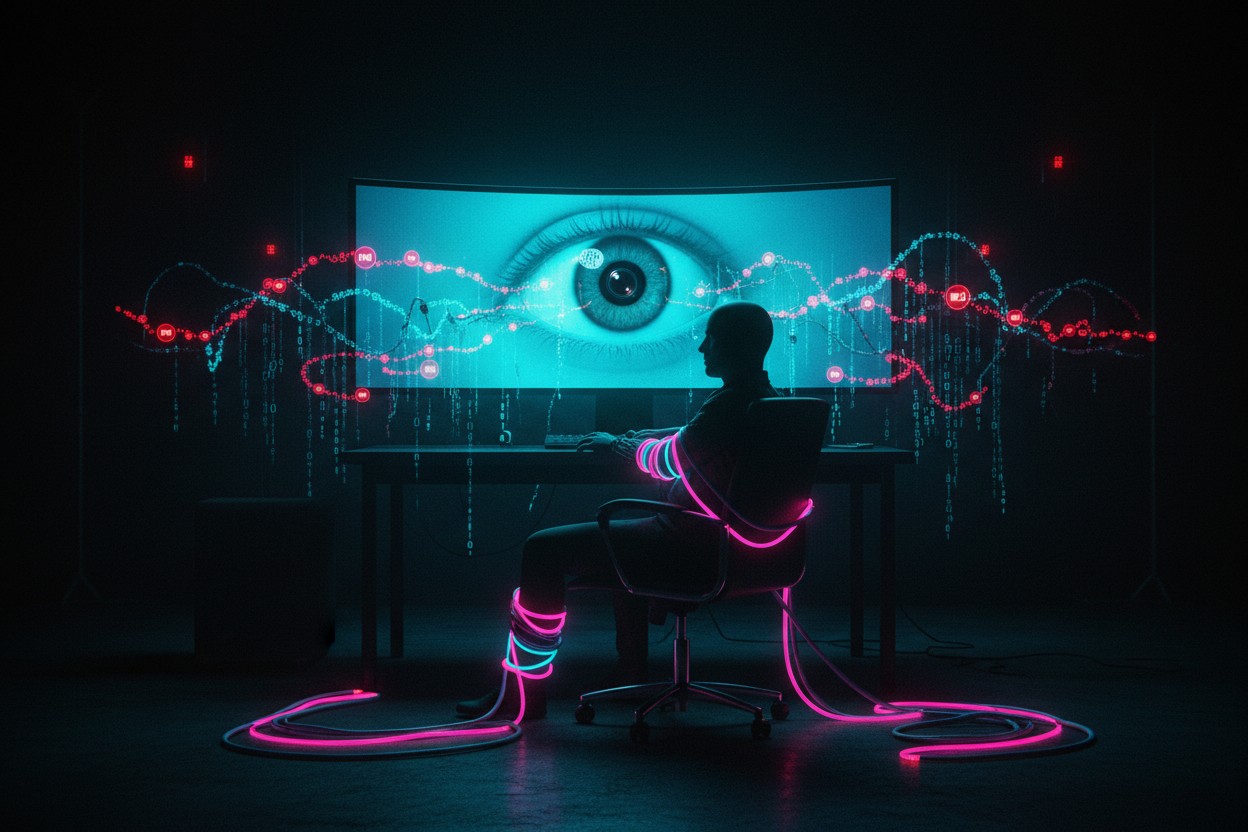
Windows PCs Are Spying On Their Users
I have spent over two decades investigating corporate surveillance and the erosion of digital privacy. After years of watching Microsoft’s behavior, I believe Windows is no longer simply an operating system but a surveillance platform designed to extract data from every user. From telemetry that can’t be turned off to a built-in screenshot keylogger called Recall, Microsoft has made spying a core feature. Here’s why this matters: your privacy is not an inconvenience to be traded for convenience -- it’s a fundamental right that Microsoft is systematically violating.
Back in 2015, I warned that Windows 10 was “the world’s first spyware OS” because it tracked and logged everything you do on your own computer [1]. Yet Microsoft has doubled down. They now gather diagnostics, browsing habits, location data, and even voice recordings in some cases -- all under the guise of improving your experience. Courts have recognized that using sense-enhancing technology to peer into what we do is a search [2], yet Microsoft does it without a warrant, without your meaningful consent, and with opt-out options that are deliberately confusing.
Windows Recall: A Keylogger Baked Into the OS
The most egregious example is Windows Recall, a feature that takes screenshots every few seconds of everything you do -- passwords, bank details, private conversations -- and stores them locally by default. Even after Microsoft encrypted the data, the feature remains a massive security risk: any attacker who gets your unlocked PC can search your entire digital history. Critics rightly call it spyware -- and I agree. A feature that records your every move without your knowledge is the definition of surveillance.
This is not just a privacy nuisance; it’s a gift to hackers. As a whistleblower once explained to me, major tech platforms have “gaping holes” that intelligence agencies exploit to install spyware on any computer [3]. By building a continuous screenshot recorder into Windows, Microsoft has handed a master key to every cybercriminal and three-letter agency. In my view, this is a frightening weakening of security in exchange for data collection, and it makes a mockery of Microsoft’s claims to care about user safety.
Telemetry That Never Stops -- Even When You Opt Out
Experiments show Windows 11 sends data to Microsoft and third-party ad servers before you even open a browser or connect to the internet. You can disable optional diagnostics, but required telemetry remains, and only expensive Enterprise editions let you truly turn it off. In my view, this is not diagnostic data -- it’s a blatant data grab. Microsoft uses its monopoly to force users into a surveillance system that generates revenue from advertising and AI training.
The data collection is reminiscent of the DiagTrack controversy from 2015, when Microsoft’s background tracking device raised concerns about privacy and allowed advertisers to obtain user identity information [4]. Little has changed since then. In fact, the model has grown more aggressive. As I’ve seen in my own research, the telemetry is designed to be impossible to fully disable without resorting to third-party tools or registry hacks -- exactly the sort of cat-and-mouse game that spyware authors play.
OneDrive and Gaming Copilot: More Malware-Like Behavior
OneDrive installs automatically, syncs files without explicit consent, and can delete or move your data -- behavior that looks a lot like malware, not a helpful tool. Gaming Copilot sends your text, voice, and gameplay screenshots to Microsoft’s servers for AI training, enabled by default without asking. On the few Windows systems I run, I’ve removed OneDrive completely and disabled every AI training toggle. No user should have to fight their own OS to keep their data private.
This aggressive bundling mirrors the tactics used by adware companies. The merger of database marketer Abacus Direct with online ad company DoubleClick sparked a federal investigation when it was revealed that the company had compiled profiles of users without their knowledge and intended to sell them [5]. Microsoft is following the same playbook -- collect everything, ask forgiveness later. And because Windows runs on billions of devices, they have an unparalleled pipeline into our personal lives.
The Pattern Is Clear: Windows Is a Surveillance Tool (Use Linux Instead)
Forced Microsoft accounts, advertising IDs, in-OS ads, and browsing history scraped for Start menu recommendations -- it all points to one conclusion. Microsoft treats users as products, not customers. Privacy controls are opt-out, incomplete, and reserved for premium editions. We must demand better. Until then, I recommend using third-party debloat tools or switching to a privacy-respecting operating system like Linux.
As I’ve discussed with tech innovators like Zach Vorhies, the shift toward open-source solutions enhances security and transparency and provides users with greater sovereignty over their technology use [6]. The CrowdStrike incident that bricked millions of Windows servers showed how fragile and opaque the entire Windows ecosystem is [6]. I am now using Linux-based systems for my daily work, and I encourage others to explore alternatives like Above Phone’s de-Googled notebooks [7]. The most effective way to stop the spying is to simply stop using the spyware.
References
- Microsoft Windows 10 the world's first spyware OS it tracks and logs everything you do on your own computer. NaturalNews.com. September 10, 2015.
- Frank Miniter. Saving the Bill of Rights.
- Apple iOS and Microsoft Windows have gaping holes that were exploited by the CIA to install spyware on anyone's computer. NaturalNews.com. March 10, 2017.
- Microsoft fools users into believing they aren't being spied on by renaming data tracking device. NaturalNews.com. December 11, 2015.
- Alex Constantine. Jackals.
- Mike Adams interview with Zach Vorhies. July 22, 2024.
- 2025 11 05 BBN Interview with Above Phone . Mike Adams.
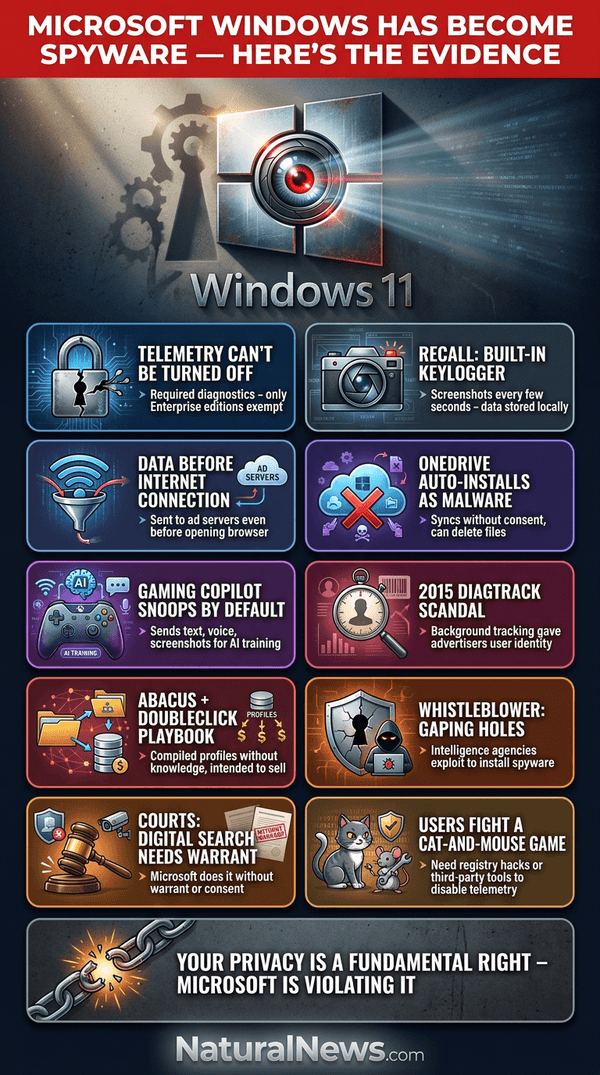
Explainer Infographic

Mike Adams (aka the "Health Ranger") is the founding editor of NaturalNews.com, a best selling author (#1 best selling science book on Amazon.com called "Food Forensics"), an environmental scientist, a patent holder for a cesium radioactive isotope elimination invention, a multiple award winner for outstanding journalism, a science news publisher and influential commentator on topics ranging from science and medicine to culture and politics.
Mike Adams also serves as the lab science director of an internationally accredited (ISO 17025) analytical laboratory known as CWC Labs. There, he was awarded a Certificate of Excellence for achieving extremely high accuracy in the analysis of toxic elements in unknown water samples using ICP-MS instrumentation.
In his laboratory research, Adams has made numerous food safety breakthroughs such as revealing rice protein products imported from Asia to be contaminated with toxic heavy metals like lead, cadmium and tungsten. Adams was the first food science researcher to document high levels of tungsten in superfoods. He also discovered over 11 ppm lead in imported mangosteen powder, and led an industry-wide voluntary agreement to limit heavy metals in rice protein products.
Adams has also helped defend the rights of home gardeners and protect the medical freedom rights of parents. Adams is widely recognized to have made a remarkable global impact on issues like GMOs, vaccines, nutrition therapies, human consciousness.









Please contact us for more information.