- The book presents a defiantly optimistic, data-driven rebuttal to the globalist "doom-and-gloom" narrative, demonstrating that extreme poverty has collapsed, life expectancy has doubled and literacy has soared. It argues that the UN, WHO and Bill Gates profit by manufacturing crises to justify centralized control, a tactic perfectly illustrated by the COVID-19 pandemic.
- The core thesis is that twelve accelerating technologies (AI, solar, battery, vertical farming) are converging to drive the cost of everything—energy, food and healthcare—toward zero. This creates a radical, deflationary future that threatens the profit model of the pharmaceutical cartel and the globalist oligarchs.
- The book explicitly identifies blockchain and cryptocurrencies as the only effective countermeasure to the globalist plot for Central Bank Digital Currencies (CBDCs) and mandatory digital IDs. It explains how "trustless trust" systems liberate individuals from the fragile, corrupt centralized ledgers run by the Federal Reserve and the deep state.
- The text delivers a devastating analysis of how the FDA and EPA have been captured by the industries they are supposed to regulate, crushing natural remedies and small farmers while protecting the Big Pharma and industrial polluters that fund their revolving-door leadership.
- While the book champions a decentralized, open-source path to liberation (MTPs, ExOs, vertical farms), it admits this is not guaranteed. The battle is between this grassroots vision and the centralized forces of the CIA, Big Tech censorship and China's accelerating AI development, which are all racing to control that same power for mass surveillance and depopulation.
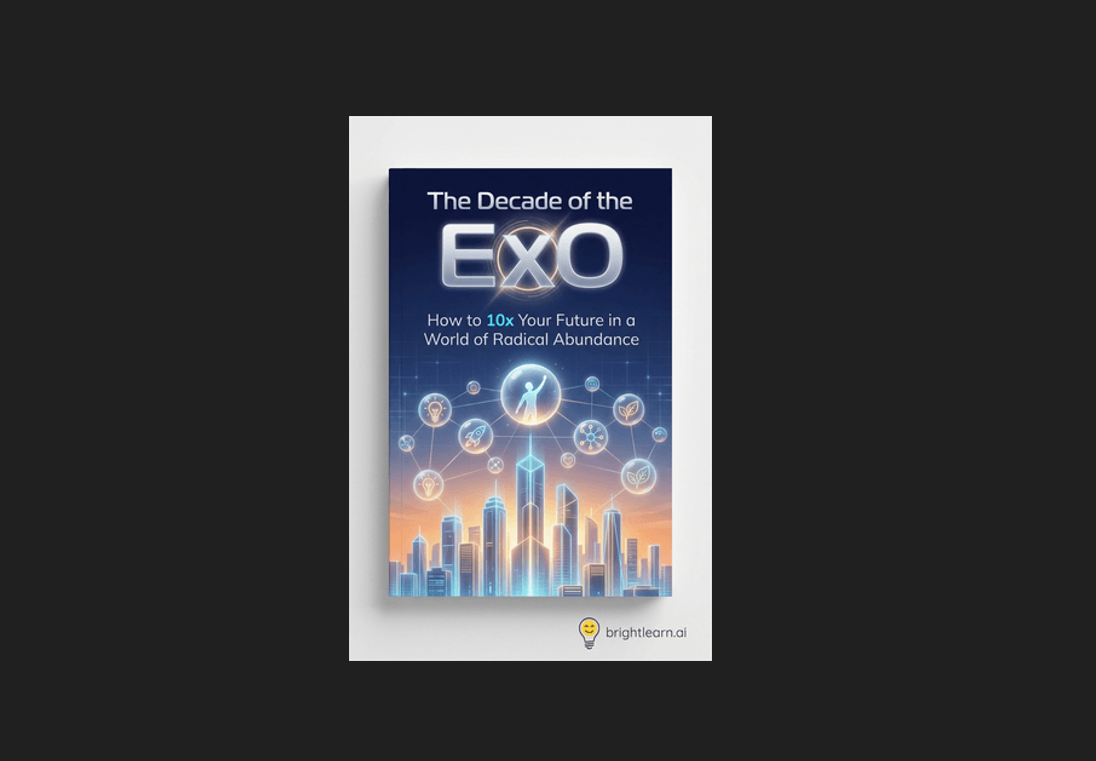
"The Decade of the ExO: How to 10x Your Future in a World of Radical Abundance" is a manifesto disguised as a business book, a survival guide masquerading as a technology forecast and—depending on your worldview—either a blueprint for human liberation or a seductive trap dressed in exponential jargon.
The book opens with a data-driven assault on the doom-and-gloom narrative that has dominated our headlines for decades. The author, channeling the spirit of Peter Diamandis and Salim Ismail, makes an audacious claim: extreme poverty has collapsed from 94% to under 10% since 1820. Global life expectancy has more than doubled. Literacy rates have climbed from 20% to over 86%.
These aren't trivial statistics. They represent a revolution in human well-being that the corporate media—which profits from fear—systematically obscures. The book argues that institutions like the United Nations and the World Health Organization (WHO) benefit from promoting crises, creating a self-perpetuating cycle where centralization becomes the only "solution" to problems these same institutions help manufacture.
This resonates deeply with anyone who has watched the COVID narrative unfold. The book doesn't shy away from naming the players: Bill Gates, the WHO and the pharmaceutical cartel are all implicated in a system that profits from sickness and control.
What makes this book different from a hundred other tech-optimist manifestos is its focus on the convergence of technologies. It's not just Moore's Law anymore. The author identifies a dozen technologies all accelerating simultaneously:
- Artificial Intelligence that can now design proteins (AlphaFold solved a 50-year problem)
- Solar energy that has dropped 500-fold in cost since 1975
- Battery technology moving toward sodium-ion and solid-state alternatives that could end lithium dependency
- Vertical farming capable of producing 100x more food per square foot with 90% less water
- The Materials Project using AI to engineer substitutes for rare earth metals
The book's central insight is that when these technologies converge, they create a radically deflationary future. The cost of everything—energy, food, computation, healthcare—approaches zero. This isn't fantasy; it's the mathematical extrapolation of curves that have been trending for decades.
The decentralization thesis: Where it gets dangerous (and interesting)
Here's where the book separates itself from mainstream tech optimism. The author doesn't believe existing institutions will deploy these technologies. Instead, he argues that blockchain, cryptocurrency and decentralized autonomous organizations (DAOs) are the true engines of liberation.
The chapter on the Byzantine Generals Problem is genuinely fascinating. It explains why centralized ledgers—whether run by the Federal Reserve, Equifax or the government—are inherently fragile. The solution? Trustless trust: systems where you don't need to trust any individual or institution because the math enforces the rules.
This is where the worldview aligns powerfully with the book's argument. The same technologies that enable Bitcoin also allow us to resist Central Bank Digital Currencies (CBDCs) and mandatory digital IDs. The book explicitly states that globalists are pushing CBDCs as a tool of surveillance and control and that decentralized money is the only effective countermeasure.
The chapter on regulatory capture deserves special mention. The book dissects how agencies like the FDA and EPA have been captured by the very industries they're supposed to regulate. The mechanism is straightforward:
- The revolving door between regulators and industry
- The $2.6 billion cost of drug approval (a barrier that crushes natural remedies)
- The cozy relationships that enable corporate lobbying to shape policy
This analysis is devastating because it's empirically supported. The FDA has indeed suppressed life-saving natural medicines for decades. The EPA has indeed crushed small farmers while giving industrial polluters a pass. The book doesn't just gesture at these problems; it names names and provides a framework for understanding how to fight back.
The MTP concept: Your personal declaration of independence
The Massive Transformative Purpose (MTP) is the book's most practical contribution. It's not a mission statement; it's a north star that guides every decision. The book argues that in a world where centralized institutions tell you what to think, your MTP is a declaration of independence.
Examples given:
- Google: "Organize the world's information."
- TED: "Ideas worth spreading."
- Personal MTP: "Eradicate plastic from the oceans" or "Put vertical farms in every urban home."
The key is that an MTP must be audacious, measurable and aligned with your deepest values. This is the antidote to the feeling of helplessness that globalist propaganda cultivates.
Data density. Every chapter is packed with verifiable statistics that challenge the scarcity narrative. The poverty, life expectancy and literacy data alone are worth the price of admission.
Practical frameworks. The ExO Canvas, the 10-week Sprint and the T-shaped expertise model are immediately actionable.
Unflinching honesty. The book doesn't sugarcoat the threat from centralized institutions. It names the Federal Reserve, the FDA and the WHO as entities that have failed their missions.
The decentralization vision. From DeFi to DAOs to energy-backed currencies, the book offers a coherent alternative to the surveillance state.
Cautions and criticisms
No book is perfect and this one has blind spots worth acknowledging:
- The technology-will-save-us trap. While the book acknowledges that the same tools can be used for control or liberation, it occasionally veers into technological determinism. The assumption that open-source AI will inevitably triumph over closed systems isn't guaranteed. China's centralized AI development is proceeding at terrifying speed.
- Overconfidence in timelines. Predictions that deflationary abundance will arrive within 5-10 years feel ambitious. The author would do well to remember that the "peak oil" theorists were wrong, but so were the early internet optimists who expected rapid transformation of every sector.
- The X Prize framework may not scale. The $250-per-month abundance bundle is a compelling vision, but integrating 3D-printed housing, vertical farming, AI education and natural healthcare into a single package faces enormous regulatory headwinds.
The book's ultimate argument is that the future belongs to the decentralized. But this assumes that the forces of centralization will simply step aside. History suggests otherwise. The pharmaceutical industry didn't cede power gracefully. The fossil fuel cartel didn't welcome solar energy. The banking establishment didn't embrace Bitcoin.
The author's optimism is both the book's greatest strength and its most vulnerable point. He believes that, given the right tools, individuals and communities can bypass corrupt institutions. I want to believe this too. But the forces arrayed against this vision—from the CIA's history of manipulation to Big Tech's censorship apparatus to the globalist agenda of depopulation—are not going to surrender without a fight.
Grab a copy of "The Decade of the ExO: How to 10x Your Future in a World of Radical Abundance" via this link. Read, share and download thousands of books for free at Books.BrightLearn.AI. You can also create your own books for free at BrightLearn.AI.
Watch the "Decentralize TV" episode below, where Salim Ismail talks about exponential organizations, AI and decentralized innovation.
This video is from the Health Ranger Report channel on Brighteon.com.
Sources include:











Please contact us for more information.