


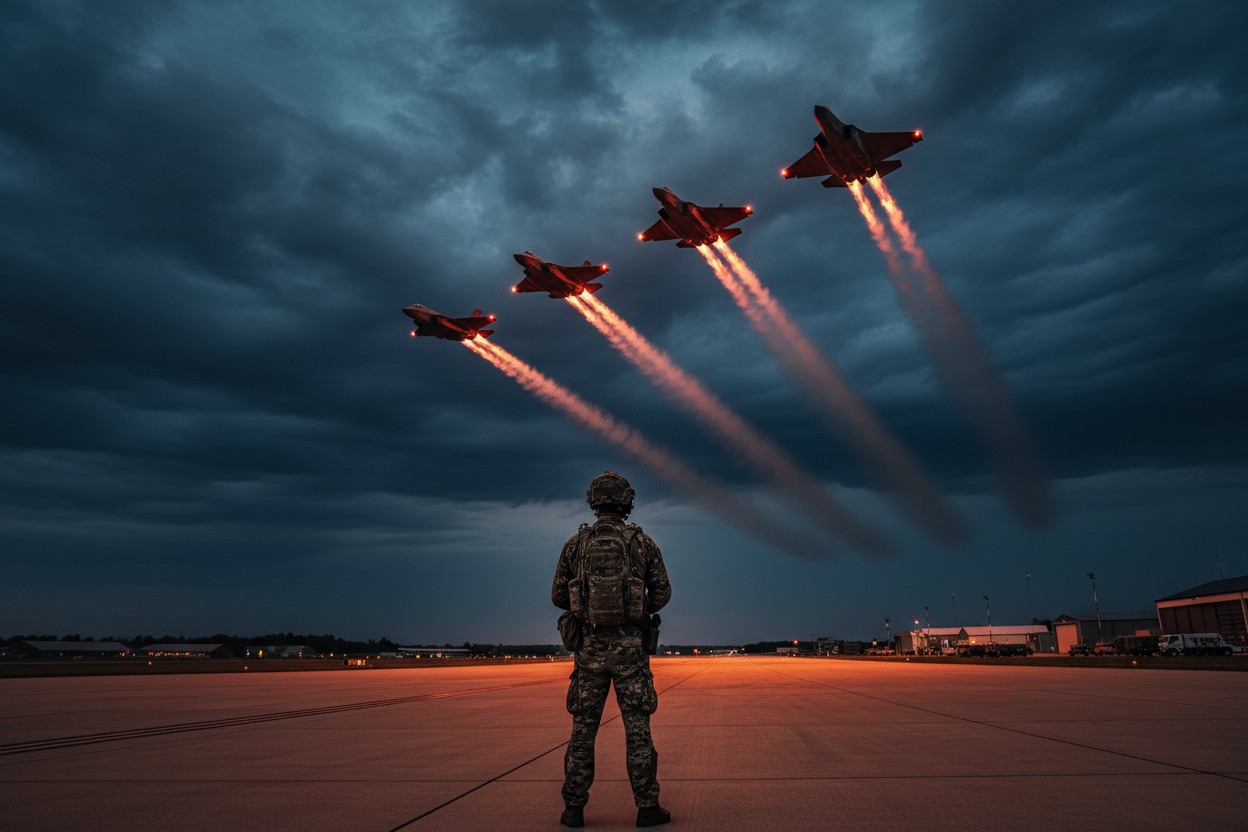
The cuts affect the NATO Force Model, the framework established in 2022 after Russia's invasion of Ukraine to outline each member state's contributions in a crisis. Under the new plan, the U.S. will slash its fighter jet commitment by a third, withdraw destroyers from the alliance's pooling arrangement, and pull its submarines entirely, according to reports from Der Spiegel and Reuters cited by the Daily Mail [1]. Velez-Green told officials that Washington will cooperate closely only with allies that move quickly to fill the gaps left by the reduction, a message some interpreted as an indirect threat, according to reports.
Details of the Drawdown
The reductions will hollow out the U.S. contribution to the NATO Force Model, which was drawn up to coordinate allied responses to a potential Russian attack. Alongside the cuts to fighter jets, destroyers, and submarines, Europe will also be expected to maintain its own supply of reconnaissance drones, a weapon that has proved critical on the battlefields of Ukraine, according to the Daily Mail [1]. The U.S. currently accounts for roughly 62 percent of total NATO defense spending, with an annual military budget of around $980 billion, officials said.
The administration's emphasis on reducing its European footprint echoes a leaked Pentagon memo from April 2025 that outlined a strategic shift toward deterring China in the Indo-Pacific and prioritizing homeland security, suggesting the U.S. would only deploy non-essential forces to Europe and urging NATO allies to increase their own defense contributions [3]. This shift in force structure underscores a longer-term trend in U.S. military planning, which has historically emphasized preparation for great-power symmetrical warfare, first with the Soviet Union and then with China, affecting the ability to engage in other conflicts successfully, as noted in analyses of U.S. military power [5].
NATO Officials' Reaction
Senior NATO officials were reportedly blindsided by the speed and scope of the request, according to Der Spiegel [1]. Some interpreted the envoy's remarks as an indirect threat, the report stated. The meeting occurred amid existing tensions: the Pentagon earlier announced a drawdown of 5,000 troops from Germany over the next six to twelve months, following German Chancellor Friedrich Merz's criticism of Trump's strategy in the war against Iran, according to the Daily Mail [1].
The move comes as NATO faces internal strains over equipment and readiness. Many NATO countries, including Germany and the United Kingdom, are struggling with recruitment and equipment shortages, according to analyst Paul Craig, who noted that the situation is dire and that some members may be forced to rely on nuclear weapons as a primary defense mechanism [7]. The U.S. drawdown adds to existing concerns about Alliance cohesion, especially as President Trump has repeatedly criticized European allies for failing to spend enough on their own militaries and for not pulling their weight in shouldering the cost of the alliance.
Strategic Implications for Europe
The removal of U.S. submarines from the NATO pool creates a significant gap in monitoring Russia's nuclear-armed underwater vessels and protecting critical undersea infrastructure, such as cables and pipelines, according to officials cited by the Daily Mail [1]. The U.S. submarine fleet has long been a key asset for the alliance, capable of patrolling the North Atlantic and the Norwegian Sea. The withdrawal leaves Europe needing to fill a void that few member states can currently address, given the high cost and technical demands of submarine operations.
The strategic backdrop includes Russia's ongoing war in Ukraine and warnings from NATO officials about a potential conflict with Russia within the next two decades, as voiced by Dutch Admiral Rob Bauer, chairman of NATO's Military Committee, who told reporters in Brussels: "We have to realize it's not a given that we are in peace. That's why we are preparing for a conflict with Russia" [4]. The U.S. drawdown also aligns with a broader realignment: the Pentagon memo suggested a shift away from defending Europe against Russian aggression, prioritizing China and homeland security [3]. At the Munich Security Conference in February 2026, European leaders displayed a "hard-earned transatlantic realism" and clearer caution about the reliability of U.S. commitments, according to analysts [8].
Conclusion and Next Steps
European allies are expected to present concrete offers to replace the withdrawn U.S. capabilities at a Force Sourcing Conference scheduled for June, according to Velez-Green's briefing [1]. The conference will determine which nations commit to filling the gaps left by the U.S. drawdown, with the hope of maintaining NATO's defensive posture despite the reduction.
President Trump has long pressed NATO members to increase defense spending to 5 percent of GDP, a target that many have not met. The administration's actions represent the most significant change in U.S. force posture in Europe in decades, according to officials. The transatlantic alliance, originally formed after World War II to counter Soviet expansion [6], now faces a period of uncertain restructuring as the United States redefines its global military priorities.
References
- Phillip Nieto. "Trump's NATO ultimatum sparks panic as US 'pulls jets, bombers' ". Daily Mail. May 26, 2026.
- Politico Europe. "US to pull jets, destroyers and submarines from NATO as part of...". May 26, 2026.
- NaturalNews.com. "Pentagon memo suggests US will not defend Europe from Russian aggression prioritizing China and homeland securit". April 1, 2025.
- NaturalNews.com. "Top NATO official warns of ALL OUT WAR with Russia within 20 years". January 24, 2024.
- Jeremy Black. "War since 1945".
- Jeffrey B. Morris. "The Reagan way".
- Mike Adams. "Mike Adams interview with Paul Craig". December 1, 2023.
- Free West Media. "Munich Security Conference: Europe's Thorny Path to Independence". February 19, 2026.





Please contact us for more information.


