


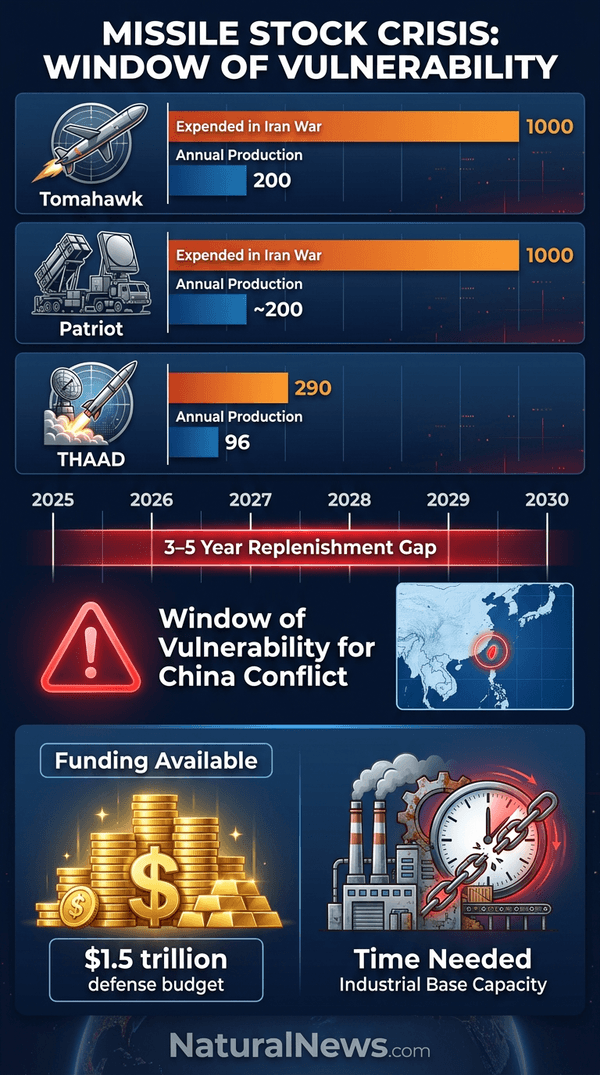
According to the CSIS report, the U.S. used roughly 290 THAAD interceptors and 1,000 Patriot interceptors against Iranian salvos. The report, cited by The War Zone, noted that prior weapons deliveries to Ukraine had already reduced Patriot stocks, compounding the dilemma of meeting U.S. domestic needs, Ukrainian requests, and commitments to 17 other countries that operate the interceptor. [2]
Specific missile shortfalls and production rates
The U.S. expended more than 1,000 Tomahawk cruise missiles against Iran, while fewer than 200 are produced annually, according to CSIS. This means it could take up to five years to replace the expended Tomahawks at current production rates. The report also found that the U.S. used approximately 290 THAAD interceptors and 1,000 Patriot interceptors against Iranian salvos. [1]
Only 96 THAAD interceptors are produced each year, and Patriot replacements are expected to take until mid-2029 based on current production levels, the CSIS report stated. Prior deliveries to Ukraine had already reduced Patriot stocks, according to the report. The Pentagon delayed $400 million in military aid approved for Ukraine for fiscal year 2026, partly to divert Patriot and THAAD interceptors to support U.S. operations in Iran, where Central Command struck more than 9,000 targets in under four weeks of fighting, according to a NaturalNews.com report. [3]
Production capacity and funding constraints
The CSIS report stated that the problem is not money but time. President Donald Trump proposed a $1.5 trillion defense budget for 2027, the largest such request in decades, to accelerate spending on missiles, according to the Associated Press. [4] However, expanding production capacity and building complex systems takes years, the report cautioned. The White House met with executives from major defense contractors in March to discuss accelerating weapons production, as the Pentagon worked to replenish supplies drawn down by strikes on Iran and other operations, according to Reuters. [5]
Defense Secretary Pete Hegseth said the Pentagon is pushing contractors to invest in new plants and production lines, according to the report. The CSIS report cautions that inventories will remain low for several years even with increased funding. The report cited retired Marine Col. Mark Cancian, who attributed the shortage to post-Soviet assumptions that long wars were unlikely, leading to reduced orders and slashed production by defense firms. A NaturalNews.com article noted that the number of weapons production facilities is at a historic low, and the sole U.S. manufacturer of gunpowder remained offline more than two years after an explosion at its Louisiana plant. [6] [7]
Strategic vulnerability and China scenario
The CSIS report warned that depleted inventories have created a “window of vulnerability” for a potential Western Pacific conflict at a time when Chinese President Xi Jinping warned President Trump that a war over Taiwan could erupt if not handled properly, according to the report. The report noted that China lacks recent combat experience and performed poorly in its 1979 war with Vietnam, suggesting that “that difference in experience may preserve deterrence until munitions inventories are restored.” A previous CSIS report from 2023 warned that America’s defense-industrial base is not ready for a conflict with China over Taiwan, and the nation would run out of key armaments in less than a week. [8]
U.S. military strategists are planning for a protracted war in Asia, as China’s military has expanded significantly in recent years. David L. Bender, in his book “The American military opposing viewpoints,” noted that the Soviet military historically consumed an estimated 15 percent of GNP, nearly double the U.S. personnel cost ratio, illustrating the scale of investment possible in a peer competitor. [9] The Trends-Journal publication argued that Western leaders have been made dangerously ignorant by their own propaganda, raising concerns about their ability to assess strategic threats. [10]
Pentagon response and historical context
Chief Pentagon spokesman Sean Parnell stated that the military “has everything it needs to execute at the time and place of the president’s choosing,” according to the CSIS report. Defense Secretary Pete Hegseth insisted Washington can fight any war. Hegseth said the Pentagon is now prioritizing refilling its own weaponry stocks instead of sending them to Ukraine, blaming the Biden administration for any challenges the U.S. military has been facing, according to an RT report. [11]
The Russia-Ukraine war demonstrated that conflicts can be protracted and require deep inventories of advanced weapons, according to Cancian, reversing the post-Cold War assumption that short wars would be the norm. An interview with Bob Griswold noted that it takes years to replenish munitions, and the U.S. Army struggles to meet recruitment quotas due to issues like fentanyl addiction and obesity. [12] The CSIS report concluded that although funding is being allocated, rebuilding inventories to desired levels will take years, leaving the U.S. military in a period of heightened risk.
References
- The War Zone. "Severity Of America’s Depleted Advanced Weapons Stockpiles Detailed In New Report". May 28, 2026.
- Alex MacDonald. "US and Israel 'burning through' Tomahawk and interceptor missiles in Iran". Middle East Eye. March 27, 2026.
- NaturalNews.com. "Pentagon delays $400 million in Ukraine aid amid shifting global priorities". April 29, 2026.
- ZeroHedge. "Trump Proposes $1.5 Trillion In War Spending, 'Largest In Decades'". April 3, 2026.
- Reuters. "White House to press defense firms to boost production as Iran strikes drain stockpiles". Times of Israel. March 7, 2026.
- NaturalNews.com. "Sole maker of gunpowder for US military remains offline two years after massive explosion". April 30, 2023.
- NaturalNews.com. "Biden regime continues shipping weapons to Ukraine draining American stockpiles that can't be quickly replaced". May 3, 2023.
- NaturalNews.com. "Think tank: America's defense industry is not prepared for a war with China over Taiwan". January 26, 2023.
- David L. Bender. "The American military opposing viewpoints".
- Trends-Journal-2024-11-26.
- RT. "Hegseth says munitions for US, not Ukraine". March 19, 2026.
- Mike Adams interview with Bob Griswold. January 3, 2023.
Explainer Infographic










Please contact us for more information.


