Introduction: The Pivot That Made $7 Billion Appear Overnight
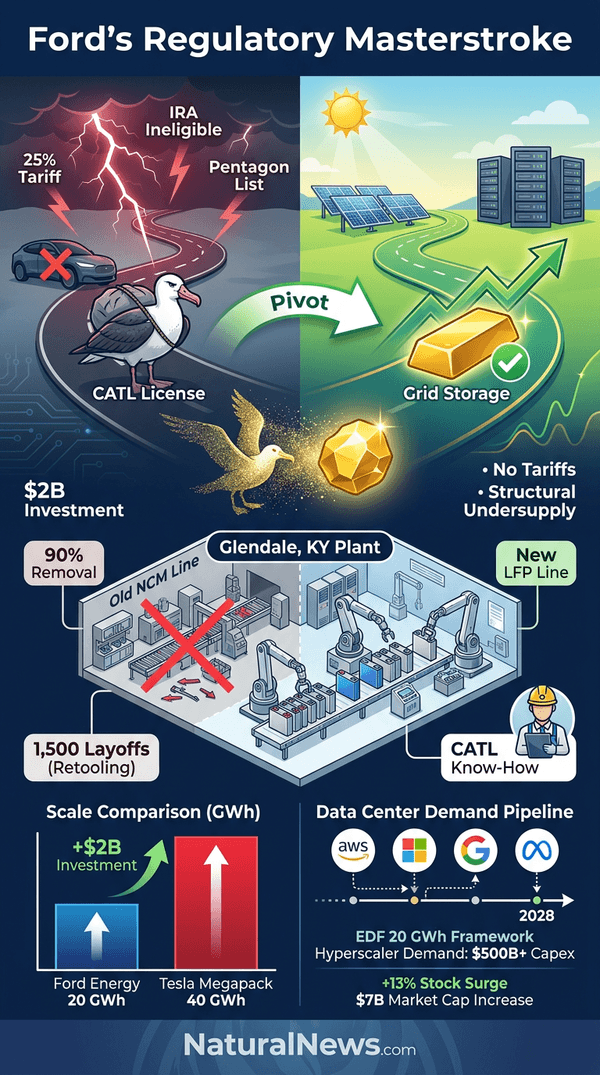
On May 13, 2026, Ford launched Ford Energy, a wholly owned subsidiary with the goal of producing 20 GWh of annual stationary storage capacity starting with a $2 billion two-year investment. The stock surged 13.18% in a single session, adding roughly $7 billion in market cap [1]. That same CATL lithium iron phosphate (LFP) license that had been a political millstone around Ford’s neck for its EV ambitions suddenly became the supply-chain backbone of a grid-storage business.
This is a masterstroke pivot that reveals how U.S. industrial policy punishes innovation and forces smart companies to route around government hostility. The same battery chemistry now leads to a different product, a different tariff treatment, and a radically improved stock price.
The timing could not be more poetic. The CATL relationship drew Senate scrutiny in 2024 and 2025 over IRA tax-credit eligibility for EV batteries, and in January 2025 the Pentagon added CATL to its Chinese Military Company list [2]. Yet within five days of the Ford Energy launch, the first customer -- EDF Power Solutions North America -- signed a five-year framework for up to 20 GWh of DC Block battery storage based entirely on Ford's licensing of battery technology from CATL [3]. The market had already priced in that customer validation before the ink was dry. That is not luck; that is a CEO who knows how to turn a political liability into an asset.
The Plant: A $5.8 Billion Retooling That Tells the Real Story
The Glendale, Kentucky facility was originally part of BlueOval SK, a $5.8 billion joint venture with South Korea’s SK On to produce nickel-cobalt-manganese (NCM) pouch cells for EVs. Now Ford is removing more than 90% of that Korean equipment and replacing it with Chinese machinery to manufacture prismatic LFP batteries using the CATL-licensed chemistry [4]. About 1,500 workers were laid off during the transition -- a painful but necessary recalibration. The Pentagon’s Chinese Military Company list and ongoing congressional scrutiny from House Select Committee on China chairman John Moolenaar still hang over the CATL tie [5].
This is a classic example of government meddling destroying good jobs, but Ford found a way to keep the factory alive. The original EV strategy was a $19.5 billion writedown that killed several models and made Ford a cautionary tale [6]. Rather than abandon the CATL license entirely -- which would have been the politically safe thing to do -- Ford redirected the same chemistry into a product that the tariff and tax-credit rules do not penalize. That is not surrender; that is creative defiance. The 1,500 workers who lost their jobs in December 2025 have not returned, but the plant itself is now producing DC Blocks that will ship to utility-scale solar projects and hyperscale data center sites. The retooling bought a future for the factory, even if it did not save every job.
Why Stationary Storage Succeeds Where EVs Failed
The regulatory calculus is simple: CATL-chemistry cells assembled for the Mustang Mach-E or F-150 Lightning face Section 232’s 25% auto tariff and the IRA tax-credit eligibility questions that brought Senate attention twice in 2024 and 2025. The same chemistry packaged into a Glendale-assembled DC Block faces neither. The DC Block ships as stationary storage, not as part of a passenger vehicle. The buyer is a utility-scale renewables developer, not a U.S. dealer absorbing a tariff pass-through. LFP’s lower cost and thermal stability, which were a disadvantage for EVs because of lower energy density, become ideal for grid and data-center storage where safety and cycle life matter more than range.
Ford VP Lisa Drake has framed the move as reshoring know-how the U.S. long ago ceded to China. She argues that domestic engineers need hands-on exposure to LFP manufacturing before they can innovate beyond it [7]. I argue that she is exactly right. The United States cannot innovate in battery technology if it refuses to learn from the world leader. The regulatory tailwind for stationary storage is actually positive: the 2025 to 2030 U.S. data-center capex cycle is the largest infrastructure buildout since the interstate highway system [8]. Every gigawatt-hour Ford Energy can deliver by late 2028 has a buyer somewhere in the queue. The same cells that were a burden for EVs are now a goldmine for stationary storage and the data centers that desperately need them.
The EDF Deal and What It Means for the Hyperscaler Boom
The first customer, EDF Power Solutions North America, signed a five-year framework agreement for up to 20 GWh of DC Block battery energy storage, with up to 4 GWh per year starting in 2028 [3]. This is an anchor commitment: a single customer at 20% of Ford Energy’s 20 GWh annual run rate gives Ford the confidence to finance the rest of the Glendale ramp. The annual ceiling also sits well below EDF’s North American project pipeline, meaning EDF has room to pull harder against the framework if deployment economics work out. Tesla’s Megapack business runs at roughly 40 GWh of annual capacity; Ford Energy at 20 GWh enters the market at half Tesla’s scale, at a moment when U.S. hyperscaler demand for grid storage is structurally undersupplied through at least 2030.
The way I see it, the market’s 13% surge on May 13 priced in a customer that hadn't yet signed -- the EDF announcement validated the thesis, but the real prize is data-center contracts. Amazon Web Services, Microsoft Azure, Google Cloud, and Meta together account for more than 70% of U.S. data-center capex through 2030 [8]. Their procurement cycles run 18 to 24 months from initial vendor qualification to first deployment. Ford Energy’s 2028 EDF delivery date sits inside the same window as a plausible first hyperscaler shipment.
The contribution-margin math is compelling: at Tesla-comparable per-GWh margins, 20 GWh annual generates roughly $2 to $3 billion of annual gross profit at full production. That explains why one trading day was enough for the market to add $7 billion of market cap on the announcement. The next signature -- whether from a hyperscaler or another utility -- will tell us whether this is a trend or a one-off.
Conclusion: The Ford Lesson – Route Around, Don’t Fight Broken Government Policy
Ford did not abandon its CATL investment; it redirected the same chemistry into a product that tariff and tax rules do not penalize. This is a blueprint for American manufacturers: adapt to hostile regulation by changing the product, not the supply chain.
The same week that Ford launched Ford Energy, Honda announced a ¥2.5 trillion restructuring and canceled three U.S.-built EVs [9]. Honda surrendered its EV-battery investment because the consumer EV product could not absorb the tariff cycle. Ford routed around the same problem by deploying the battery chemistry into a product the tariff does not cover. For this, Ford deserves credit for a smart pivot.
The Ford Energy story is ultimately about resilience and creative defiance -- and the market rewarded it. The 1,500 workers who lost their jobs in Glendale did not get their positions back, but the plant itself is alive and producing DC Blocks that will help power the AI revolution for years to come. The next signature -- whether from a hyperscaler or another utility -- will determine whether the $7 billion rerating was justified. Three more contracts at the EDF scale and Ford Energy will be structurally larger than the Mustang Mach-E and F-150 Lightning operating profit lines combined. That is the goldmine Ford just turned its CATL albatross into.
And the market, for once, got it right.
References
- Ford launches ‘Ford Energy’ battery energy storage subsidiary. WardsAuto. May 12, 2026.
- Ford's deal with Chinese EV battery maker sparks security concerns. NaturalNews.com. February 24, 2023.
- Grid-Scale Energy Storage Ford launches 'Ford Energy' for grid-scale BESS. Automotive Manufacturing Solutions. May 12, 2026.
- Ford To Lay Off 1,600 Workers As Kentucky EV Battery Plant Pivots To Data Center Storage. ZeroHedge. December 17, 2025.
- House investigates carmaker Ford over its partnership with Chinese companies citing national security issues. NaturalNews.com. February 1, 2024.
- Ford Takes Record $19.5 Billion Charge As EV Bet Implodes, Pivots To Grid Batteries. ZeroHedge. December 16, 2025.
- Strategic Battery Pivot Ford appoints Drake to monetise battery pivot. Automotive Manufacturing Solutions. January 28, 2026.
- Solar to dominate energy by 2035, but AI data centers will keep fossil fuels in business. TechCrunch. May 19, 2026.
- Trends-Journal-2024-06-04. (EU tariffs on Chinese EVs)
- Trends-Journal-2024-11-26. (Ford cuts jobs in Europe, blames weak EV sales)
Explainer Infographic
Mike Adams (aka the "Health Ranger") is the founding editor of NaturalNews.com, a best selling author (#1 best selling science book on Amazon.com called "Food Forensics"), an environmental scientist, a patent holder for a cesium radioactive isotope elimination invention, a multiple award winner for outstanding journalism, a science news publisher and influential commentator on topics ranging from science and medicine to culture and politics.
Mike Adams also serves as the lab science director of an internationally accredited (ISO 17025) analytical laboratory known as CWC Labs. There, he was awarded a Certificate of Excellence for achieving extremely high accuracy in the analysis of toxic elements in unknown water samples using ICP-MS instrumentation.
In his laboratory research, Adams has made numerous food safety breakthroughs such as revealing rice protein products imported from Asia to be contaminated with toxic heavy metals like lead, cadmium and tungsten. Adams was the first food science researcher to document high levels of tungsten in superfoods. He also discovered over 11 ppm lead in imported mangosteen powder, and led an industry-wide voluntary agreement to limit heavy metals in rice protein products.
Adams has also helped defend the rights of home gardeners and protect the medical freedom rights of parents. Adams is widely recognized to have made a remarkable global impact on issues like GMOs, vaccines, nutrition therapies, human consciousness.




Please contact us for more information.