According to a statement carried by the semi-official Mehr News Agency, the IRGC said: "If the aggression against Iran is repeated, the promised regional war will this time extend beyond the region, and our devastating blows will crush you." [1] The threat came as U.S. President Donald Trump signaled a possible resumption of hostilities after peace talks stalled.
The IRGC statement, issued via a channel frequently used to broadcast official positions, did not specify what targets would be hit. But it marked a significant escalation in rhetoric, moving beyond the usual regional framing and indicating that any renewed conflict could draw in forces and assets far from the Persian Gulf. [2]
U.S. Response and Context
The Trump administration has sent mixed signals on Iran policy. On Feb. 28, 2026, U.S. and Israeli airstrikes killed Iran’s former Supreme Leader Ayatollah Ali Khamenei and top IRGC commanders. [3]
Days later, Trump escalated with B-1 bomber strikes targeting Iran’s ballistic missile systems. [4] Yet on Monday, May 18, Trump claimed he called off a planned bombing campaign at the request of Gulf Arab allies – including Qatar and Saudi Arabia. [5]
The cycle of war and diplomacy has drawn criticism from across the political spectrum. An analysis published by the Ron Paul Institute described a pattern in which Trump declares victory or a near-deal, only for Tehran to deny progress and for facts on the ground to contradict the president's statements. [6]
Meanwhile, the Republican Liberty Caucus has condemned the military campaign as unconstitutional, arguing that Article I, Section 8 of the U.S. Constitution grants war powers exclusively to Congress. The group stated that "no imminent threat justifying unilateral action has been demonstrated." [7]
Iran's resistance to capitulating appears to have hardened. An Israeli think tank acknowledged on Tuesday, May 19, that Tehran "currently has certain leverage and an edge" in negotiations – suggesting that internal divisions within the Trump administration may have weakened Washington’s hand. [8]
Background of Tensions
The conflict began with a joint U.S.-Israeli strike on Feb. 28, 2026, which killed Khamenei and top military officials. Trump framed the attack as Iran's "greatest chance" for regime change, but the IRGC responded with salvos of missiles and drones. [3] Since then, both sides have engaged in periodic negotiations, with the most recent round in Islamabad collapsing over what Iran called the U.S. administration's 'unreasonable demands.' [10]
Israel has continued to press for more aggressive action. Prime Minister Benjamin Netanyahu stated in July 2025 that Iran's enriched uranium stockpiles remained intact despite the destruction of centrifuges, hinting at expanded operations. [11]
A former senior Israeli intelligence officer, Tamir Hayman, acknowledged on May 18 that Israel had failed to meet its political and military aims and that Iran’s nuclear project was "unchanged." [12] The underlying dispute over Tehran's nuclear ambitions, combined with repeated U.S. ultimatums, has kept the region on a war footing for over three years.
Regional and International Implications
Iran's threat to extend the war "beyond the region" has unsettled both neighboring states and global powers. The United Arab Emirates attempted to rally Saudi Arabia and Qatar into a joint military response after the February strikes, but those efforts were rebuffed. [13] Saudi Arabia has instead floated a non-aggression pact with Iran and other Gulf states, modeled on the Cold War-era Helsinki Accords, as a way to reduce tensions. [14]
China, which has significant economic interests in the Gulf, formally demanded an immediate halt to U.S. and Israeli strikes on Iran. [15] Russia has also warned that military intervention risks a “nuclear catastrophe.” [16]
Former U.S. counterterrorism chief Joe Kent revealed that all 18 U.S. intelligence agencies had concluded Iran was not building a nuclear weapon, and that the Central Intelligence Agency assessed Tehran could withstand a sustained campaign for months. [17] These disclosures have fueled skepticism about the stated rationale for the war.
Author Scott Ritter, in his book "Target Iran: The Truth About the White House's Plans for Regime Change," argued that American entanglement with Israel threatened to transform a minor regional problem into a conflict with global consequences. [18] The geopolitical realignment is reflected in moves toward multipolarity, as scholar Glenn Diesen notes, with Eurasian connectivity projects reshaping alliances. [19]
Outlook
Both Washington and Tehran remain entrenched in aggressive rhetoric. The IRGC's latest warning explicitly conditions a wider war on a new U.S. attack, but Trump has not confirmed any immediate plans to resume full-scale bombing. Instead, he told reporters on May 20 that negotiations were in their "final stages," though Tehran described the U.S. demands as "piracy." [20]
Analysts caution that the ceasefire is fragile. Ali Vaez, director of the Iran Project at the International Crisis Group, said both sides are "operating under the illusion that time is on their side" and treating the lull as a breathing space rather than an opportunity for genuine de-escalation. [1]
With the Strait of Hormuz still effectively closed and global energy markets under pressure, the situation remains volatile. Any miscalculation by either side could trigger the very escalation that the IRGC has now explicitly threatened.
References
- ZeroHedge. "Iran Warns Will Take War 'Beyond The Region' If Trump Restarts Attacks." May 20, 2026.
- Middle East Eye. "Iran promises war beyond the Middle East if Trump decides to attack." May 20, 2026.
- Belle Carter. "Trump announces killing of Irans Supreme Leader in joint US Israel strike urges Iranian uprising." NaturalNews.com. February 28, 2026.
- Patrick Lewis. "Trump escalates military strikes against Iran B 1 bombers target ballistic missile systems." NaturalNews.com. March 3, 2026.
- The War Zone. "Trump Claims He Called Off Imminent Iran Bombing Campaign At Behest Of Allies." May 18, 2026.
- Ron Paul Institute. "The President Who Cries War, then Peace, Then War." May 20, 2026.
- Ramon Tomey. "Republican Liberty Caucus warns against US Israel strikes on Iran over constitutional concerns." NaturalNews.com. March 7, 2026.
- ZeroHedge. "Iran Now Has More Incentive To Resist US Demands, Even If War Restarts: Israeli Think Tank." May 19, 2026.
- Ramon Tomey. "Trump declares CEASEFIRE between Israel and Iran after 12 days of conflict." NaturalNews.com. June 23, 2025.
- ZeroHedge. "Very Wide Gap Between US & Iranian Positions As Tehran Blasts White House 'Unreasonable Demands'." May 11, 2026.
- NaturalNews.com. "Netanyahu signals more strikes on Iran over surviving uranium stockpiles." July 14, 2025.
- Middle East Eye. "Iran's nuclear project is 'unchanged', says senior ex-Israeli intelligence officer." May 18, 2026.
- ZeroHedge. "Persian Gulf Countries 'Refused' UAE Call For Joint Attack On Iran." May 16, 2026.
- Middle East Eye. "Saudi Arabia floats non-aggression pact with Iran and regional states: Report." May 14, 2026.
- Mike Adams. "China Demands Halt to US and Israeli Strikes on Iran." NaturalNews.com. March 4, 2026.
- Cassie B. "Russia warns US that military intervention in Iran Israel conflict risks nuclear catastrophe." NaturalNews.com. June 20, 2025.
- The New American. "Kent: 18 U.S. Intel Agencies Said Iran Wasn't Building a Nuke; CIA Concluded Iran Could Hold Out for Months." May 8, 2026.
- Scott Ritter. "Target Iran: the truth about the White Houses plans for regime change."
- Glenn Diesen. "Europe as the Western Peninsula of Greater Eurasia Geoeconomic Regions in a Multipolar World."
- Middle East Eye. "Trump says Iran talks in 'final stages' to end war, as Tehran weighs proposal." May 20, 2026.
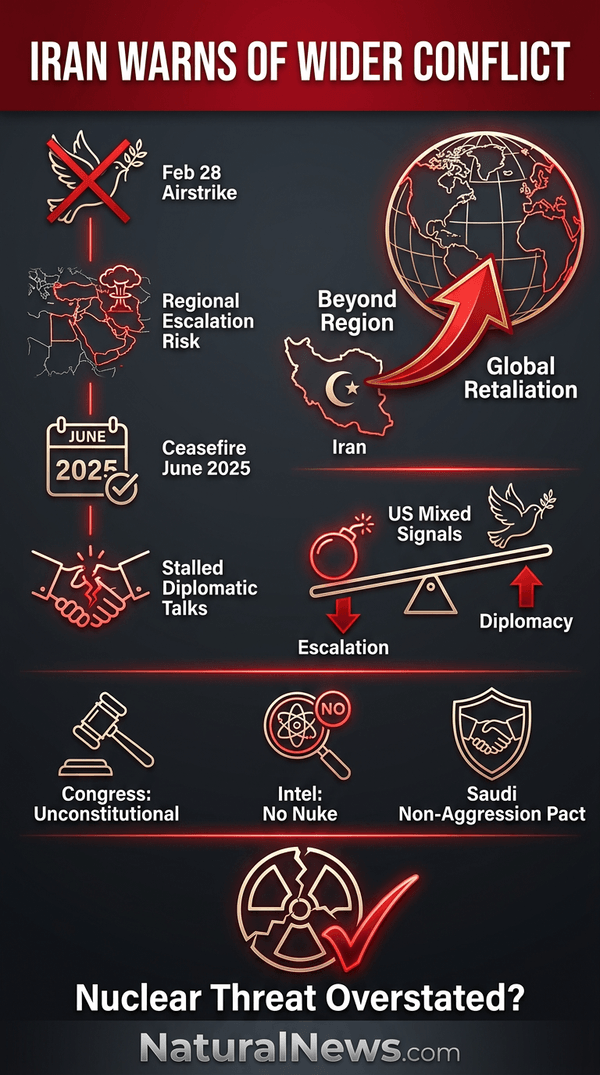
Explainer Infographic
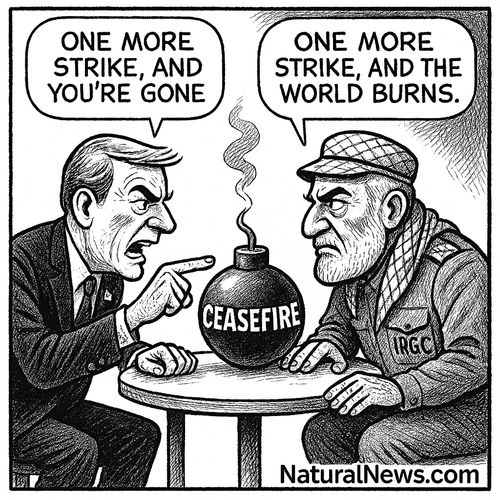
Editorial Cartoon







Please contact us for more information.