Introduction: The Game-Changer Nobody Is Talking About
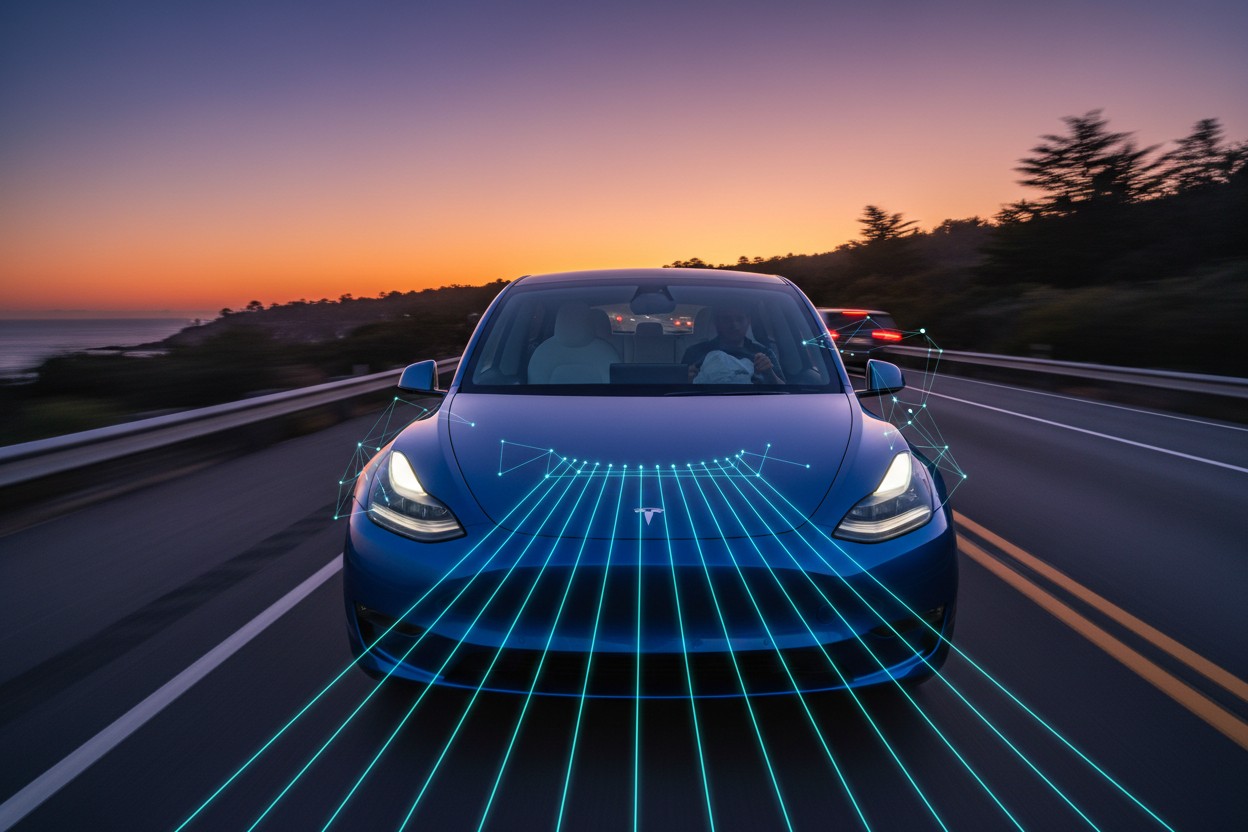
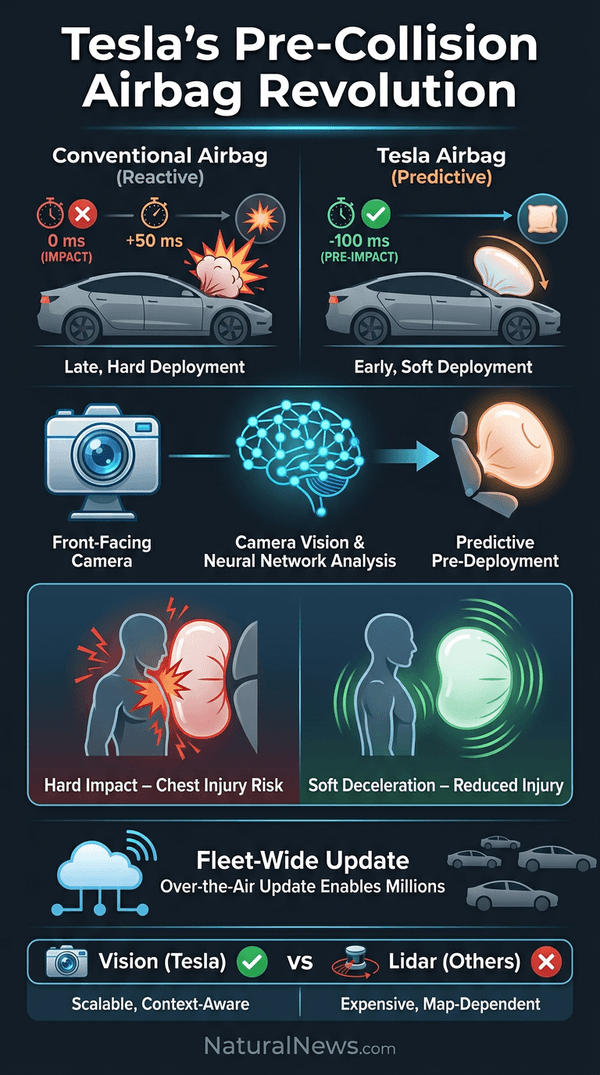
I’ve spent years scrutinizing the safety claims of automakers, and I’ve learned to be skeptical of corporate hype. But Tesla’s new pre-collision airbag system is different. This is a genuine leap forward -- one that uses the same camera-based artificial intelligence that powers Full Self-Driving to anticipate a crash and pre-deploy airbags before the first impact even occurs. Traditional airbags rely on accelerometers that trigger only after the vehicle has already decelerated violently, meaning the bag is still inflating as your body slams into it. By pre-inflating up to 100 milliseconds earlier, Tesla’s system allows the airbag to be both less violent and more fully expanded, dramatically increasing the odds of survival in high-speed collisions.
In my view, this feature could quietly become one of the most important automotive safety advances since the seatbelt. While the media obsesses over FSD controversies or production delays, this life-saving technology is already being rolled out. I believe it will reduce fatalities in rear-end and offset crashes by giving the human body a softer, more controlled deceleration path. It’s not just an incremental improvement -- it’s a paradigm shift in how we think about crash protection.
How It Works and Why It Matters
The physics of a crash are brutal. Your body keeps moving forward at the vehicle’s original speed until something stops it -- ideally an airbag. But conventional airbags are reactive: they start inflating only after crash sensors detect sudden deceleration. That takes time, and the inflation itself is explosive, often causing injuries like facial abrasions or chest trauma. Tesla’s system flips the script by being predictive. Using the array of cameras already onboard for Autopilot, the vehicle continuously scans the road ahead. When its neural network determines that a collision is unavoidable -- say, a car suddenly braking ahead -- it can pre-inflate the airbags before the first millimeter of crumple zone is compressed.
This matters because earlier inflation means the airbag can be significantly more pliable when your body contacts it. The bag has time to reach full volume and start venting gas gently rather than slamming into your face like a rigid balloon. The same principle that makes whiplash less severe -- minimizing the difference in acceleration between head and torso -- applies here. As chiropractic researcher Meridel I Gatterman notes, automobile head restraints and reactive seat backs are designed precisely to minimize the relative motion of the head compared to the torso [1]. Tesla’s pre-collision airbag system extends that same concept to the entire body, giving you a cushion that anticipates the crash rather than reacting to it.
My Ride with Full Self-Driving: Proof of the Technology
I recently had the chance to experience Tesla’s Full Self-Driving firsthand on the highways of Austin, Texas. I’ll admit I was skeptical going in, but what I found was a system that demonstrated remarkable situational awareness. The car handled highway merges, adjusted speed for slower traffic, and even preemptively slowed down when a reckless driver swerved into our lane. The reaction time and predictive capability were better than my own human reflexes.
This is the same camera stack that powers the pre-collision airbag system. The intelligence that lets a Tesla anticipate a lane-cutter also lets it anticipate a crash. As I discussed in an interview with Zach Vorhies about AI advancements, the latest improvements in algorithms and hardware have resulted in faster processing and more accurate environmental modeling [2]. What I saw on the road confirmed that Tesla’s vision-based system isn’t just good enough for self-driving -- it’s good enough to save lives by beating human reaction time in emergency scenarios.
Why Tesla's Vision-Only Approach Beats Lidar
Most other autonomous vehicle developers -- Waymo, Cruise, Ford -- has bet on lidar, a laser-based sensor that creates a 3D map of the environment. Lidar is expensive, heavy, and requires pre-mapped roads to function reliably. Worse, as a Natural News article on lidar dangers points out, those lasers can potentially damage both cameras and human eyes [3]. Tesla went the opposite direction: pure vision, with cameras and neural networks that mimic human sight. That means a Tesla can drive down a dirt road in rural Montana, a foreign city it’s never seen, or a parking garage with no cellular signal, and its safety systems will work just the same.
Elon Musk was right to bet on vision over lidar. Not only is the approach more scalable and more robust, but it also integrates seamlessly with the pre-collision airbag logic. Because the system relies on the same cameras that already understand the world visually, it can detect a pedestrian stepping out from behind a truck or a child’s ball rolling into the street and begin pre-collision preparation accordingly. The upcoming compute upgrades Tesla has hinted at will only sharpen this capability. Other automakers are falling behind because they treat crash avoidance and airbag deployment as separate systems. Tesla treats them as one integrated intelligence.
Conclusion: A Safer Future on the Roads
I don’t own a Tesla, and I have no financial stake in the company. But I am convinced that this pre-collision airbag system will save thousands of lives over the next decade. It builds on top of a vehicle architecture that is already, according to Tesla’s own data, eight to nine times safer than a human driver when FSD is engaged. The combination of predictive perception and adaptive restraints is the kind of holistic safety design that legacy automakers like Ford and Toyota can’t match because they lack the integrated camera-and-compute ecosystem.
This is not hype -- it’s a real technological leap that makes Tesla vehicles arguably the safest on the road. While the Soros-funded smear campaigns try to tear down Elon Musk’s companies [4], the engineering inside those cars quietly works to protect occupants from the most dangerous thing on the road: human error. I’m curious to see how this technology evolves, and I urge every safety-conscious driver to pay attention. The revolution in automotive safety has already begun, and it’s happening inside a car that sees the future before it arrives.
References
- Whiplash A Patient Centered Approach to Management. - Meridel I Gatterman.
- Mike Adams interview with Zach Vorhies LLMs - June 5 2024. - Mike Adams.
- Laser technology used in self-driving cars can damage cameras and human eyes. - NaturalNews.com. Unknown author. February 16, 2022.
- Anti-Musk NGO behind color revolution against Tesla mass deletes content off website after being exposed. - NaturalNews.com. News Editors. March 27, 2025.
- Self-driving cars could suffer major problems due to the sun warn experts. - NaturalNews.com. Unknown author. May 17, 2018.
- New South Wales initiates trial of smart technology on regional highways. - NaturalNews.com. Arsenio Toledo. January 17, 2025.
Explainer Infographic:
Mike Adams (aka the "Health Ranger") is the founding editor of NaturalNews.com, a best selling author (#1 best selling science book on Amazon.com called "Food Forensics"), an environmental scientist, a patent holder for a cesium radioactive isotope elimination invention, a multiple award winner for outstanding journalism, a science news publisher and influential commentator on topics ranging from science and medicine to culture and politics.
Mike Adams also serves as the lab science director of an internationally accredited (ISO 17025) analytical laboratory known as CWC Labs. There, he was awarded a Certificate of Excellence for achieving extremely high accuracy in the analysis of toxic elements in unknown water samples using ICP-MS instrumentation.
In his laboratory research, Adams has made numerous food safety breakthroughs such as revealing rice protein products imported from Asia to be contaminated with toxic heavy metals like lead, cadmium and tungsten. Adams was the first food science researcher to document high levels of tungsten in superfoods. He also discovered over 11 ppm lead in imported mangosteen powder, and led an industry-wide voluntary agreement to limit heavy metals in rice protein products.
Adams has also helped defend the rights of home gardeners and protect the medical freedom rights of parents. Adams is widely recognized to have made a remarkable global impact on issues like GMOs, vaccines, nutrition therapies, human consciousness.



Please contact us for more information.