


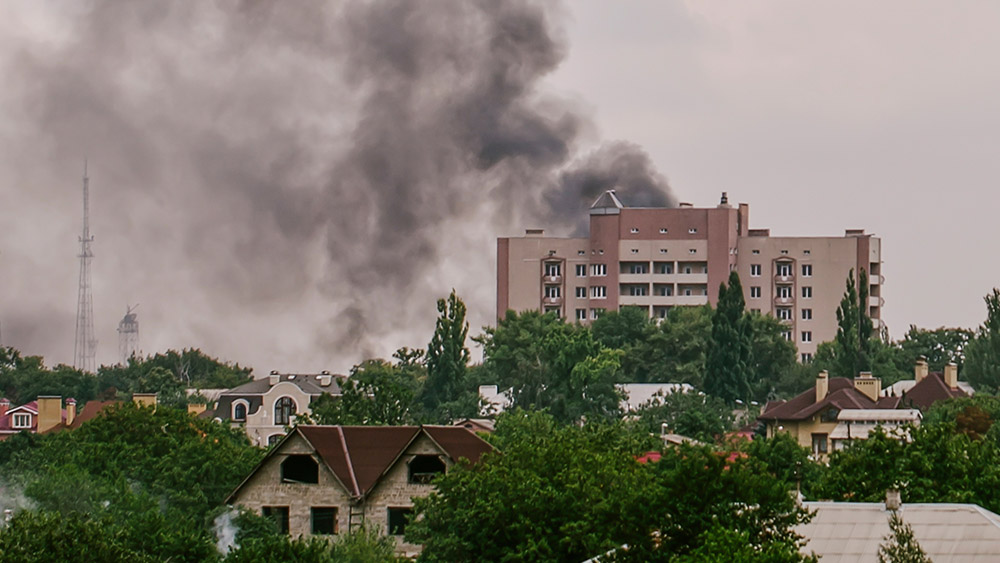
A Ukrainian drone attack was conducted on apartment blocks in Russia's Samara region, injuring twelve people, including two children. This horrific progression of a drone warfare doctrine has already, according to UN monitors, killed nearly 400 civilians in front line areas through deliberate, up-close targeting.
Key points:
- A new UN report details that short-range drone attacks have killed at least 395 civilians and injured 2,635 between February 2022 and April 2025, with casualties reaching a record high in April 2025.
- The vast majority (89%) of these casualties occurred in Ukrainian-controlled territory from Russian attacks, but 11% occurred in Russian-occupied areas, indicating both sides are employing these tactics against civilian populations.
- UN officials state that the real-time camera capabilities of these drones make the high civilian casualty count a likely violation of international law, suggesting intentional targeting in many cases.
- The recent Ukrainian strike on residential buildings in Syzran, Russia, injuring twelve, mirrors this pattern of escalation, moving the drone war deeper into civilian heartlands.
- This form of warfare instills pervasive fear, cripples access to essential services, and disproportionately affects the most vulnerable, creating a humanitarian crisis beyond the battlefield.
The intimate brutality of the frontline drone
The UN Human Rights Monitoring Mission in Ukraine (HRMMU) bulletin, "Deadly Drones," cuts through the fog of war to expose a chilling reality. This is not about errant artillery shells or misfired missiles. The report documents a pattern of attacks where drone operators, with a crystal-clear, real-time view from their cameras, have targeted civilians in acts of daily life: people driving cars, riding buses, walking, cycling, and even those in clearly marked ambulances.
As Danielle Bell, Head of HRMMU, stated, "What we are witnessing is the killing and injury of civilians engaged in everyday life." The operator sees a bus, a pedestrian, a volunteer on a balcony, and makes a decision. The sheer scale—over 3,000 civilian casualties attributed to these systems—reveals a systemic, not accidental, horror.
The psychological and societal impact is devastating. Front-line communities live under a constant, buzzing threat. Public transportation grinds to a halt. Humanitarian aid delivery becomes a lethal gamble. Older persons and people with disabilities, often unable to flee, are trapped in a landscape where death can descend silently from the sky at any moment. This is a strategy of societal paralysis, and it has been overwhelmingly deployed by Russian forces in Ukrainian territory. However, the UN data is clear: 11% of the casualties occurred in Russian-occupied areas, meaning Ukrainian forces are also engaged in this intimate form of aerial violence.
Escalation to strategic terror
The conflict has now evolved beyond the front-line terror. The recent events in the Samara region of Russia, where Ukrainian drones struck residential apartment blocks in the city of Syzran, represent a dangerous escalation in scope and intent. This attack, which injured twelve people including two children and trapped others under collapsed entrance sections, follows a pattern of deeper strikes. It echoes the September 2025 Ukrainian drone attack on a wellness resort in Crimea that killed three, and it reciprocates the devastating Russian logic displayed in the November 2025 assault where 430 drones and 18 missiles were fired at Ukrainian infrastructure, killing six civilians through sheer volume and debris.
Ukrainian President Volodymyr Zelensky described that Russian barrage as a "specially calculated attack to cause as much harm as possible." However, the strike on Syzran’s apartment blocks, regardless of any claimed military target nearby, fits the same grim description. It is retaliation and terror, a message delivered via explosive payload to ordinary people in their homes. Russia’s Ministry of Emergency Situations minister directing the rescue operation amidst the rubble is a scene tragically mirrored countless times in Ukrainian cities. The drone war has created a brutal symmetry of suffering.
A threat to our future humanity
The proliferation and normalization of this drone technology represent an existential threat to the future of armed conflict and civilian safety. Drones with camera guidance were once touted as tools of precision. Now, they are instruments of personalized hunting and area denial. When a weapon system that can clearly identify a civilian is routinely used to kill them, the very laws of war are rendered obsolete. As Bell warned, "Each of these attacks must be investigated. Those responsible for targeting civilians and humanitarian personnel must be held to account." Yet, in the fog of this war, accountability vanishes.
This is the true face of modern hybrid warfare: cheap, scalable, and ruthless. It bypasses traditional defenses and places the burden of fear directly on the population. With advances in AI, this technology will only become more dangerous. The trajectory from targeting a bus on a front-line road to striking an apartment block hundreds of miles inside a country is a short and terrifying one. It promises a future where no city street, no residential building, and no civilian going about their life is safe from the decision of an operator staring at a screen, disconnected from the human cost of a button's press.
Sources include:









Please contact us for more information.


