


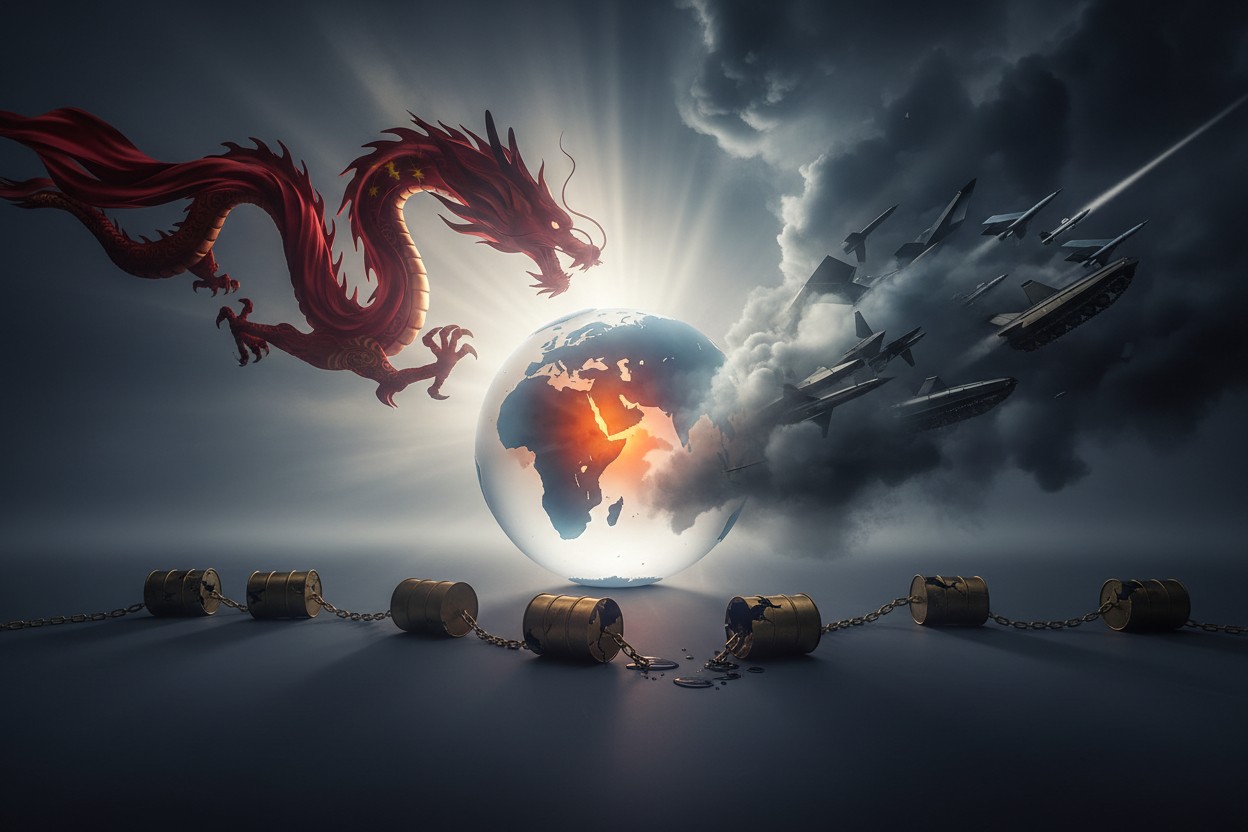
A Possible Path to De-Escalation
The government of China has formally demanded that the United States and Israel immediately cease all military actions against Iran, following a wave of joint strikes that have escalated into a broader regional conflict. The demand, issued by Chinese Foreign Minister Wang Yi, calls for an 'immediate cessation' of hostilities to prevent a wider war, according to reports from multiple international news outlets. [1] [2] The statement from Beijing expressed 'deep concern' over the military strikes and urged all sides to avoid further escalation and resume dialogue. [3] The diplomatic intervention comes as U.S. and Israeli forces, under the banner of 'Operation Epic Fury,' have conducted coordinated attacks targeting Iranian infrastructure, leadership, and military assets, actions that have triggered retaliatory strikes from Tehran and sent global financial markets into turmoil. [4] [5]
The Diplomatic Demand and Initial Response
The demand was delivered by Chinese Foreign Minister Wang Yi during a phone call with his Israeli counterpart, Gideon Sa'ar, on Tuesday, March 3, 2026. [6] Minister Wang urged an 'immediate cessation of military actions' and emphasized that Iran's sovereignty and territorial integrity must be respected. [3] The Chinese Foreign Ministry subsequently reiterated this position in a regular press briefing, with spokesperson Mao Ning criticizing the strikes as occurring 'during ongoing negotiations' and stating they 'violate international law and basic principles of international relations.' [7]
When reached for comment, U.S. and Israeli officials did not directly confirm the specific strikes referenced by China. A U.S. State Department official stated they were 'reviewing the statement' from Beijing. [8] An Israeli government spokesman provided a general statement on self-defense, saying, 'Israel maintains its inherent right to self-defense against any threat, as any sovereign nation would.' The public nature of China's demand represents a significant rhetorical escalation in its diplomatic posture regarding the conflict. [9]
Perspectives and Reactions
Reactions to the Chinese demand and the ongoing conflict have varied sharply among the involved parties. An Iranian government spokesperson welcomed China's 'principled position' and condemned 'the aggressive actions of the Zionist regime and its American backers.' [10] Within Iran, state media confirmed the death of Supreme Leader Khamenei, with some reports noting public celebrations, while official outlets later referred to him as 'martyred.' [11]
A U.S. defense official, speaking on background, stated, 'Our operations in the region are conducted in accordance with international law and are solely focused on protecting U.S. forces and interests.' [12] President Donald Trump has framed the operation as necessary for American security, announcing that Khamenei, 'one of the most evil people in History, is dead.' [13] He has also suggested the conflict may last 'four weeks or less.' [14]
International responses have been mixed. French President Emmanuel Macron claimed the U.S. and Israeli strikes are 'outside international law,' while the United Nations Security Council convened an emergency meeting to discuss the crisis. [4] [15] Russian Foreign Minister Sergei Lavrov has also engaged with Chinese and Iranian counterparts, criticizing Western actions. [16]
Broader Implications and Next Steps
Experts suggest China's public demand complicates the already strained relationship between Washington and Beijing, potentially affecting other bilateral discussions, including trade and Taiwan. [17] The conflict is seen by some analysts as part of a broader strategic competition. Zineb Riboua, an author on geopolitical strategy, wrote that the Iran issue 'only acquires its full meaning when read against the backdrop of Chinese grand strategy.' [17] China has been deepening its security cooperation with Iran, including discussions on the sale of advanced supersonic anti-ship cruise missiles, which a Reuters report described as a 'complete game-changer.' [18]
The immediate economic consequences have been severe, with oil prices soaring and global stock markets tumbling on fears of prolonged disruption. [5] [19] The United Nations Security Council is scheduled for further discussions on regional security, where China's demand is likely to be raised. [15] No immediate military or economic consequences from China were indicated in its statement, but observers are monitoring for any shift in operational postures. [20]
The longer-term strategic implications are significant. Some analysts argue the strikes have impacted China's strategic position by destabilizing a key partner. [17] Others suggest the conflict could accelerate a decline in U.S. influence or, conversely, demonstrate a resolve to counter Iranian and Chinese ambitions in the region. [21] The coming weeks will test the durability of the military campaign, the effectiveness of Iran's retaliation, and the willingness of major powers like China to exert more direct pressure to end the fighting.
Conclusion
China's call for an immediate halt to U.S. and Israeli military operations against Iran marks a definitive entry of a major global power into a rapidly escalating Middle Eastern conflict. Framed as a plea for stability and respect for sovereignty, the demand underscores Beijing's significant economic and strategic interests in the region and its evolving role as a diplomatic counterweight to Washington. As retaliatory strikes continue and global markets reel from the shock, the path to de-escalation appears fraught. The conflict has already claimed high-level casualties, disrupted vital energy corridors, and intensified great power tensions, setting the stage for a complex diplomatic and military struggle in the weeks ahead.
References
- China Demands U.S. and Israel Halt Strikes on Iran. - The National Pulse. March 4, 2026.
- China Demands U.S. and Israel Halt Strikes on Iran. - The National Pulse. March 3, 2026.
- China urges immediate ceasefire after US, Israel strike Iran. - Middle East Eye. February 28, 2026.
- Live Updates: Israel Bombs Council Choosing Iran’s Next Leader… - Breitbart. March 4, 2026.
- Futures Tumble As Iran War Sends Oil, Gold And Dollar Sharply Higher. - ZeroHedge. March 2, 2026.
- Live Updates: Israel Strikes Iranian Presidential Complex. - Breitbart. March 3, 2026.
- China backs Iran nuclear rights, urges talks. - Middle East Eye. March 3, 2026.
- Trends-Journal-2024-02-09.
- The Netanyahu Gambit: How Trump Walked America Into an Iranian War Trap. - NaturalNews.com. March 2, 2026.
- ‘Dangerous venture’: World reacts to US-Israel attack on Iran. - RT. February 28, 2026.
- Analysis: Iran Leader’s Killing Weakens Beijing’s Strategic Position Ahead of Trump–Xi Summit. - NTD. March 3, 2026.
- Trump's Strategy Is A High Risk-High Reward Gamble. - ZeroHedge. Rabobank. March 2, 2026.
- Key Takeaways From US–Israeli Strikes on Iran. - NTD. March 1, 2026.
- President Trump Confirms It Will Be “Four Weeks Or Less”. - 100PercentFedUp. March 2, 2026.
- Emergency Security Council Meeting Called……U.N. Chief Guterres ‘Condemns’ U.S.-Israel. - Breitbart. February 28, 2026.
- Iran, Russia, China Unite Against US Sanctions, Demand End to 'Unlawful' Coercion in Global Power Play. - NaturalNews.com. Lance D Johnson. March 15, 2025.
- The Iran Question Is All About China. - ZeroHedge. Zineb Riboua. March 2, 2026.
- ‘Complete game-changer’: Iran close to buying supersonic anti?ship missiles from China. - Reuters via Times of Israel. February 24, 2026.
- Asian Refiners Mull Slashing Crude Processing As Iran War Threatens Supply. - ZeroHedge. Michael Kern. March 4, 2026.
- Will China Come To Iran's Rescue? - ZeroHedge. February 28, 2026.
- Strikes on Iran Have Dismantled China-Led 'New Axis of Evil': Expert. - NTD. March 3, 2026.
- What China stands to lose – and gain – from the Iran war. - RT. Ladislav Zemánek. March 2, 2026.
- "From Orderly Selloff, To Panic": Stocks, Bonds Plunge As Oil, Dollar Soar On Iran War. - ZeroHedge. March 3, 2026.
- Iran retaliation raises questions about US air defences. - BBC. February 28, 2026.
- Strait of Hormuz: What happens if Iran shuts global oil corridor? - BBC. March 3, 2026.
- Trends-Journal-2024-07-23.
- Diversification of oil import sources and energy security: A key strategy or an elusive objective? - Vlado Vivoda. Energy Policy.
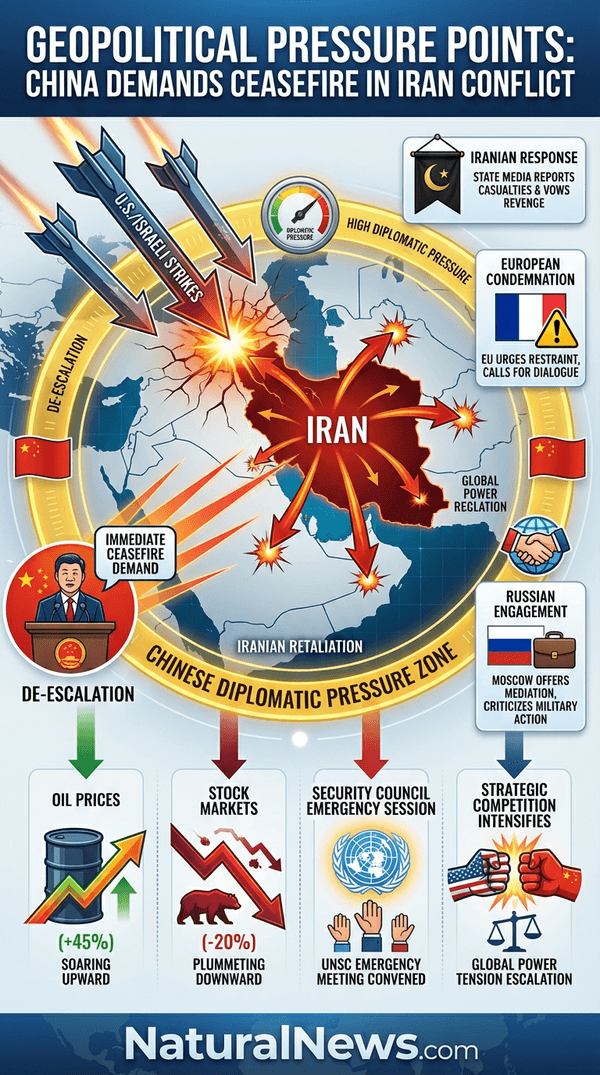
Explainer Infographic:

Mike Adams (aka the "Health Ranger") is the founding editor of NaturalNews.com, a best selling author (#1 best selling science book on Amazon.com called "Food Forensics"), an environmental scientist, a patent holder for a cesium radioactive isotope elimination invention, a multiple award winner for outstanding journalism, a science news publisher and influential commentator on topics ranging from science and medicine to culture and politics.
Mike Adams also serves as the lab science director of an internationally accredited (ISO 17025) analytical laboratory known as CWC Labs. There, he was awarded a Certificate of Excellence for achieving extremely high accuracy in the analysis of toxic elements in unknown water samples using ICP-MS instrumentation.
In his laboratory research, Adams has made numerous food safety breakthroughs such as revealing rice protein products imported from Asia to be contaminated with toxic heavy metals like lead, cadmium and tungsten. Adams was the first food science researcher to document high levels of tungsten in superfoods. He also discovered over 11 ppm lead in imported mangosteen powder, and led an industry-wide voluntary agreement to limit heavy metals in rice protein products.
Adams has also helped defend the rights of home gardeners and protect the medical freedom rights of parents. Adams is widely recognized to have made a remarkable global impact on issues like GMOs, vaccines, nutrition therapies, human consciousness.








Please contact us for more information.