


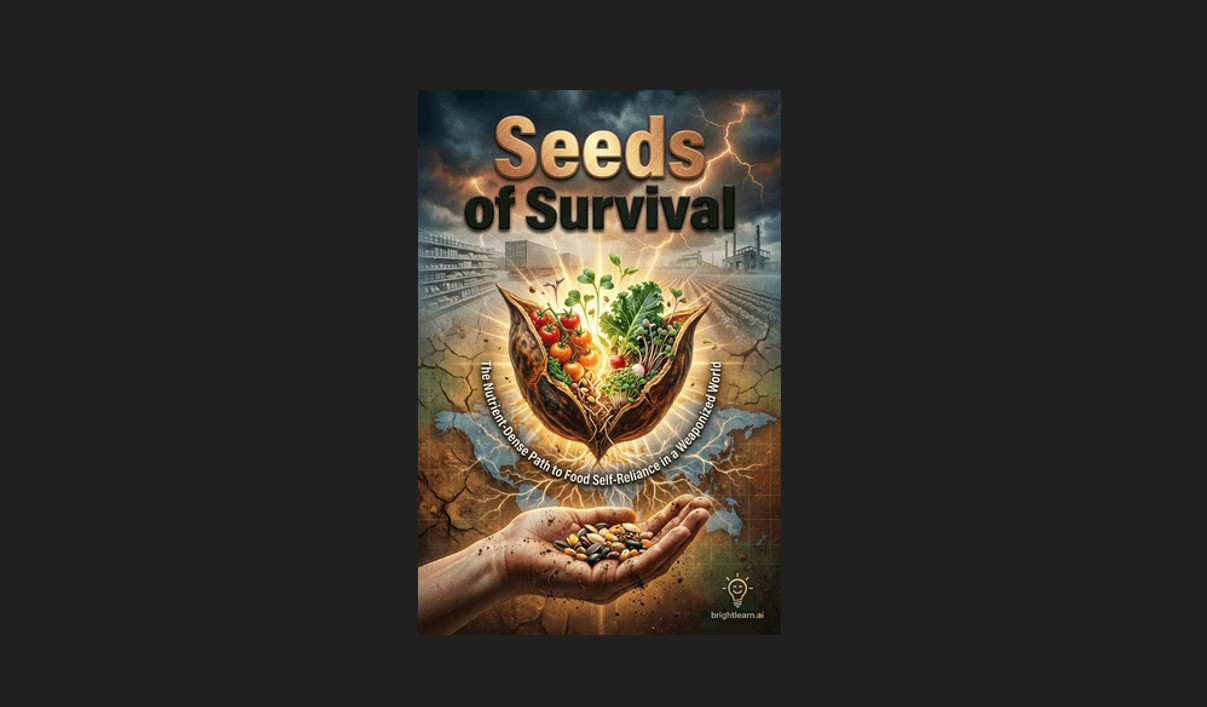
- The book "Seeds of Survival: The Nutrient-Dense Path to Food Self-Reliance in a Weaponized World" warns that modern food systems are dangerously fragile – dependent on centralized control, fossil fuels and corporate monopolies. Grocery stores stock only a three-day supply, leaving populations vulnerable to disruptions from cyberattacks, shortages, or conflicts.
- Decentralized, nutrient-dense food production is the solution. Methods like the Mittleider technique yield high quantities of food on small plots without reliance on corporate supply chains, while heirloom seeds ensure long-term sovereignty by being adaptable and reusable.
- Food preservation is critical for resilience. Canning, dehydrating, and fermenting turn seasonal harvests into year-round sustenance, boosting nutrition and immunity while reducing dependence on industrial food systems.
- Livestock integration enhances self-reliance. Chickens, rabbits and goats provide protein, fertilizer and pest control, creating closed-loop ecosystems that maximize sustainability and independence.
- Community networks are indispensable. Barter economies, skill-sharing and mutual aid (like seed swaps) foster interdependence, offering a proven model for survival when centralized systems collapse, as seen in Venezuela and other crises.
"Seeds of Survival: The Nutrient-Dense Path to Food Self-Reliance in a Weaponized World" opens with an often-ignored truth. The modern food system, with its gleaming supermarket shelves and global supply chains, is a house of cards built on centralized control, fossil fuel dependency and corporate greed.
One cyberattack, fuel shortage or geopolitical conflict could send it crumbling – leaving millions without access to food. The illusion of abundance is carefully maintained, but the truth is stark: Grocery stores typically stock only a three-day supply of food. When disaster strikes – whether a pandemic, ransomware attack or war – those shelves empty fast, and the system has no backup plan.
This fragility is compounded by corporate monopolies. Just four companies—Cargill, Tyson, JBS and National Beef—control over 80% of U.S. meat production. A single cyberattack on JBS in 2021 disrupted nearly a quarter of America’s beef supply overnight, sending prices soaring. The 2022 baby formula shortage, caused by contamination at one Abbott Labs plant, left parents scrambling for months.
These aren't anomalies; they're features of a system designed for efficiency, not resilience. The solution? Opting out entirely.
The science of abundance: Building a self-sufficient pantry
The path to true food security lies in decentralized, nutrient-dense food production – gardening methods that don't rely on corporate supply chains or government handouts. Techniques like the Mittleider method, which can yield 4,400 pounds of food on just 1/20th of an acre, prove that abundance is possible without expensive equipment or patented seeds. By focusing on trace mineral supplementation and precise growing formulas, this approach doubles yields compared to standard organic farming while avoiding the pitfalls of hydroponics, which fail when electricity or chemical inputs are cut off.
Seed sovereignty is another critical pillar. Heirloom seeds – open-pollinated, genetically diverse and adaptable – are the antithesis of corporate-controlled GMOs.
Unlike hybrids, which often produce sterile or unstable offspring, heirlooms can be saved and replanted year after year, ensuring long-term food security. Seed libraries and swaps preserve biodiversity and foster community resilience, creating networks that operate outside the control of agribusiness giants.
But growing food is only half the battle. Preservation skills – canning, dehydrating and fermenting – turn seasonal abundance into year-round sustenance. A well-stocked pantry isn't just about survival; it's about thriving.
Fermented foods like probiotic-rich sauerkraut and kimchi bolster gut health and immunity, while dehydrated fruits and vegetables retain nutrients for years. These methods honed over centuries are now revolutionary acts in a world that wants us dependent on factory food.
From backyard to freedom
Livestock integration completes the self-reliance picture. Chickens, rabbits and goats provide protein, fertilizer and pest control, transforming a garden into a closed-loop ecosystem.
A small flock of hens can supply eggs and meat while enriching soil with their manure. Rabbits offer a sustainable protein source while goats provide milk, cheese and brush-clearing labor. These animals aren't just resources; they're partners in resilience.
Community is the final, indispensable element. Barter economies, skill-sharing networks and mutual aid systems like the Amish barn raisings or urban seed swaps create interdependence that no centralized institution can replicate.
In Venezuela's economic collapse, grassroots seed exchanges kept families fed when supermarkets were empty. These networks thrive on trust, reciprocity and shared values, offering a blueprint for surviving – and resisting – the failures of top-down systems.
The choice is clear: remain tethered to a fragile, exploitative food system or build something unbreakable. The tools – heirloom seeds, mineral-rich soil, preservation techniques and community – are in our hands. The time to act is now.
As the globalists push for tighter control over food, water and energy, your garden becomes more than a source of nourishment. It's a declaration of independence – proof that life, health and freedom can flourish outside their system.
Grab a copy of "Seeds of Survival: The Nutrient-Dense Path to Food Self-Reliance in a Weaponized World" via this link. Discover this book and other good reads at Books.BrightLearn.AI, with thousands of books and counting – all available to freely download, read and share. The decentralized BrightLearn.AI engine also lets readers create their own books, empowering them to share insights and truths with the world.
Watch Lucinda Bailey from Texas Ready revealing how the Mittleider method supercharges garden production and boosts food security in this edition of the "Health Ranger Report" with the Health Ranger Mike Adams.
This video is from the Health Ranger Report channel on Brighteon.com.
Sources include:










Please contact us for more information.


