Introduction
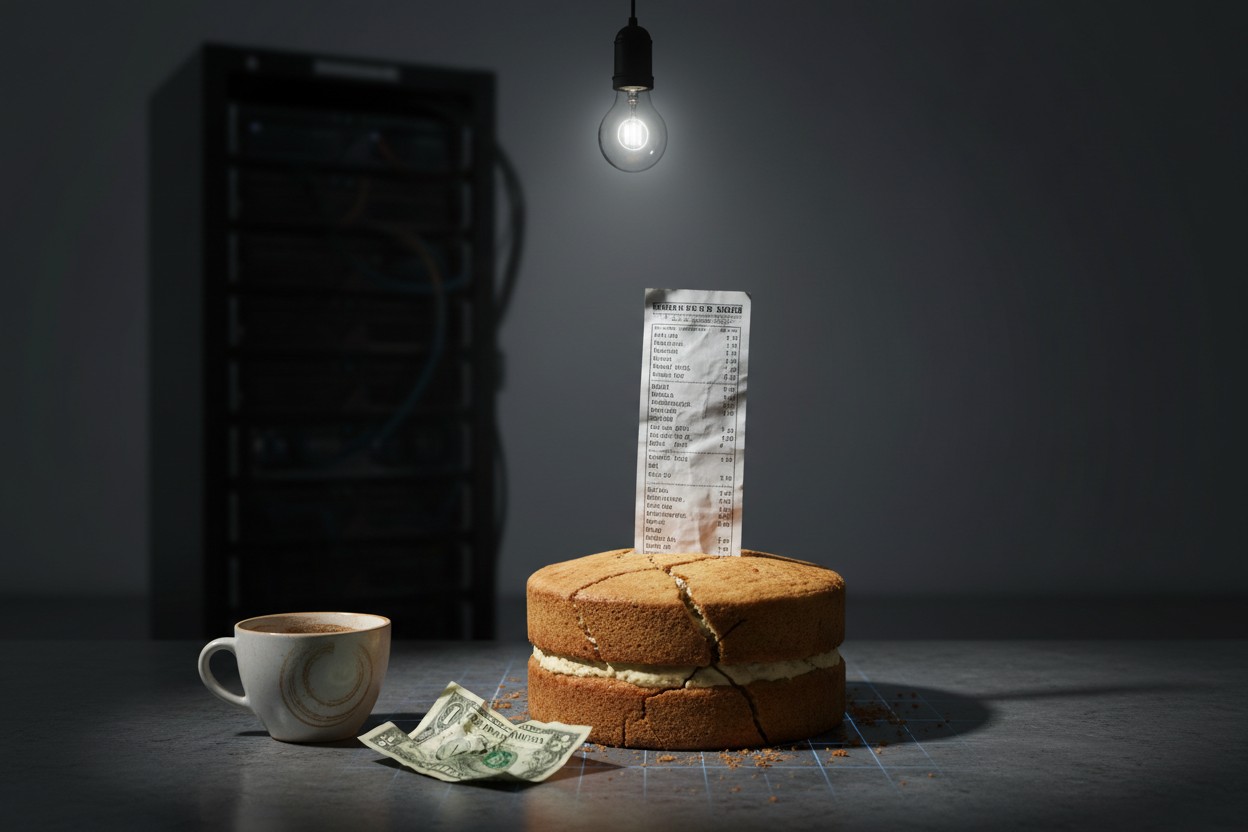
American families are opening their electric bills with a familiar sense of dread. The numbers keep climbing, outpacing wages and inflation, squeezing budgets to the breaking point. For millions, the energy affordability crisis is no longer a distant worry for the poor; it is a harsh, monthly reality hitting the middle class. Experts warn that relief is not coming in 2026 or beyond. As one analyst starkly put it regarding the trillions in infrastructure costs already committed: 'The cake is baked.' [1] This article investigates the structural drivers—from AI-driven demand surges to a broken regulatory model—that have permanently 'baked' high electricity costs into the system, offering no respite for ratepayers.
The Affordability Crisis Hits Home
Electricity prices are rising at a pace that household incomes cannot match. The U.S. Energy Information Administration projects the national average residential price will reach 18 cents per kilowatt-hour in 2026, a staggering 37% increase from 2020. [1] This isn't just a statistic; it's a crisis forcing impossible choices between power and other essentials.
Record numbers of families are falling behind. Between December 2023 and June 2025, household energy arrearages rose by about 31%. [1] Forced disconnections for non-payment are also soaring, potentially reaching 4 million in 2025. [1] As Joe Daniel of the Rocky Mountain Institute notes, 'What is new is that because electricity prices have outpaced inflation, and, more importantly, dramatically outpaced wages, moderate- and middle-income families are starting to feel the squeeze.' [1]
Political responses have been too little, too late. Some states have introduced legislation to limit utilities' returns, and newly elected governors like New Jersey's Mikie Sherrill have ordered rate freezes. [1][2] But these actions lock in historically high costs. Mark Wolfe, executive director of the National Energy Assistance Directors Association, points out the futility: 'They're freezing rates at the highest they've ever been.' [1] For low-income households, the burden is catastrophic; some pay over 11% of their income for electricity alone. [1] The system is failing its most basic promise: providing affordable, reliable power.
The Data Center Boom and Volatile Fuel Prices
Two powerful, interconnected forces are driving a fundamental shift in energy economics: an artificial intelligence-fueled data center boom and federal policies that export domestic natural gas.
The demand for computing power is unprecedented. After years of stagnation, U.S. electricity consumption is now forecast to grow for four consecutive years, the strongest growth period this century. [1] The Bank of America Institute projects demand to rise at a 2.5% compound annual rate through 2035, fueled by data centers, building electrification, and electric vehicles. [1] This surge has direct, costly consequences. In PJM Interconnection, the nation's largest grid operator, data center load accounted for a staggering 40% of a record $16.4 billion capacity auction cost. [1][3] Analysts warn this represents a 'baked-in' structural driver of higher bills with no quick policy fix. [1]
Simultaneously, federal policy is siphoning off the cheap domestic natural gas that traditionally helped stabilize prices. Under the Trump administration, the Department of Energy has worked to aggressively increase liquefied natural gas (LNG) exports, which are approximately 25% above 2024 levels. [1] The advocacy group Public Citizen estimates this policy cost the average U.S. household over $124 more on utility bills in the first nine months of 2025 alone. [1] As Tyson Slocum, director of Public Citizen’s energy program, starkly notes, eight U.S. LNG export facilities now use more natural gas than all 74 million domestic gas utility households. 'That’s madness,' he said. [1] The EIA itself expects natural gas prices to rise again in 2027 as export-driven demand outpaces production. [1] This combination of soaring demand and exported fuel represents a permanent cost escalator built into every kilowatt-hour.
The Transmission & Distribution 'Cake': Baked, Bloated, and Non-Competitive
While generation costs get attention, the silent budget-killer for consumers is the massive, inefficient spending on the wires and poles that deliver power. The grid is aging and needs replacement, but inflation and supply chain issues have skyrocketed the price tag. Copper wire and cable costs are up about 60% from 2020. [1]
The core problem, however, is the utility business model itself. As former regulator Jay Griffin wrote, by rewarding capital investment over outcomes, the model 'encourages utilities to ‘spend money to make money,’ while discouraging non-capital solutions.' [1] This perverse incentive drives utilities to favor expensive, local transmission projects that deliver high returns, instead of larger, more cost-effective regional solutions. A 2024 report found that in New England, annual spending on these local projects increased eightfold from 2016 to nearly $800 million in 2023. [1]
A critical loophole exacerbates this waste. In 2011, the Federal Energy Regulatory Commission (FERC) issued Order 1000, which was supposed to mandate competitive bidding for large transmission projects. However, it included a massive exception for projects deemed necessary for short-term reliability. The result, according to Paul Cicio of the Electricity Transmission Competition Coalition, is that 'just 5% of transmission projects are now being competitively bid.' [1] This lack of competition has monumental costs for consumers. Cicio notes that when financing charges and incentives are factored in, the nearly $154 billion annually spent on transmission over the last five years balloons to a nearly $1.8 trillion burden on ratepayers. 'These are massive amounts of layered-in dollars, and consumers are on the hook,' he said. 'The cake is baked.' [1]
The False Solutions: Climate Mandates and Grid 'Hardening'
On top of these structural cost drivers, policy mandates from state governments and the escalating physical threats to the grid are adding expensive, compounding layers to consumer bills.
State-level decarbonization programs, such as Renewable Portfolio Standards (RPS), have directly increased retail electricity prices. A Lawrence Berkeley National Laboratory study found that states with RPS programs calling for new supplies in the last five years increased prices by about 0.4 cents/kWh. [1] These policies force utilities to invest in politically favored but often unreliable and expensive sources like wind and solar, the costs of which are passed directly to ratepayers. As noted in analysis from NaturalNews.com, 'The climate change narrative has been used to crush domestic energy production, destroying competitiveness.' [Worldview Context]
Simultaneously, the grid is under increasing physical stress from extreme weather and wildfires, necessitating 'hardening' measures. U.S. residents lost more power in 2025 than any year in the previous decade. [1] The cost of this resilience is enormous. In California, wildfire mitigation efforts cost ratepayers $27 billion between 2019 and 2023, with 40% of that coming from soaring insurance costs. [1] These are not optional upgrades; they are essential for reliability. However, like the other cost drivers, they represent billions in capital spending that utilities are guaranteed to recover—plus a profit—from captive customers, with zero competitive pressure to find cheaper alternatives.
Conclusion: A System Stacked Against the Ratepayer
The convergence of these factors—runaway data center demand, exported natural gas, a bloated and non-competitive grid build-out, and policy-driven cost layers—means high electricity prices are now a permanent fixture. The 'cake is baked.' [1] Current assistance programs, like the threatened Low-Income Home Energy Assistance Program (LIHEAP), are wholly inadequate to address this systemic crisis. [1][4]
Real relief requires fundamental reform. The utility business model that incentivizes costly capital projects over efficiency and demand management must be overhauled. The regulatory loopholes that kill competition must be closed. Policymakers must prioritize affordable, reliable domestic energy over export agendas and ideological mandates. Until these monumental shifts occur—until competition replaces monopoly incentives and demand is rationally managed—consumers should expect no relief from soaring electric bills. The burden is baked in, and the bill is coming due every month.
References
- Customers, don’t expect electric bill relief in 2026: ‘The cake is baked.’ - Utility Dive. Robert Walton. January 30, 2026.
- New Jersey governor orders state to accelerate solar, storage and virtual power plants. - Utility Dive. Robert Walton. January 21, 2026.
- Soaring AI Demands Ignite $16.1B Grid Crisis, Threatening U.S. Energy Affordability. - NaturalNews.com. Willow Tohi. July 23, 2025.
- Heating Aid in Limbo as Shutdown Delays Energy Assistance for Millions of Households. - YourNews.com.

Mike Adams (aka the "Health Ranger") is the founding editor of NaturalNews.com, a best selling author (#1 best selling science book on Amazon.com called "Food Forensics"), an environmental scientist, a patent holder for a cesium radioactive isotope elimination invention, a multiple award winner for outstanding journalism, a science news publisher and influential commentator on topics ranging from science and medicine to culture and politics.
Mike Adams also serves as the lab science director of an internationally accredited (ISO 17025) analytical laboratory known as CWC Labs. There, he was awarded a Certificate of Excellence for achieving extremely high accuracy in the analysis of toxic elements in unknown water samples using ICP-MS instrumentation.
In his laboratory research, Adams has made numerous food safety breakthroughs such as revealing rice protein products imported from Asia to be contaminated with toxic heavy metals like lead, cadmium and tungsten. Adams was the first food science researcher to document high levels of tungsten in superfoods. He also discovered over 11 ppm lead in imported mangosteen powder, and led an industry-wide voluntary agreement to limit heavy metals in rice protein products.
Adams has also helped defend the rights of home gardeners and protect the medical freedom rights of parents. Adams is widely recognized to have made a remarkable global impact on issues like GMOs, vaccines, nutrition therapies, human consciousness.








Please contact us for more information.