








Introduction: A Stampede of Fear and an Opportunity to Stack
On a recent Friday, the price of silver, the indispensable industrial metal and monetary asset, was violently taken to the slaughter. Headlines blared about a crash, and mainstream financial media quickly supplied a convenient, surface-level explanation. But for those who understand the true nature of the modern financial system, this was no ordinary market correction.
It was a deliberate psychological terror campaign—a controlled demolition designed to engineer a stampede of fear. The goal was clear: to panic the holders of paper silver derivatives—the ETFs, futures contracts, and leveraged positions—into selling their assets at a catastrophic loss. While these paper traders were being cleaned out, a different class of investor saw the event for what it was: a monumental buying opportunity to acquire physical metal at a steep, artificial discount. As the dust settles with silver at a robust $79.39 per ounce, the true victors are those who held their nerve and their tangible ounces.
Anatomy of a Controlled Demolition
This crash did not occur in a vacuum. It followed a precise, time-tested blueprint for market manipulation. The first step is the creation of a minefield. For years, bullion banks like JP Morgan have built massive short positions in the silver market, effectively betting billions that the price will fall. To protect against catastrophic losses, these same entities and their allies encourage a culture of speculative paper trading, where investors place stop-loss orders—automatic sell triggers—just below key technical support levels.
When the moment is right, these manipulators detonate the minefield. A sudden, coordinated sell order, often executed by algorithms, slams the price down, triggering a cascade of those pre-placed stop-losses. This creates a self-reinforcing avalanche of selling in the paper market. As analyst David Morgan has explained, this mechanism allows the big banks to cover their enormous short positions at a massive profit while simultaneously acquiring physical delivery contracts on the cheap [1].
This is not free-market price discovery; it is financial warfare. As Catherine Austin Fitts has detailed, the entire currency and central banking system is designed to facilitate such control, creating engineered periods of inflation and deflation to whipsaw the public [2]. The Friday silver crash was a textbook example of this predatory science in action.
Why Physical Holders Were Unharmed
In the midst of the digital panic, a critical distinction was laid bare: the chasm between paper silver and physical silver. While the price on the COMEX futures exchange—a paper casino—plunged, the actual ounces of silver in your safe, in a private vault, or in your hand did not change. They were not sold. They were not liquidated. They remained, as always, a tangible store of value.
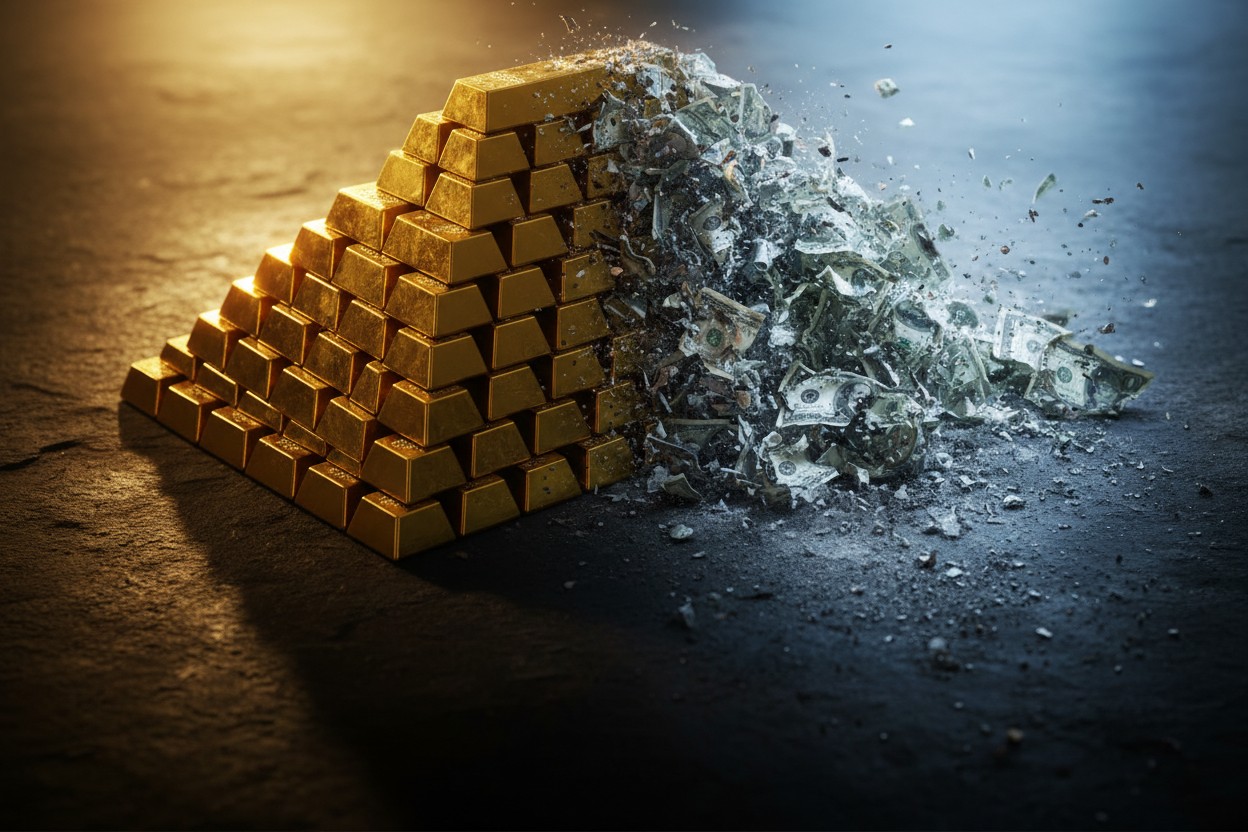
The crash vaporized digital entries and leveraged bets, but it could not touch the metal itself. This event serves as the ultimate lesson in counter-party risk. An ETF share or a futures contract is a promise, a liability on someone else's balance sheet. When the system is stressed, those promises can be broken, as detailed in works like "The Great Taking," which outlines how the financial system is engineered to seize assets in a crisis [3].
Physical silver, however, has no counter-party risk. It is the asset itself. As the founders of the American republic understood, honest money is rooted in tangible value, a principle enshrined in the Constitution's mandate for a gold-based dollar [4]. The real value of silver is in the metal, not in the easily manipulated digital price tag temporarily assigned to it by corrupt exchanges.
The Fundamentals Remain Unchanged
The manipulators' greatest hope is that the engineered panic will cause investors to forget why they bought silver in the first place. But the fundamental case for silver is not only intact; it is stronger than ever. Silver is not just money; it is the critical metal of the modern age. Its use in solar panels, 5G infrastructure, advanced weaponry, and all forms of electronics creates a relentless industrial demand that already far outpaces annual mine supply.
Scientific literature confirms silver's unique properties are driving its adoption in cutting-edge applications, from nanomaterials to advanced computing [5]. This structural deficit is compounded by the geopolitical landscape. With a new BRICS currency project threatening the petrodollar's hegemony, nations are actively de-dollarizing and accumulating physical gold and silver [6].
Simultaneously, the relentless printing of fiat currency by central banks—a practice described as diluting the economic "broth" with water [7]—continues to destroy the purchasing power of paper money. In an environment of rising global tensions and currency debasement, precious metals are not a speculative trade; they are a necessary form of financial insurance. The long-term runway for their value is immense.
The Warsh Narrative: A Convenient Cover Story
In the immediate aftermath of the crash, the corporate media rushed to provide a plausible-sounding cover story. The plunge was blamed on fears of a hawkish Federal Reserve appointee, a narrative designed to make the event seem like a rational, if sudden, market reaction to political news. This explanation, however, collapses under scrutiny.
First, it ignores political reality. With President Donald Trump in office and a Republican majority in Congress, the appointment of a radically hawkish Fed chair who would aggressively raise interest rates is highly unlikely. The true political goal, as evidenced by the Trump administration's policies, is lower rates to fuel economic growth and manage the towering national debt.
Second, and more importantly, lower interest rates would be wildly bullish for precious metals. As Gerald Celente of the Trends Journal has warned, the entire financial system is built on a foundation of debt and distortion [8]. Lower rates accelerate currency debasement, making tangible assets like silver and gold more attractive. The media's narrative was a classic misdirection, a tool of what has been called a "Golden Age of Propaganda" where intelligence agencies shape news coverage to control public perception [9], [10]. It was a story designed to obscure the real mechanics of the smash.
Conclusion: Don't Play the Casino, Own the House
The Friday silver smash was more than a market event; it was a psychological operation—a "Silver Psyop"—aimed at the minds of investors. Its purpose was to test resolve, to harvest cheap assets, and to reinforce the illusion that the paper price is reality. The best defense against such financial warfare is to refuse to play their game.
Do not gamble in the paper casino of ETFs, futures, and options. Instead, own the house. Take possession of honest money outside the digital control grid: physical gold and silver. These assets cannot be hacked, frozen, or inflated away by central bank decree. They represent true sovereignty.
Use these engineered panic events not as a reason to flee, but as a strategic signal to buy. Every artificial smash is a gift, a chance to increase your stack of tangible wealth at a discount. By doing so, you secure your financial freedom and opt out of a system built on debt, deception, and central control. As Mike Adams has articulated, achieving resilience and abundance requires decentralizing your life, and that begins with decentralizing your savings into assets they cannot create with a keyboard [11]. The choice is clear: remain a pawn in their manipulated game, or become the master of your own financial destiny.
References
- Mike Adams interview with David Morgan - September 8 2022. Mike Adams.
- Solari Report The State of our Currencies. Catherine Austin Fitts.
- Warning Are Your Retirement Funds About to V - Mercola.com. Mercola.com. January 07, 2024.
- Money Gold and History. Lewis Lehrman.
- Analysis and assessment of the occurrence, the fate and the behavior of nanomaterials in the environment. Marinella Farré. Environmental Science & Technology 2011.
- HOW AMERICA ENDS: Putin announces new BRICS global reserve currency project to REPLACE the petrodollar - NaturalNews.com. Mike Adams. June 24, 2022.
- Monumental Myths of the Modern Medical Mafia and Mainstream Media and the Multitude of Lying Liars that. Ty Bollinger.
- Brighteon Broadcast News - MARKET MELTDOWN - Mike Adams - Brighteon.com. Mike Adams. April 07, 2025.
- Part 2: The Belly of The Daily Beast and Its Perceptible Ties to the CIA. Children's Health Defense.
- If you hope to survive the chaos that's accelerating you MUST be able to discern the difference between what's REA - NaturalNews.com. NaturalNews.com. May 03, 2020.
- Health Ranger Report - Financial Armageddon is coming get prepared - Mike Adams - Brighteon.com. Mike Adams. September 10, 2022.
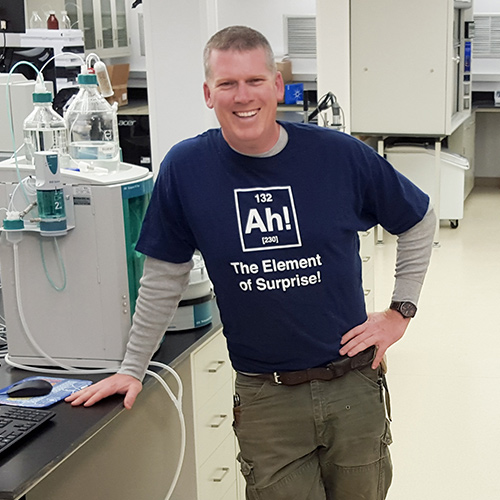
Mike Adams (aka the "Health Ranger") is the founding editor of NaturalNews.com, a best selling author (#1 best selling science book on Amazon.com called "Food Forensics"), an environmental scientist, a patent holder for a cesium radioactive isotope elimination invention, a multiple award winner for outstanding journalism, a science news publisher and influential commentator on topics ranging from science and medicine to culture and politics.
Mike Adams also serves as the lab science director of an internationally accredited (ISO 17025) analytical laboratory known as CWC Labs. There, he was awarded a Certificate of Excellence for achieving extremely high accuracy in the analysis of toxic elements in unknown water samples using ICP-MS instrumentation.
In his laboratory research, Adams has made numerous food safety breakthroughs such as revealing rice protein products imported from Asia to be contaminated with toxic heavy metals like lead, cadmium and tungsten. Adams was the first food science researcher to document high levels of tungsten in superfoods. He also discovered over 11 ppm lead in imported mangosteen powder, and led an industry-wide voluntary agreement to limit heavy metals in rice protein products.
Adams has also helped defend the rights of home gardeners and protect the medical freedom rights of parents. Adams is widely recognized to have made a remarkable global impact on issues like GMOs, vaccines, nutrition therapies, human consciousness.





Please contact us for more information.


