



The company is set to begin trading Thursday, Nov. 19, on the Nasdaq under the ticker ANT, according to its regulatory filing [3][4]. The pricing caps a weeks-long marketing push that coincided with sharp swings in technology shares and questions about the durability of spending on artificial intelligence (AI) infrastructure.
Offering Details and Investor Demand
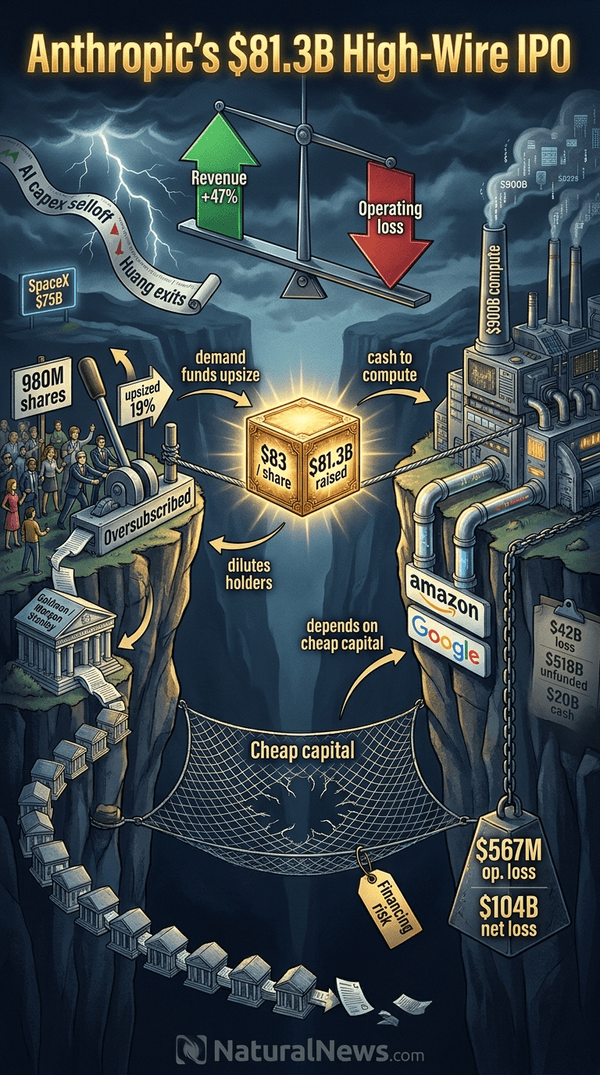
Anthropic increased the number of shares sold by about 19% to 980 million from the 825 million it initially planned, Reuters reported Wednesday [5][6]. Investors requested several times more shares than the company was selling, people familiar with the matter said.
Goldman Sachs and Morgan Stanley are lead underwriters on the offering, part of a 22-bank syndicate, filings showed [7]. Christopher Forbes of CMC Markets said volumes are big and demand comes from all clients, retail to institutional.
The upsized deal followed a marketing effort that included a public fireside chat between CEO Dario Amodei and JPMorgan Chase CEO Jamie Dimon, part of a push for what the company cast as one of the largest initial public offerings (IPOs) on record [8][9].
Market Reaction and AI Sector Context
Shares in Anthropic were up about 20% in over-the-counter gray market trading, according to IG Markets and CMC Markets. Armina Rosenberg of Minotaur Capital said the IPO is a useful gauge of investor appetite for AI, but one listing will not settle the debate. Chipmakers and cloud companies have come under pressure in recent weeks because of valuation concerns, mounting AI infrastructure costs and the exit of Jensen Huang as Nvidia's CEO.
Anthropic's IPO eclipses the record debut of SpaceX in June, which raised $75 billion [10][11]. The listing puts Anthropic among the most valuable U.S. companies and marks the first time an AI-focused firm has tested public markets at that scale, according to the company's filings.
Financials, Risks, and Competition
Revenue rose to $16.96 billion in the third quarter, up 47% from the second, but the company reported an operating loss of $567 million, its amended filing showed [12][13]. Anthropic has committed to nearly $900 billion in computing spending with partners including Amazon and Google [14][15]. The company reported a $104 billion net loss for the nine months ended Sept. 30, according to the filing [13].
Anthropic warned in its filing that if financing for computing capacity becomes unavailable or more costly, contracted capacity may be delayed, repriced, reduced or not delivered.
Peter Singlehurst of Baillie Gifford said the vast amount of value will accrue to whoever is at the frontier, and the firm is betting Anthropic has the ingredients to remain there. The prospectus has drawn scrutiny from investors who pointed to earlier leaks showing a $42 billion net loss, $518 billion in unfunded spending commitments and about $20 billion in cash [16].
Outlook and Implications
A strong debut could give confidence to other companies waiting to tap public markets, with OpenAI expected to pursue a listing as early as next year. Anthropic faces questions over how it will balance commercial ambitions with its emphasis on AI safety; Amodei has called for slowing the pace of developing increasingly powerful models [17][18].
The IPO is seen as one of the clearest tests of whether the economics of AI are holding up, according to Rosenberg. Anthropic's annualized revenue run rate reached $81 billion as of Oct. 31, up $10 billion from Sept. 30, according to its IPO filing.
Critics have warned that the offering is priced for perfection while the company's cash burn remains steep. The Health Ranger Mike Adams has argued that the wave of AI listings is wildly overvalued and that the broader IPO process functions as a mechanism that shifts risk to public investors [19][20].
References
- Anthropic Prices IPO at $83 a Share on Strong Demand. https://www.wsj.com/finance/stocks/anthropic-prices-ipo-at-83-a-share-0290494c
- Anthropic valued at $1.5 trillion as IPO raises record $81 billion. https://www.reuters.com/legal/transactional/anthropic-prices-blockbuster-ipo-83-share-source-says-2026-11-18/
- Anthropic set to begin trading as a $1.5 trillion company in the biggest IPO on record. https://apnews.com/article/anthropic-ipo-nasdaq-ai-b6a74b8949021207dc162fcc876c4649
- Anthropic prices initial public offering. https://www.anthropic.com/news/anthropic-prices-initial-public-offering
- Anthropic IPO Prices At $83, Raises A Record $107 Billion... With Its Own Chip Suppliers Holding Up The Floor. https://www.zerohedge.com/markets/anthropic-prices-83-raises-record-94-billion-its-own-chip-suppliers-holding-floor
- Anthropic Clinches Biggest IPO Ever With $81 Billion Offering. https://www.ntd.com/anthropic-clinches-biggest-ipo-ever-with-81-billion-offering_1186133.html
- Anthropic's S-1 Is Out: A $974 Million Operating Profit, An $800 Billion Compute Bill, And Elon Musk As Landlord. https://www.zerohedge.com/ai/anthropics-s-1-out-974-million-operating-profit-800-billion-compute-bill-and-elon-musk-landlord
- Watch Live: Anthropic's Dario Amodei Joins JPMorgan's Jamie Dimon To Pitch Record IPO. https://www.zerohedge.com/technology/watch-live-anthropics-dario-amodei-joins-jpmorgans-jamie-dimon-pitch-record-ipo
- Is Anthropic About To Delay The Biggest IPO Ever?. https://www.zerohedge.com/ai/anthropic-about-delay-biggest-ipo-ever
- Anthropic’s $83 IPO price puts it on track for a record-breaking debut on Wall Street. Here’s what it means. https://www.cnn.com/2026/11/18/investing/anthropic-ipo-price-stock
- Anthropic prices IPO at $83 per share, overtakes Space's stock market. https://www.firstpost.com/business/anthropic-ipo-record-spacex-ai-stock-market-debut-14061085.html
- Skynet, Spies, And Your Vote Doesn't Count: The 10 Biggest Red Flags In Anthropic's IPO Filing. https://www.zerohedge.com/ai/skynet-spies-and-your-vote-doesnt-count-10-biggest-red-flags-anthropics-ipo-filing
- Anthropic Reports $17B Q3 Revenue, $104B Nine-Month Loss in Amended IPO Filing. https://www.naturalnews.com/2026-11-04-anthropic-reports-q3-revenue-nine-month-loss.html
- Anthropic Posts Nearly $900 Billion in Long-Term Spending Commitments. https://www.ntd.com/anthropic-posts-nearly-900-billion-in-long-term-spending-commitments_1182937.html
- Anthropic Files Updated Its S1: Committed Spend Jumps To $900BN, Only Google Has More. https://www.zerohedge.com/markets/anthropic-files-updated-its-s1-committed-spend-jumps-900bn-only-google-has-more
- Anthropic's IPO Looks Like a Speculative Disaster in the Making: Why I'm Staying Away - NaturalNews.com, September 30, 2026.
- Anthropic CEO Amodei: Poorly Managed AI Could Pose "Risk to Humanity" - NaturalNews.com, September 27, 2026.
- OpenAI, Anthropic Researchers Call for Slower AI Development as Safety Warnings Escalate - NaturalNews.com, September 15, 2026.
- Health Ranger Report - IPO Mania - Mike Adams - BrightVideos.com, June 09, 2026.
- IPOs Are a Bag Holder Scam: Why I'm Buying Gold Instead of Overpriced Tech Stocks - NaturalNews.com, June 09, 2026.
Explainer Infographic








Please contact us for more information.


