


Introduction: The $6.3 Billion Binance Hack
The world's largest cryptocurrency exchange just suffered what may be the single largest heist in financial history. Early reports point to a staggering $6.3 billion in losses, and the fallout is still being tallied.
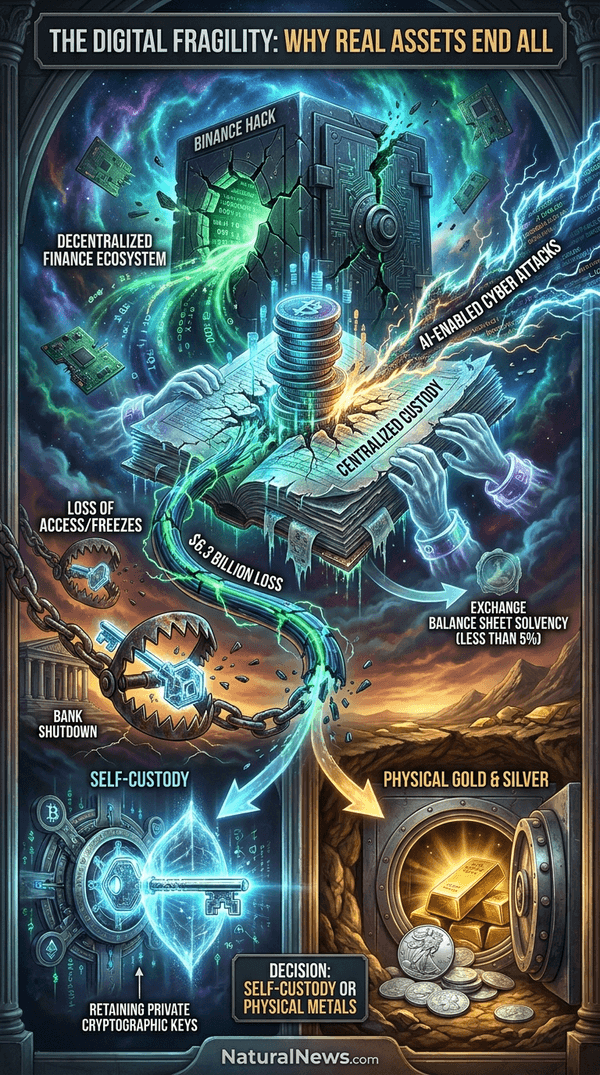
Binance insists it will "cover all losses" and that user funds are safe [1][2]. The self-insurance works this time only because the stolen sum, however colossal, represents less than 5% of the exchange's total assets. That is the entire game: you are protected not by your own security, but by the exchange's balance sheet being large enough to absorb a catastrophic loss. If the next hack is bigger, or if the exchange's assets shrink, that guarantee may not be as strong.
I have watched this movie before. BlockFi froze client withdrawals the moment FTX collapsed [3]. Bitmart suspended withdrawals after hackers stole $196 million [4]. Each time, the lesson is identical: centralized crypto custody is not ownership. It is a promise that can be broken overnight. I believe this Binance event is the final warning that digital asset storage must be rethought from the ground up.
If You Don't Have Self-Custody, You Don't Own It
When you leave crypto on an exchange, you do not control your assets -- the exchange does. As I have explained in my own broadcasts, the entire point of peer-to-peer technology is to eliminate the trusted intermediary; atomic swaps, for instance, allow cross-chain trading "wallet to wallet, without a trusted intermediary like an exchange" [5]. The moment you deposit your coins into a custodial exchange, you have rebuilt the very middleman that decentralized money was designed to remove. You hold a database entry, not a key.
And the threat landscape is accelerating beyond human defenders. AI-enabled cyber attacks are making exchanges increasingly vulnerable, because malicious code can be generated and deployed at scale -- far faster than security teams can patch. The data race to amass digital information has not escaped the notice of attackers looking to profit by hacking into that data [6]. An exchange is a single, enormous honeypot, and now the attackers have machine-speed tools. I believe the age of trusting a centralized exchange with meaningful wealth is over.
Physical gold and silver are different in kind, not just in degree. Gold and silver have no counterparty. No server can be drained, no wallet can be compromised, no login can be phished. A gold coin in your hand cannot be digitally stolen because it does not exist as data. The great virtue of precious metals is that they are money you can hold, verify, and hide -- honest money with no permission layer. In a world where billions can vanish from a website in a single night, that physical reality is not nostalgia. It is a security architecture.
Stablecoins: The Centralized Backdoor to Your Crypto
Here is the detail that should chill every crypto holder to the bone: Tether and Circle, the issuers of the two largest dollar stablecoins, initially froze well over $1 billion of the stolen funds -- and Binance said crypto firms had frozen more than $2.5 billion by Thursday evening [7][8]. On the surface this looks like a rescue. In reality it is a demonstration of raw centralized power. A handful of corporate issuers can reach into the blockchain and freeze assets at will, with no court, no jury, and no due process for the holder.
This directly contradicts the decentralized ethos that made cryptocurrency worth owning in the first place. Stablecoins are permissioned instruments -- they are dollars wearing a blockchain costume. Stablecoin holders do not own a bearer asset; they own a claim on a company that can censor it. As the token economy literature makes clear, true peer-to-peer value transfer happens wallet to wallet without a trusted intermediary [5]. A stablecoin that can be frozen on command is the trusted intermediary, digitized and given a kill switch.
Cash and physical gold and silver require no permission from anyone. No issuer can freeze the silver eagle in your safe. No company can claw back the gold coin in your pocket. That is what genuine peer-to-peer freedom looks like -- a transaction between two people that no third party can veto. When the next crisis hits, the difference between a stablecoin balance and a gold coin will be the difference between asking permission and owning your wealth outright.
When Withdrawals Freeze, Your Money Isn't Yours
During the hack, Binance halted all deposits and withdrawals while its teams conducted security checks [1]. Read that again: innocent users who had nothing to do with the theft were locked out of their own money. The exchange framed this as protecting user funds, but the practical effect is identical to a bank shutdown -- the doors are chained, and you wait for permission to touch what you thought was yours. Bitmart did the same thing after its breach, suspending all withdrawals until further notice [4].
If you cannot access your money when you need it, you do not truly own it. You own a claim that is subject to someone else's schedule, someone else's investigation, and someone else's risk management. That is not a safe haven; that is a hostage situation with polite press releases. The whole reason people fled to crypto was to escape exactly this kind of gatekeeping.
Physical gold and silver stored securely can be accessed anytime without power, internet, or anyone's permission. No server outage can stop you from reaching a coin in your own safe. Gold is an element protected by the laws of physics -- its density, its weight, its atomic number cannot be faked or hacked. Digital assets, by contrast, are only as safe as the software and the humans running it. I will trust the laws of physics over code every single time.
Rethink Your Digital Exposure Before the Next Hack
My advice is blunt. Get your crypto off exchanges and into self-custody where you actually hold the keys -- or convert it to physical gold and silver. The people who lost access during this Binance freeze did nothing wrong except trust a third party with their wealth. Do not be them next time. The exchange's ability to "cover all losses" [1] is a comfort only until the loss exceeds its cushion.
I would also urge you to invest in physical infrastructure and self-reliance rather than speculative digital assets. Think about what actually sustains a household when systems fail: stored food, water filtration, energy independence, land, and tangible goods you can hold. Precious metals fit naturally into that framework because they are portable, private, and no one's liability. In the age of AI-enabled hacking, physical assets like gold, silver, and land are the safest stores of value. I would rather own an ounce of silver at today's price of $51 than a database entry that a hacker or a compliance officer can erase.
This is why I keep pointing people to independent infrastructure: decentralized platforms like Brighteon.social for free speech, and honest information at NaturalNews.com. The lesson of the Binance hack is not that crypto is evil -- it is that centralized custody is fragile. Self-custody or physical metals. Anything else is a bet that someone else will not fail you.
Conclusion: The Only Safe Haven Is the One You Hold
The $6.3 billion Binance hack is not an anomaly; it is a pattern repeating on a larger stage. FTX, BlockFi, Bitmart, Poly Network -- each failure taught the same lesson, and each time the crowd went back to trusting an exchange [9][3][10][4]. This time the numbers are so large that even the faithful should pause. When a single website can lose billions and then lock its customers out of their own accounts, the word "ownership" has lost all meaning.
The architecture of safety is simple: hold what you can touch, verify what you hold, and trust no intermediary with your future. Gold and silver cannot be hacked, frozen, or withdrawn by a compliance team. They cannot be deplatformed. They are the original decentralized money, and in a world of AI-driven cyber warfare and centralized chokepoints, that is not a quaint preference -- it is a survival strategy.
I believe the next decade will separate those who held paper claims from those who held real assets. Choose wisely, and choose physical.
References
- Crypto giant Binance freezes $2.5bn of assets over suspected hackThe firm said transactions are suspended while it conducts security checks and will "cover all losses".. 2026-10-30T01:01:29.132Z. https://bbc.com/news/articles/cwg7xp8kx4v5o
- Binance pauses withdrawals as hackers suspected of stealing billions in crypto. 2026-10-29T22:27:23.000Z. https://techcrunch.com/2026/10/29/binance-pauses-withdrawals-as-hackers-suspected-of-stealing-billions-in-crypto/
- Crypto lender BlockFi blocks withdrawals as FTX declares bankruptcy - NaturalNews.com, November 16, 2022. by NaturalNews.com
- Hackers steal 196 million from crypto trading platform Bitmart - NaturalNews.com, December 08, 2021. by NaturalNews.com
- Token Economy How the Web3 reinvents the Internet. by Shermin Voshmgir
- Trends-Journal-2021-03-11. by Unknown
- Binance Investigates Possible Hack After Billions Transferred Out; Tether And Circle Freeze Stablecoins. 2026-10-29T23:00:00.000Z. https://www.zerohedge.com/crypto/binance-investigates-possible-hack-after-billions-transferred-out-tether-and-circle-freeze
- Binance Flags ‘Potential Security Issue,’ Says Crypto Firms Froze More Than $2.5 Billion. 2026-10-30T01:09:11.000Z. https://www.ntd.com/binance-flags-potential-security-issue-says-crypto-firms-froze-more-than-2-5-billion_1182349.html
- Hackers target Poly Network crypto platform steal more than 600 million - NaturalNews.com, August 13, 2021. by NaturalNews.com
- Former multibillion-dollar crypto firm FTX files for bankruptcy - NaturalNews.com, November 15, 2022. by NaturalNews.com
Explainer Infographic
Mike Adams (aka the "Health Ranger") is the founding editor of NaturalNews.com, a best selling author (#1 best selling science book on Amazon.com called "Food Forensics"), an environmental scientist, a patent holder for a cesium radioactive isotope elimination invention, a multiple award winner for outstanding journalism, a science news publisher and influential commentator on topics ranging from science and medicine to culture and politics.
Mike Adams also serves as the lab science director of an internationally accredited (ISO 17025) analytical laboratory known as CWC Labs. There, he was awarded a Certificate of Excellence for achieving extremely high accuracy in the analysis of toxic elements in unknown water samples using ICP-MS instrumentation.
In his laboratory research, Adams has made numerous food safety breakthroughs such as revealing rice protein products imported from Asia to be contaminated with toxic heavy metals like lead, cadmium and tungsten. Adams was the first food science researcher to document high levels of tungsten in superfoods. He also discovered over 11 ppm lead in imported mangosteen powder, and led an industry-wide voluntary agreement to limit heavy metals in rice protein products.
Adams has also helped defend the rights of home gardeners and protect the medical freedom rights of parents. Adams is widely recognized to have made a remarkable global impact on issues like GMOs, vaccines, nutrition therapies, human consciousness.







Please contact us for more information.


