



Section 63D requires platforms to take reasonable steps to prevent age-restricted users from having accounts [1] [2].
Meta and eSafety offered no immediate comment. Snap, TikTok and Google did not reply to Bloomberg [1] [2].
Penalties and Investigative Powers
The maximum penalty for breaching Section 63D began at A$49.5 million and was doubled six months after the ban took effect to A$109.2 million, or about US$76 million [1] [2]. Courts could order fines of up to 49.5 million Australian dollars ($33 million) for systemic failures to comply, according to earlier reporting [3].
As of September 12, 2026, the eSafety Commissioner can demand information and documents from any person believed to hold them and can summon individuals to appear and be examined on oath or affirmation [1] [2]. Refusal to answer carries a penalty of imprisonment for 12 months [1] [2]. The powers extend to current and former employees of companies under investigation [1] [2].
Wells said at the National Press Club on October 15 that the law is not failing; platforms are failing to comply with the law. She added that the government will not flinch at holding tech companies to account [1] [2].
The law bars platforms from requiring government ID or Digital ID unless they offer alternative means that are reasonable in the circumstances [1] [2]. Australian authorities said in September 2025 that social media platforms should not demand age verification for all account holders starting from the outset [4].
Compliance Data and Investigation Timeline
When eSafety launched the investigation in March 2026, it said five investigations were underway and 23 notices had been issued to 10 platforms, with a planned enforcement decision by the middle of 2026 [1] [2]. The regulator said enforcement would require evidence that was more than simply showing that a platform still has some children aged under 16, and that what counts as reasonable is ultimately a question for the courts [1] [2].
Meta said it removed access to more than 750,000 Facebook and Instagram accounts in Australia [1] [2]. In January 2026, reports said Meta had deleted nearly 550,000 accounts within weeks, including approximately 330,000 Instagram profiles, 173,000 Facebook accounts, and 40,000 Threads accounts [5]. Australia was described as the first country to enforce a sweeping ban on social media access for children under 16, resulting in the shutdown of nearly five million accounts in the first weeks [6].
A parent survey cited in the report found around 7 in 10 reported their child still had an account on Facebook, Instagram, Snapchat and TikTok [1] [2]. A University of Chicago working paper cited in the report found about 73% of 14- and 15-year-olds covered by the ban were still using the banned platforms [1] [2]. A study published in the British Medical Journal cited in the report described the ban as having limited implementation, incomplete compliance and substantial circumvention [1] [2]. A separate Reuters report said platforms sought no age proof for any of the 50 tests [7].
Reddit and the Digital Freedom Project went to the High Court to challenge the law, saying it imposes intrusive and potentially insecure verification processes on adults as well as minors.
References
- Australia Set to Sue Facebook, TikTok in Child-Safety Push. https://www.bloomberg.com/news/articles/2026-10-20/australia-to-sue-facebook-tiktok-for-alleged-breaches-of-ban
- Australia’s Social Media Age Verification Law Demands Aren't Working, So It’s Going to Court. https://reclaimthenet.org/australia-social-media-age-ban-court-case
- Meta, Snapchat, TikTok and YouTube aren’t fully complying with child account ban, Australia says. https://apnews.com/article/australia-social-media-ban-children-58c50c845d96057b39529e988bd778bc
- Australia warns social media platforms against age verification for all ahead of a ban on children. https://apnews.com/article/australia-chldren-banned-social-media-2bbc1f2921af4f008215c16d5e8b3506
- Digital purge: Meta deletes 550000 accounts as Australia's social media ID law reshapes the internet - NaturalNews.com, January 15, 2026.
- Australia blocks 5 million underage social media accounts in landmark crackdown - NaturalNews.com, January 17, 2026.
- Australia's teen social media ban fails to clear first hurdle in age checks, says study. https://www.reuters.com/world/australias-teen-social-media-ban-fails-clear-first-hurdle-age-checks-says-study-2026-07-07/
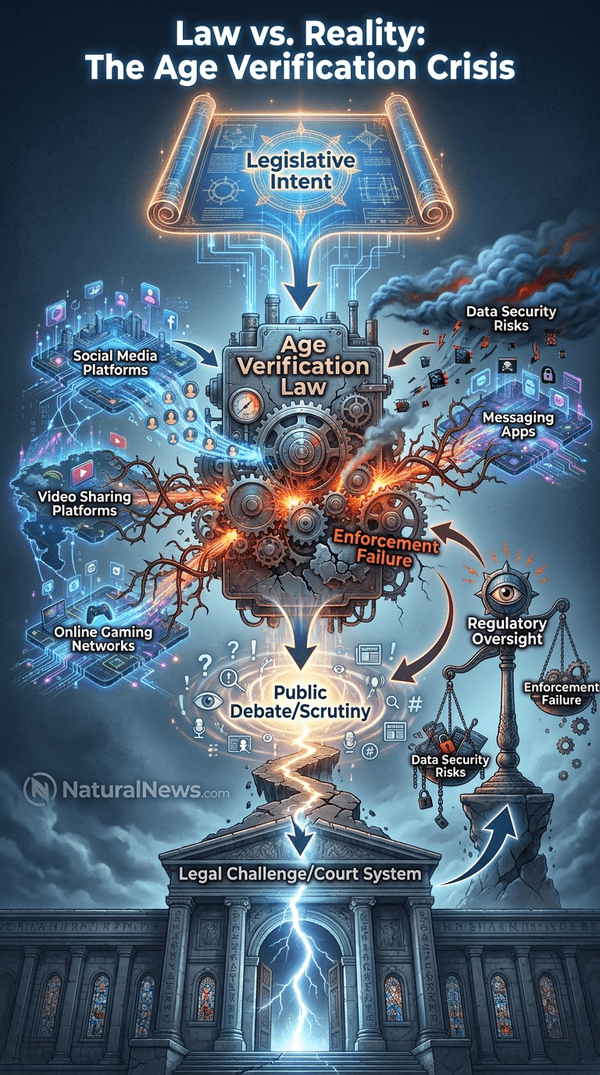
Explainer Infographic












Please contact us for more information.


