
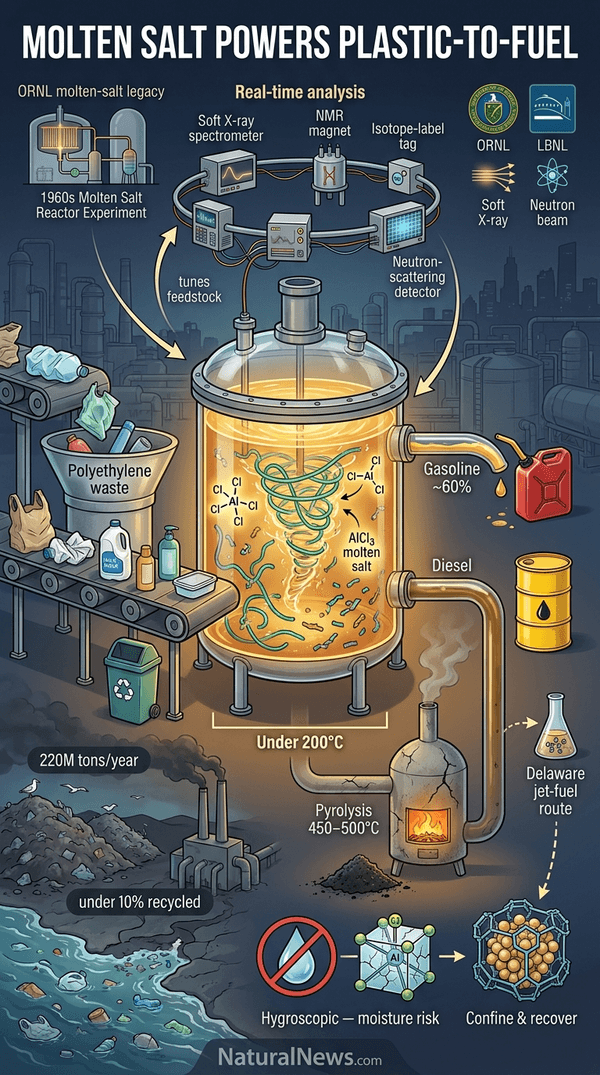
The process combines polyethylene with molten salts containing aluminum chloride, which act as both the reaction medium and the catalyst that drives the chemical conversion, the lab said. The research was conducted at ORNL and employed user facilities at both ORNL and Lawrence Berkeley National Laboratory, according to the report.
The results arrive amid growing global interest in diverting plastic waste from landfills and waterways. Earth Action estimates countries worldwide are on pace to generate 220 million tons of total plastic waste this year, with more than a third ending up in nature, according to a report released April 11 [1]. Less than 10% of plastic waste from recent decades has been recycled, while the rest has been incinerated or buried, according to a report in The Defender [2].
Process Uses Molten Salts as Catalyst and Reaction Medium
According to ORNL, charged aluminum atoms bind with three other atoms to create highly acidic catalytic sites that attack long molecular chains that make up polyethylene and split them into smaller hydrocarbon molecules. The researchers tracked the reactions using soft X-ray spectroscopy and nuclear magnetic resonance, the lab said.
The method does not require noble-metal catalysts, organic solvents, external hydrogen, or a chemical initiator, researchers said. Zhenzhen Yang, an ORNL staff scientist and co-corresponding author of the paper, said in a statement that the process operates at a temperature below 200 degrees Celsius, compared with 450 to 500 degrees Celsius for traditional pyrolysis methods.
"Unlike traditional techniques for converting polymer to fuel, the new process did not require noble-metal catalysts, organic solvents or external hydrogen," Yang said. "This is the first time molten salts were used as media to produce high-value-added chemicals from waste without any catalytic initiator or solvent and at a temperature below 200 degrees Celsius."
Earlier approaches have relied on pyrolysis, a process that uses intense heat to break large polymer molecules into smaller hydrocarbons. Research published in Renewable and Sustainable Energy Reviews documents that such thermochemical conversion methods generate oil, gas, and char fractions and require substantial heat input [3].
Experiments Yield About 60% Gasoline Under Mild Conditions
The experiments achieved a gasoline yield of about 60% under relatively mild reaction conditions, according to the study. Additional experiments using isotopic labeling and neutron scattering showed how the structure of the starting polymer influenced the resulting fuel, the lab said.
Researchers said simpler polymer chains tended to produce gasoline-like compounds, while more complex chains generated diesel-like fuels. Liqi Qiu, a postdoctoral researcher at the University of Tennessee, Knoxville, who performed most of the experiments in the ORNL laboratory of Sheng Dai, said the team developed an efficient and selective polyethylene-to-gasoline conversion.
"Polymer source material is abundantly available from consumer waste, and our catalyst system, aluminum molten salts, is very cheap," Qiu said. "This advance may be promising for industry."
The work forms part of a broader field of research into plastic conversion. A separate research team at the University of Delaware reported a method to break down polyolefins into smaller carbon molecules for jet fuel and diesel using a novel catalyst [4]. NaturalNews.com reported in 2020 that a group of researchers developed a method for upcycling low-level plastics into motor oils, lubricants, detergents, and cosmetics [5].
Researchers Cite Potential Energy Security, Industrial Competitiveness
If the method can eventually be scaled beyond laboratory experiments, researchers say it could contribute to U.S. energy security and strengthen industrial competitiveness, according to the lab. The researchers stated the work could expand the range of methods available for producing transportation and industrial fuels from waste materials.
Tomonori Saito, who managed the project and contributed expertise in polymer science, said the team is trying to understand fundamental science that will lead to discoveries and new economic opportunities.
"In this case we tackled polyethylene, a widely available commodity polymer, using molten salt," Saito said. "We're trying to understand fundamental science that will lead to discoveries and new economic opportunities."
ORNL has studied molten salts for decades. During the 1960s, its Molten Salt Reactor Experiment demonstrated that mixtures of molten salts could function as both nuclear fuel and reactor coolant, the lab stated. Dai proposed using molten salts for a different purpose: converting discarded polymers into useful fuels.
Hygroscopic Salts Present Scale-Up Challenge
The aluminum-based catalytic system is hygroscopic, meaning it readily absorbs water, which can reduce its stability, according to the researchers. The lab said the material is inexpensive and chemically active but carries an important limitation tied to moisture absorption.
The team now wants to investigate ways to confine the molten salts, potentially using halogens or carbon-based materials, which could make the salts easier to separate and process while improving their stability, the researchers said.
Sheng Dai, an ORNL Corporate Fellow and section head for separations and polymer chemistry, who is a co-corresponding author of the paper, said the system solves two fundamental issues for a stable system.
"The ORNL system solves two fundamental issues," Dai said. "One, for a stable system, the process can be radically easier to scale up. Two, the previous system needed an initiator to kick off catalytic reactions. However, the ORNL system does not need one."
Further Research Needed Before Commercial Scale
The work was supported primarily by the DOE Office of Science Materials Sciences and Engineering Division, with additional support for gas chromatography-mass spectrometry work from the Chemical Sciences, Geosciences and Biosciences Division, according to the report. The research employed user facilities at ORNL and Lawrence Berkeley National Laboratory.
Researchers said the process remains at laboratory scale and requires additional study on salt stability and confinement before potential industrial application. No timeline for commercialization was provided in the study or statements from the lab.
References
- Jake Johnson. "World on Track to Dump 220 Million Tons of Plastic Waste This Year". The Defender. April 11.
- Lisa Song. "UN Plastics Pollution Report: How Much Sway Did Industry Lobbyists Have?". The Defender.
- Samsudin Anis. "Tar reduction in biomass producer gas via mechanical, catalytic and thermal methods: A review". Renewable and Sustainable Energy Reviews 15 (2011).
- NaturalNews.com. "Scientists turn single-use plastics into jet fuel". NaturalNews.com. May 02, 2021.
- NaturalNews.com. "Scientists present a catalytic solution that could be the answer to global plastic pollution". NaturalNews.com. December 03, 2020.
Explainer Infographic









Please contact us for more information.