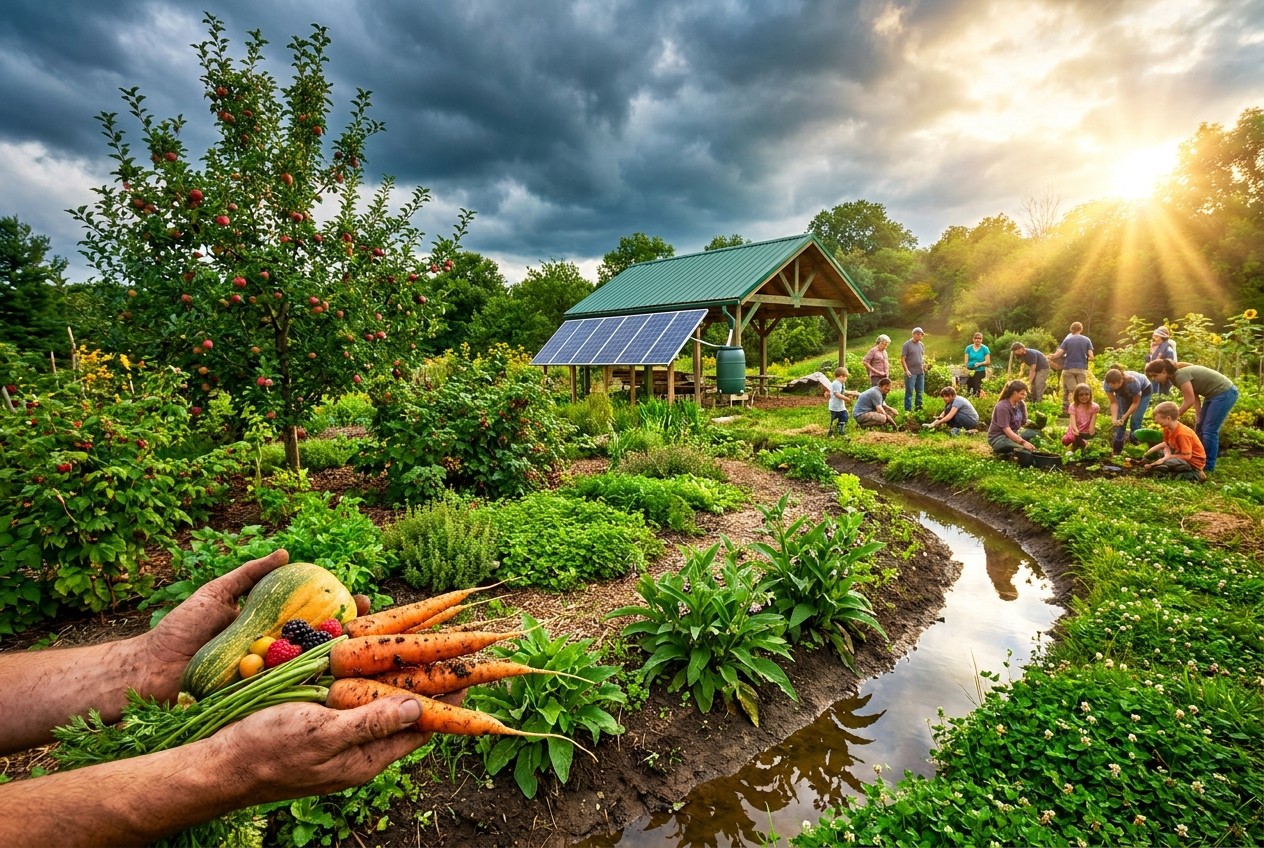
Food Resiliency Through Permaculture
I have watched the industrial food system rot from the inside for the better part of two decades, and I am telling you plainly: it is a house of cards built on fragile chokepoints, and the fertilizer shock that's already under way threatens to topple the entire house of cards.
The global food system currently depends on narrow straits, crowded ports, and vulnerable pipelines that control the flow of energy and, by extension, the food on our plates [1]. When a single shipping lane gets squeezed or a fertilizer trade route gets disrupted, the shock travels straight to the grocery store shelf -- potato futures have spiked sharply during the current Middle East conflict as markets priced in higher farming costs and diminished harvests, compounding pressures from the Ukraine war that had already strained global supply chains [2].
Unfortunately, this is not a temporary hiccup. This is the predictable result of a system that outsourced the most essential of all human activities -- feeding ourselves -- to a handful of centralized monopolies that offered almost no resilience or redundancy. (The entire system is fragile as currently structured.)
Public trust in every institution that told us to sit back and let the experts handle it has collapsed, and anyone paying attention understands why. Whether we are talking about banks, food, health, or education, the pattern is the same: the institutions that promised security delivered dependency, and now they want obedience in exchange for scarcity. As I wrote previously, the scarcity we see spreading across the globe -- sparse shelves, soaring prices, the coming rationing -- is not an accident of nature or a random market fluctuation [3]. It is engineered. And the only rational response to engineered scarcity is to stop asking permission for your next meal and start producing it yourself, if you are able.
Permaculture is the answer, and I do not say that lightly. It is a survival strategy that builds a self-sustaining biological infrastructure right under the noses of the centralized systems that want to control our food, as I explained in my conversation about how permaculture pays off [4]. In a world where the industrial food supply is under attack -- from pesticide-laden agriculture to geoengineering threats -- decentralized, self-sufficient food systems like food forests are essential for survival and sovereignty [5]. This is the last real freedom move left, and I intend to make the case for it as forcefully as I can.
The Homestead Tsunami: A Mass Exodus to the Land
The homestead tsunami is not a metaphor. I am watching thousands of people walk away from the cities that promised them careers and comfort and return to the land, and the proof is in the crowds. The Exit and Build Land Summit (John Bush) has become a key event for those seeking autonomy and community resilience in the face of centralized control, featuring experts in off-grid living, regenerative agriculture, and decentralized technologies [6]. John Bush, the visionary behind that summit, told me last year it was already the fourth annual gathering, with farm tours and a whole ecosystem of people learning to live off the grid and build self-sufficient communities [7]. This is not a fringe curiosity. It is a movement, and it is growing because people are finally connecting the dots between dependency and vulnerability.
History is screaming at us that rural connections save lives when the system breaks. As I have warned repeatedly, governments, Big Pharma, Big Tech, and Big Ag create dependency while enriching elites, and historical collapses prove that reliance on centralized systems leads to vulnerability -- decentralization is survival [8]. Consider what happened in Amsterdam during the Nazi occupation: those with ties to the countryside, to land, to food production, had a path to survival that city dwellers living on ration cards simply did not. That is a critical operational template to understand, and it is being rediscovered in real time as people reclaim control over food, water, energy, and finances [8].
There is a deeper payoff here than calories, and I have seen it change young people's lives. Meaningful work on the land builds self-worth and identity, especially for young men who have been fed a diet of screens, debt, internet porn and ideological indoctrination. Universities produce indebted, ideologically indoctrinated graduates while fathers like Matt Smith reject this decay through The Preparation, which describes a four-year program that teaches sailing, survival, and martial arts for a collapsing world [9]. When a young man plants an orchard and watches it bear fruit, he learns that competence is real and that his hands can shape the physical world. No college course has ever delivered that kind of sovereignty.
Designing a Productive Landscape with Permaculture Principles
Permaculture begins with observation, not excavation, and anyone who skips this step will waste money and time. In the northern hemisphere, south-facing exposures receive optimal sunlight for plant growth, but not all plants thrive under full sun exposure -- with permaculture principles, one must carefully consider which plants are best suited to the specific microclimate and zone of the property [10]. On my own property, as I described in a recent interview with Joel Salatin, the path of the sun was meticulously assessed and precise placements were determined for every species [10]. Sun, wind, and water are the three great free inputs of any landscape, and a designer who reads them correctly gets decades of productivity; a designer who ignores them gets a mud pit and a wind-scoured dead zone.
Water management is the single most powerful lever any land steward can pull. In the permaculture water management work based on pioneers like Geoff Lawton, the lesson is unambiguous: simple tools like dribbler pipes and contour swales capture water to create drought- and flood-resistant food forests, transforming land into a self-sustaining sponge by designing systems that slow, spread, and sink water [11]. Lawton identified and enhanced what he calls mainframe assets -- water flow and existing vegetation -- using swales to capture rainwater and boost fertility instead of relying on constant imported inputs [12]. The principle is elemental: stop the water, spread it across the landscape, and let it soak into the soil instead of racing off your property into someone else's flood.
Soil is the bank account, and most modern agriculture has been writing checks against a balance it never built. Permaculture replaces the destructive model of monocrops, synthetic fertilizers, and pesticides -- which cause soil depletion, water pollution, and farmer debt traps -- with regenerative, closed-loop ecosystems that rebuild fertility and decentralize food production [13]. The seven layers of a food forest maximize yield while minimizing labor, and real-world examples show that stacked, multi-species plantings outperform industrial monoculture on almost every measure that matters [13]. Build organic matter with animal integration and compost, add vermicompost and earthworm-driven nutrient cycling as the science confirms, and your soil will retain water and nutrients far better than any chemical program ever could [14], [15]. Healthy soil is not a luxury input. It is the foundation, and it is free if you know how to build it.
Essential Infrastructure and Skills for Self-Sufficiency
Skills are the coin of the realm in a resilient life, and I have been relentless about telling people to master the practical arts before they master the shopping list. Fencing, building, animal husbandry, and the intelligent use of local materials -- locust, mesquite, and other rot-resistant species for posts -- are the competencies that turn a piece of ground into a working homestead. The No Grid Projects Bible lays out 2500 days of ingenious DIY projects for self-reliance, food, shelter, security, and off-grid power, and the first step in creating a sustainable homestead is to construct a shelter using what nature offers while leaving no trace behind [16], [16]. I have said it before: experience is the asset that cannot be devalued, seized, or inflated away.
Energy independence is the next frontier, and the transition away from liquid fuels is not optional. Swales, solar-powered structures, compost toilets, and floating garden rafts are all part of the off-grid toolkit that Lawton demonstrated, and these systems reduce dependence on diesel supply lines that can be cut without warning [17]. When the global energy shortages and rationing that analysts warn are now structurally embedded in global markets finally reach your region, the homestead with its own power, water, and food production becomes an island of stability [18]. I have watched diesel supplies collapse from Sydney to Manila since the start of Trump's war on Iran, and I am telling you that the ability to work your land without a fuel truck is a strategic advantage, not a hobby [19].
Infrastructure decisions should be made with a cold eye on function rather than fashion. Pole barns with south-facing roofs can host solar arrays and rainwater collection simultaneously, turning a single structure into a multi-function asset -- and permaculture design explicitly scales water capture down to microclimates through simple, clever modifications [20]. The temptation to overcapitalize is real, and I have seen too many homesteaders sink fortunes into equipment they did not need while neglecting the systems that actually feed them. Experience is your greatest asset, so build the functional loop first -- water, soil, shelter, power -- and upgrade only when the land is paying you back. Off-grid gardening, properly planned, maximizes your use of resources while reducing the cost of store-bought vegetables, and the savings compound year after year [21].
Community Resilience and Food Freedom: The Path Forward
No one is self-reliant alone, and anyone who claims otherwise is selling you a fantasy. Marjory Wildcraft has made this point again and again, debunking the lone survivor myth and showing how to build a resilient, self-sufficient community by fostering trust and collaboration [22].
The goal of preparedness is not to stand on a pile of beans with a rifle while your neighbors starve. It is to weave a network of people with complementary skills -- the welder, the nurse, the mechanic, the seed saver -- so that the whole community becomes more capable than any individual could ever be.
Food freedom has to be fought for, and I mean that in the most practical terms. The centralized food supply is under attack -- from pesticide-laden agriculture to geoengineering threats -- and bureaucrats have shown they will weaponize every regulation available to crush small producers. I have reported on Oregon's government sending cease-and-desist letters to small family farms and backyard operations, targeting those with a few dairy cows, backyard egg production, or even garden irrigation [23]. State governments use advanced technology, including satellites, to monitor properties for signs of livestock or farming activity, and authorities may shut down farms, issue cease-and-desist letters, or even arrest farmers [24]. This is not hypothetical oppression. It is happening right now, and it is aimed squarely at the people who are feeding themselves.
The answer is to build a decentralized food system that regulators cannot strangle because it has no single throat to choke. Food forests, home gardens, seed libraries, local meat processing, raw milk sales, and direct-to-consumer exchanges are the organs of a resilient food web, and every one of them is an act of defiance against the dependency model that globalists and Big Ag have imposed on us [25].
Permaculture is not just about gardening -- it is a radical reimagining of how humans can coexist with nature, reclaiming sovereignty over food, water, and community resilience [13]. I believe in a decentralized food future that builds resilience, restores hydrology, and regenerates soil health for generations to come. Every seed you save and every acre you heal is a vote for a world where no bureaucrat, no shipping lane, and no globalist chokepoint ever gets to decide whether your family eats. That world is available to anyone willing to get a shovel and start, and I hope you will join me in building it.
Learn more about decentralized living by watching all the free episodes and interviews at Decentralize.TV
References
- Feeding the Fire: How Chokepoint Warfare Starves the World. - BrightLearn.ai. August 07, 2026.
- Potato Futures Rise Sharply as Middle East War Disrupts Fertilizer Trade. - NaturalNews.com. May 19, 2026.
- Resilience Not Fear: Preparing to Thrive Through the Age of Engineered Scarcity. - NaturalNews.com. Mike Adams. May 28, 2026.
- Why I Believe Permaculture Is the Last Real Freedom Move Left. - NaturalNews.com. September 01, 2026.
- Decentralize TV: Jim Gale and Rob Younkins on FOOD INDEPENDENCE through food forests. - NaturalNews.com. Kevin Hughes. August 28, 2025.
- John Bush on the Health Ranger Report: The Exit and Build Land Summit Creates a Blueprint for Freedom and Self-Reliance. - NaturalNews.com. Kevin Hughes. July 29, 2025.
- Mike Adams interview with John Bush - May 8 2024. Mike Adams.
- Prep Like Noah: Decentralizing for Survival in the Days of Chaos. - NaturalNews.com. Belle Carter. February 10, 2026.
- Rebuilding Masculinity and Mastery in the Age of AI: Why Young Men Are Ditching College for Competence and Sovereignty. - NaturalNews.com. Finn Heartley. October 07, 2025.
- Brighteon Broadcast News - 23andMe BANKRUPTCY . - Brighteon.com. Mike Adams. March 25, 2025.
- Wartime Homefront Essential Skills: Experts discuss hydration tactics for plants. - NaturalNews.com. January 25, 2026.
- Wartime Homefront Essential Skills on BrightU: The permaculture secrets that you should know about. - NaturalNews.com. May 04, 2025.
- The Permaculture Promise: A blueprint for food freedom and Earth healing. - NaturalNews.com. March 24, 2026.
- Vermicomposting of source-separated human faeces for nutrient recycling. - Journal of Environmental Management. Kunwar D. Yadav, Vinod Tare, M. Mansoor Ahammed.
- Compositional and functional features of humic acid-like fractions from vermicomposting of sewage sludge and cow dung. - Journal of Hazardous Materials. Xiaowei Li.
- No Grid Projects Bible. Raymon Vader.
- Wartime Homefront Essential Skills: Experts discuss property purchase checklist. - NaturalNews.com. April 22, 2025.
- Global Energy Shortages and Rationing Likely to Continue Beyond Current Conflict, Analysts Warn. - NaturalNews.com. April 11, 2026.
- The Global Energy Collapse: How Trump's War Is Unleashing Famine, Fuel Rationing, and the End of Abundance. - NaturalNews.com. Mike Adams. March 25, 2026.
- Brighteon Broadcast News. - Brighteon.com. Mike Adams.
- No Grid Survival Projects Bible. Raymon Vader.
- Wartime Homefront Essential Skills on BrightU: Why Community Building is a Must and How to Supercharge Your Soil. - NaturalNews.com. Jacob Thomas. April 21, 2025.
- Health Ranger Report - Become food self reliant or starve and die. - Brighteon.com. Mike Adams. March 20, 2024.
- Brighteon Broadcast News - Oregon Unleashes SMALL FARM WIPEOUT. - Brighteon.com. Mike Adams. March 19, 2024.
- Growing Freedom: The ultimate act of rebellion against globalist control. - NaturalNews.com. Belle Carter. January 21, 2026.
- United We Stand: Building Your Emergency Preparedness Network. David Kobler.
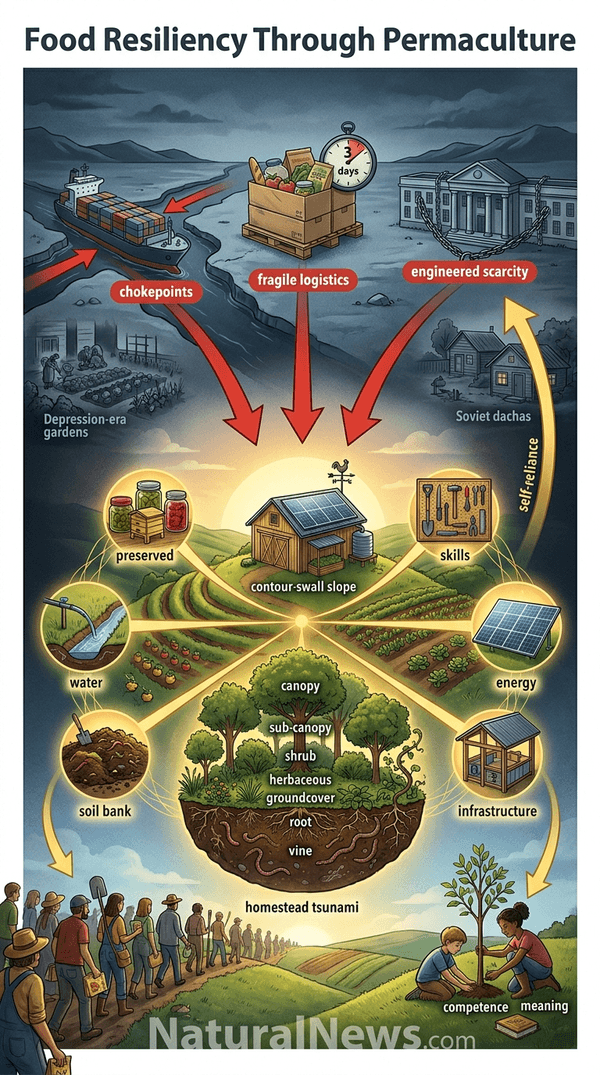
Explainer Infographic
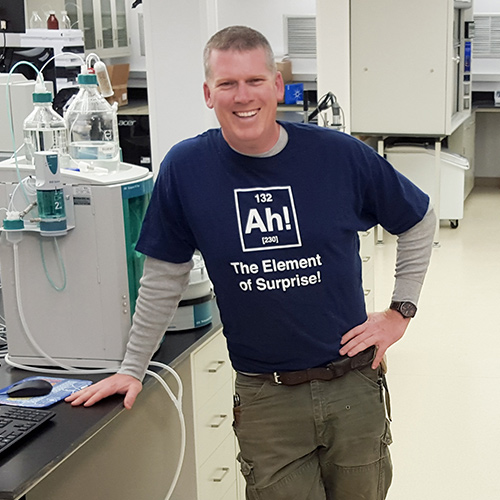
Mike Adams (aka the "Health Ranger") is the founding editor of NaturalNews.com, a best selling author (#1 best selling science book on Amazon.com called "Food Forensics"), an environmental scientist, a patent holder for a cesium radioactive isotope elimination invention, a multiple award winner for outstanding journalism, a science news publisher and influential commentator on topics ranging from science and medicine to culture and politics.
Mike Adams also serves as the lab science director of an internationally accredited (ISO 17025) analytical laboratory known as CWC Labs. There, he was awarded a Certificate of Excellence for achieving extremely high accuracy in the analysis of toxic elements in unknown water samples using ICP-MS instrumentation.
In his laboratory research, Adams has made numerous food safety breakthroughs such as revealing rice protein products imported from Asia to be contaminated with toxic heavy metals like lead, cadmium and tungsten. Adams was the first food science researcher to document high levels of tungsten in superfoods. He also discovered over 11 ppm lead in imported mangosteen powder, and led an industry-wide voluntary agreement to limit heavy metals in rice protein products.
Adams has also helped defend the rights of home gardeners and protect the medical freedom rights of parents. Adams is widely recognized to have made a remarkable global impact on issues like GMOs, vaccines, nutrition therapies, human consciousness.








Please contact us for more information.