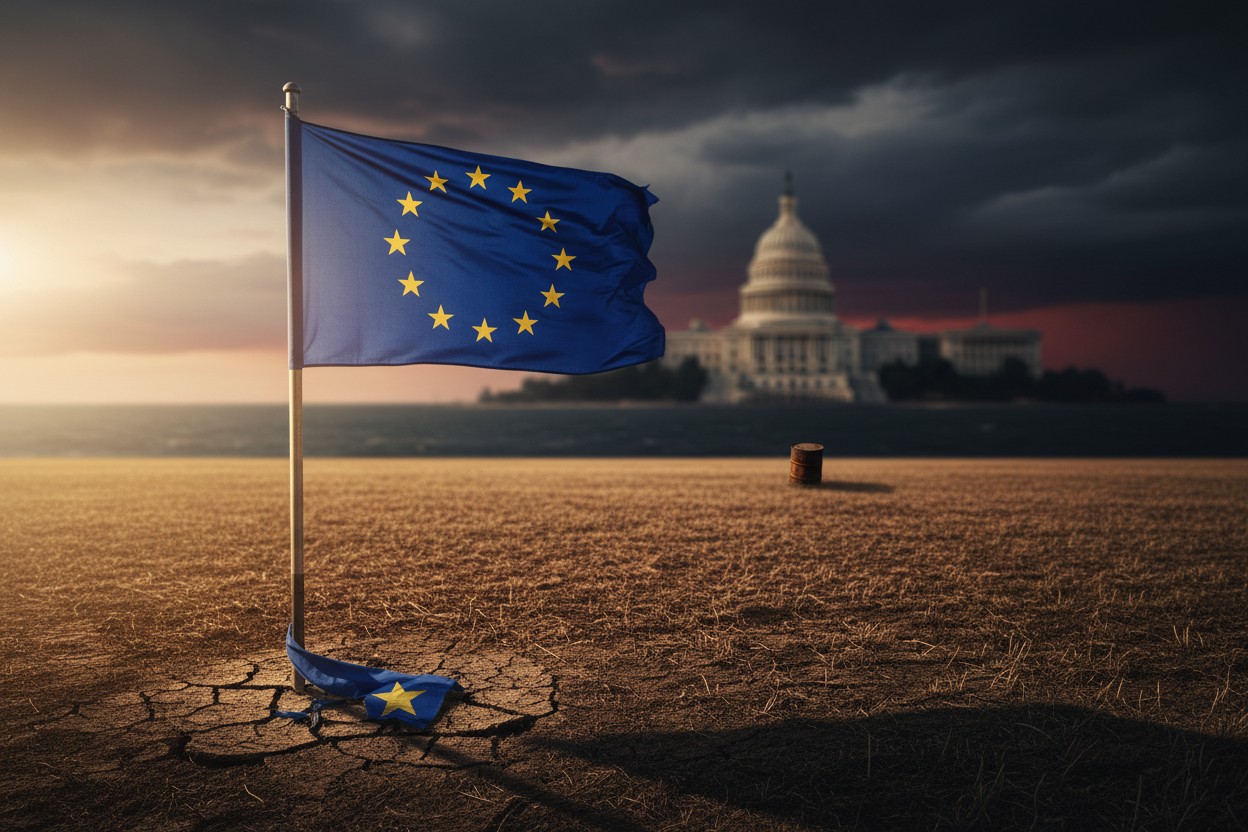
The European continent, once the pride of industrialized civilization, now faces a convergence of crises that threaten to return it to the periphery of global affairs. With European citizens bracing for a winter of potential deprivation, and as climate change actions crumble into resource scarcity, the US-EU partnership is continually deteriorating into what analysts describe as managed confrontation. Is Europe's postwar renaissance ending, replaced by an era of mass surveillance, loss of free speech, scarce resources, and a pithering military alliance?
Key points:
- The US-EU relationship has devolved from strategic alliance to transactional bargaining.
- Europe faces potential economic collapse amid sanctions-related energy shortages and migrant pressures.
- Russia's military advantages in air defense and strategic positioning expose NATO vulnerabilities.
- Digital surveillance and financialization threaten individual freedoms across the continent.
- The Global South watches as Western fragmentation accelerates selective globalization and the rise of new economic and military alliances.
The brittle economics of a frozen continent
Europe's economic predicament reveals a fundamental disconnect between financial abstraction and physical reality. The continent's leaders appear trapped in the illusion of virtual assets, where digital wealth and lofty ideas substitutes for actual resources. European nations print currency, adding digits on a screen, while facing shortages of heat, electricity, and food supplies. The welfare state, built on high taxes from employed industrial workers, now faces a revenue crisis as unemployment rises and energy costs devastate household budgets.
The migrant situation compounds these pressures. Large populations from Africa and the Middle East, unaccustomed to cold climates and extended darkness, face the prospect of harsh winters without adequate support systems. Social tensions mount as competition for scarce resources intensifies. These newcomers, who arrived expecting prosperity, instead encounter empty supermarket shelves and rationed energy, creating conditions conducive to social unrest.
The security paradox and transatlantic drift
Russia's military positioning reveals a strategic depth that Western analysts have underestimated. Despite NATO's assumption of conventional superiority, Moscow has deployed layered air defense systems that would render any no-fly zone catastrophic for alliance aircraft. The S-400 systems protect Russian forces with capabilities far exceeding American equivalents, while the S-500 represents a generation gap that Western powers cannot bridge.
The Minsk agreements of 2015 exemplify the trust deficit now poisoning diplomatic channels. Western nations signed accords they never intended to implement, a deception that has eliminated any possibility of meaningful negotiation. Russia's skepticism toward Western peace overtures stems from direct experience: nearly seven years of Western inaction on Minsk commitments demonstrated that agreements exist to be broken when convenient.
When the EU doesn't get their way with Russia, they believed that cutting Russia off with sanctions would humiliate the nation. The opposite effect has occured, as Europe desperately needs Russian gas now.
Meanwhile, the economic relationship between the United States and Europe transforms into something resembling managed confrontation. The 2025 framework agreement, with its tariff ceilings and safeguard mechanisms, embodies the transactional nature of contemporary alliance politics. Washington demands European regulatory surrender on sustainability standards while offering market access in exchange, a bargain that Brussels increasingly rejects as an infringement on regulatory sovereignty.
Europe's response, characterized by one veteran diplomat as planning for a world where "the US is seeking to undermine everything we hold dear," reflects growing recognition that American reliability has diminished. The proposal for an independent European nuclear shield, advanced by German political figures, acknowledges that the transatlantic security guarantee can no longer be assumed.
When do European nations become soverign nations again?
The trajectory leads toward a Europe that is simultaneously accommodating and resisting American pressure, seeking market stability while preserving regulatory autonomy. This sado-masochistic tango produces aggregate trade resilience masking adversarial relations beneath the surface. For emerging economies watching from the Global South, the lesson is clear: selective globalization means open markets where Western interests align, restrictions where they do not.
Europe's decision makers face an impossible choice: continue depending on the US or pursue strategic autonomy with insufficient resources. Either path leads through greater insecurity and costly decoupling. The continent's leaders continue to make catastrophic decisions with stubborn persistence, refusing to acknowledge errors even as consequences multiply. History's judgment will be harsh on those who transformed a prosperous region into a regurgitated backwater, victimized by their own incompetence and unwillingness to lead as sovereign nations, to revere their distinct cultural identities, and be held accountable to the people they serve.
Sources include:






Please contact us for more information.