


Diesel at $102 Over Crude: The Economy's Canary Is Dead, and Inflation Will Follow
The most important number in the American economy right now is not the stock market, the jobs report, or even the price of crude oil. It is the diesel crack spread -- now $102 over crude. That figure is so far outside historical norms that it does not represent a market correction. It represents a structural collapse in fuel supply.
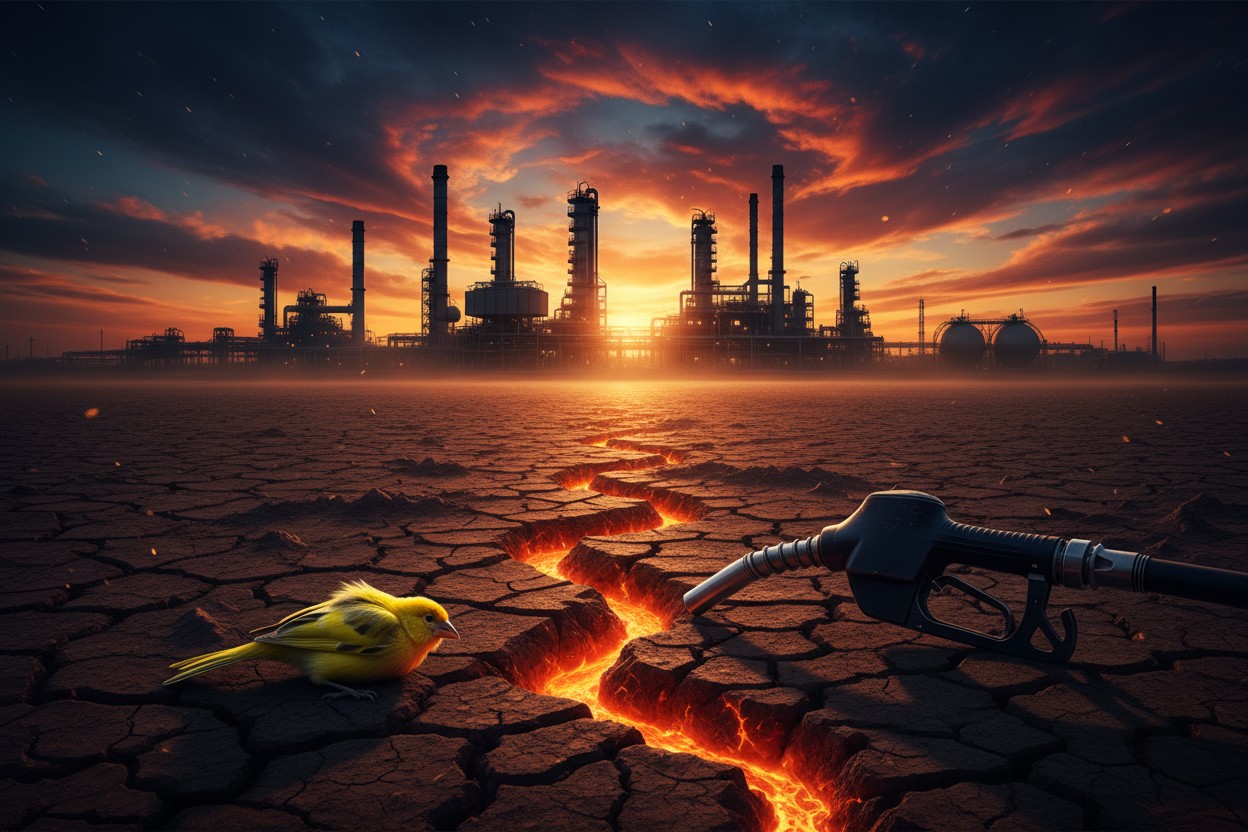
The economy runs on diesel, you see, not oil. Crude is just a raw material. But diesel is what moves food, medicine, construction materials, and every physical good in this country. When diesel breaks, everything breaks. And the crack spread -- the canary in this economic coal mine -- just died.
The Diesel Crack Spread Is Screaming
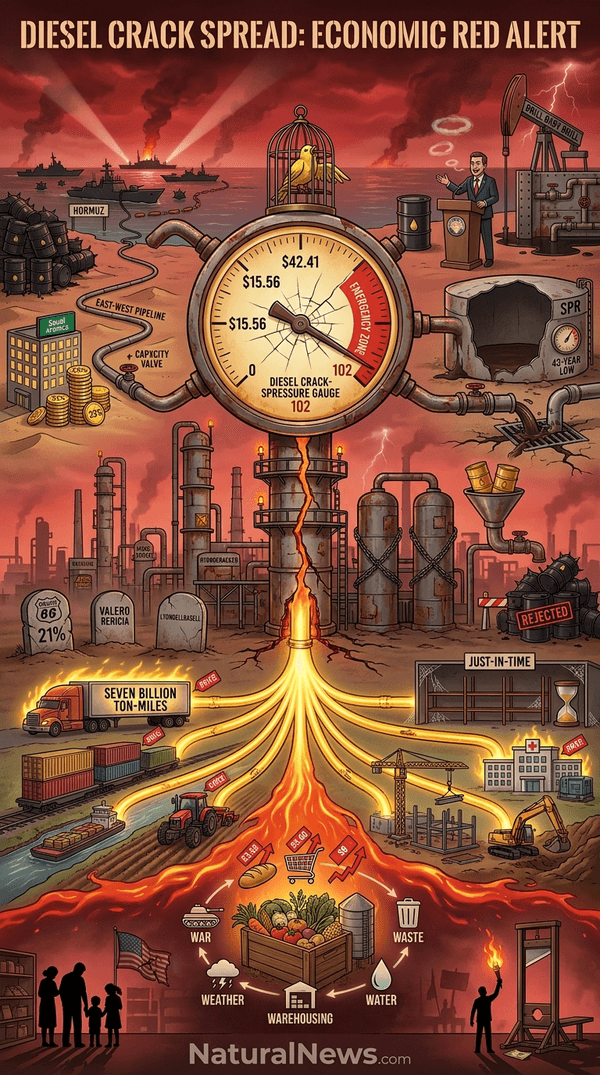
The crack spread is the pricing difference between a barrel of crude oil and the petroleum products refined from it. [1] When it widens, it means refineries cannot keep up with demand for specific fuels. Back in January 2023, analysts were alarmed when the spread hit a three-month high of $42.41, against a five-year January average of just $15.56. [1] Today we are staring at $102. That is not an outlier; it is an emergency.
Jefferies, one of Wall Street's sharpest energy desks, put it in exactly these words: the Hormuz shock is "manifesting itself in cracks, not crude." [2] Politicians can easily manipulate crude prices, releasing strategic reserves and spinning narratives. But they cannot fake diesel supply. And when diesel supply tightens, the whole economy follows.
Why Refining Matters More Than Drilling
Everyone watches crude. Almost nobody watches refineries. That is a fatal blind spot. A refinery's configuration determines which fuels it can produce, and American refineries were largely optimized for light sweet crude. Diesel, however, comes disproportionately from the heavier sour barrels that flow through the Persian Gulf (and Venezuela, for those keeping track of the global RISK gameboard).
The war with Iran has cut off exactly those supply lines. Saudi Aramco reported a 33 percent jump in quarterly profits while redirecting what crude it could through its East-West Pipeline to the Red Sea. [3] But pipelines cannot fix a chemistry problem. When refineries are forced to run suboptimal crude slates, diesel output falls, and the crack spread blows out.
This is why I have been warning that drilling alone is a fantasy. You can drill a million new wells and it will not produce a single gallon of diesel unless the refineries can process what comes out of the ground. Refining capacity is the bottleneck -- and that bottleneck is now poised to strangle the economy.
The Permanent Destruction of US Refining Capacity
While Washington wrings its hands over crude prices, America's refining capacity is being dismantled from within. California -- the state that lectures the rest of the country about energy virtue -- has lost two major refineries. The Phillips 66 refinery in Los Angeles and the Valero Energy Corp. refinery in Benicia are closed down, reducing California's refining capacity by 21 percent. [4]
These are not maintenance shutdowns. They are permanent closures. They come on top of the earlier shuttering of the LyondellBasell refinery in Houston, a sprawling 700-acre facility that produced over 200,000 barrels of fuel per day before its owners decided the upgrade costs were simply too high. [5]
Every one of these closures permanently removes diesel production capacity. Meanwhile, the Strategic Petroleum Reserve has been drained to a 43-year low. [6] There is no buffer. No cushion. When the next disruption hits -- and it will -- there will be nothing left to absorb it.
When Diesel Prices Spike, Everything Breaks
Here is what the financial press refuses to tell you: diesel is the fuel of physical reality. Approximately 7 billion ton-miles of freight move by truck every single day in the United States, consuming upward of 2.9 million barrels of diesel per day. [7] Retail diesel has already surged from $3.55 a gallon to $5.60 -- a 56 percent increase in the cost of moving every physical good in America. [7] By the end of this year, it could easily reach $8 or even higher.
Farming runs on diesel. Construction runs on diesel. Trains, mining, shipping, manufacturing -- all of it runs on diesel. Diesel inflation does not stay in the fuel tank; it works its way into food prices, consumer goods, and construction materials. JPMorgan is already warning that a global food crisis could erupt next year, driven by what its analysts call the "Five Ws": War, Weather, Warehousing, Water, and Waste. [8] Higher diesel prices will make food inflation far worse.
And the claim that "demand destruction" will fix this? Not without a lot of economic chaos happening first. Shortages cascade from fuel to food to everything else. A fuel shock becomes a food shock, and a food shock becomes a social shock with dire political consequences.
How to Prepare for the Diesel Supply Shock
If you live in California, prepare for diesel at $8 to $10 a gallon. The rest of the country may not be far behind. Do not expect the government to save you -- the Strategic Petroleum Reserve is nearly empty, and no amount of political spin can rebuild refining capacity that has been permanently destroyed.
What actually protects you is self-reliance. Grow your own food. Store fuel safely if you can. Learn to live without the just-in-time delivery system that is about to break. I have been growing a portion of my own food for years, and it remains one of the most powerful acts of resistance available to a free citizen. [9] The practical knowledge found in books like John Seymour's classic "Farming for Self-Sufficiency" is worth more than any government program. [10]
The crack spread is the canary. At $102 over crude, that canary is dead. The inflation that follows will be neither polite nor temporary. Prepare now, while you still can.
Watch my video interviews at Decentralize.TV to learn practical steps for off-grid living and decentralizing away from banks, the broken medical system and the stressed power grid.
References
- Gas and diesel prices expected to increase as crack spread soars. - NaturalNews.com. NaturalNews.com. January 27, 2023.
- Hormuz Shock "Manifesting Itself In Cracks, Not Crude," Jefferies Says. - ZeroHedge. August 13, 2026.
- Saudi Aramco Profit Soars As CEO Warns Hormuz Closure Removes 100 Million Barrels A Week. - ZeroHedge. August 4, 2026.
- California gas prices could skyrocket by 75 in 2026 following SHUTDOWN of oil refineries in the state. - NaturalNews.com. NaturalNews.com. May 10, 2025.
- DISMANTLING AMERICA: Massive Texas oil refinery to shut down amid record-high gas prices. - NaturalNews.com. NaturalNews.com. June 09, 2022.
- U.S. Oil Reserve Falls to 43-Year Low as Trump Drawdown Nears Its Limit. - The New American. July 10, 2026.
- When The Persian Gulf Supply Shock Meets The Warsh Fed: Stagflation & The Coming AI Bubble Bust. - ZeroHedge. David Stockman. May 9, 2026.
- "Won't Be Short-Lived": JPMorgan Warns Next Global Food Crisis Could Erupt Next Year. - ZeroHedge. August 15, 2026.
- Brighteon Broadcast News. - Mike Adams. Brighteon.com.
- Farming for self-sufficiency independence on a five-acre farm. - Seymour John.
- Farming for Self Sufficiency Independence on a Five Acre Farm. - John Seymour.
Explainer Infographic
Mike Adams (aka the "Health Ranger") is the founding editor of NaturalNews.com, a best selling author (#1 best selling science book on Amazon.com called "Food Forensics"), an environmental scientist, a patent holder for a cesium radioactive isotope elimination invention, a multiple award winner for outstanding journalism, a science news publisher and influential commentator on topics ranging from science and medicine to culture and politics.
Mike Adams also serves as the lab science director of an internationally accredited (ISO 17025) analytical laboratory known as CWC Labs. There, he was awarded a Certificate of Excellence for achieving extremely high accuracy in the analysis of toxic elements in unknown water samples using ICP-MS instrumentation.
In his laboratory research, Adams has made numerous food safety breakthroughs such as revealing rice protein products imported from Asia to be contaminated with toxic heavy metals like lead, cadmium and tungsten. Adams was the first food science researcher to document high levels of tungsten in superfoods. He also discovered over 11 ppm lead in imported mangosteen powder, and led an industry-wide voluntary agreement to limit heavy metals in rice protein products.
Adams has also helped defend the rights of home gardeners and protect the medical freedom rights of parents. Adams is widely recognized to have made a remarkable global impact on issues like GMOs, vaccines, nutrition therapies, human consciousness.










Please contact us for more information.


