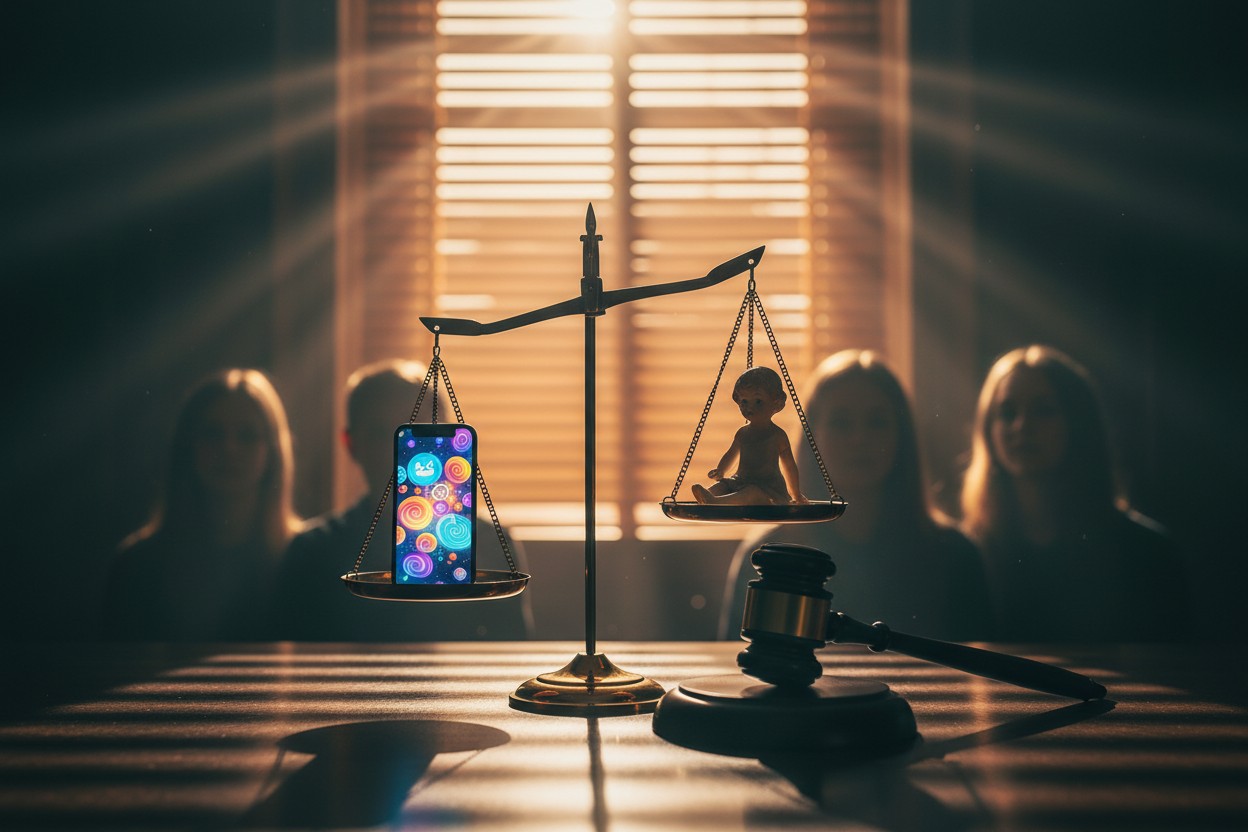
Meta, the owner of Facebook and Instagram, is accused of knowingly misleading the public about the dangers of its platforms, according to court filings [2]. The trial follows a New Mexico judgment against Meta and a Los Angeles jury verdict that found Instagram and YouTube addictive and deliberately engineered [6][5].
Meta Faces Federal Trial in California Over Teen Safety Allegations
The jury was seated last week in the Oakland federal courthouse, and U.S. District Judge Yvonne Gonzalez Rogers is presiding, according to court proceedings. Four states — California, Colorado, Kentucky, and New Jersey — are parties to a wider lawsuit involving a total of 29 states, filed in 2023 [1]. The states have asked the court to impose remedies that would apply nationwide, according to filings.
The trial is one of several pending against Meta and other social media companies. In a separate matter, former Meta employee Arturo Bejar testified before a U.S. Senate subcommittee that Meta was aware of harassment and other harms affecting teenage users but "failed to address them," according to NaturalNews.com [9].
Research on social media and adolescent self-harm dates back several years. A 2018 review in the Indian Journal of Psychiatry examined the role of online social networking in deliberate self-harm and suicidality in adolescents, according to James Barrat's book "Facing Suicide" [12].
States Allege Violations of Federal and State Laws
The states allege violations of the Children's Online Privacy Protection Act and various consumer protection statutes, according to court filings. In a statement, Bonta said Meta "designed a dangerous product for young users, knew it to be dangerous, and then lied to children, families, and the community about how dangerous it was."
Meta responded that the coalition's "limited claims are unsubstantiated and their financial demands are vastly disproportionate." The company said the attorneys general "offer no proof anyone in their states was misled, claim benign features like having an additional Instagram account somehow harmed their residents, and attempt to penalize Meta for industry-wide challenges like age verification."
Advocacy groups have pressed for similar changes at the federal level. In 2022, a coalition of more than 60 organizations wrote to congressional leaders urging them to enact online protections for young Americans and arguing that the Big Tech business model is "fundamentally at odds" with the well-being of children [10].
New Mexico Ruling Precedes California Trial
Earlier this month, Meta lost a child safety case in New Mexico, marking the first time the company was held liable by a court for endangering child safety, according to TechCrunch [6]. A jury in that state ruled in March that Meta must pay $375 million for violating the state's unfair practices act, and a judge later ordered the company to pay $567 million into an abatement fund, according to CNBC. Meta said it disagrees with the ruling and plans to appeal.
The day after the New Mexico judgment, a jury in Los Angeles found that Meta's Instagram and Google's YouTube were addictive and deliberately engineered that way, ordering the companies to pay $6 million in damages to a young woman known as Kaley [5][6].
New Mexico Attorney General Raúl Torrez said the focus on app design features and alleged safety misrepresentations "really provides a blueprint for other states to hold them accountable." He said the approach allows states to avoid Section 230 of the Communications Decency Act, which has generally shielded tech companies from liability for third-party content.
Potential Damages and Market Effects
Meta's attorneys have said the consolidated state trial could lead to damages as high as $1.4 trillion, a figure nearly equal to the company's market value of about $1.5 trillion, according to the company's legal response [3]. Lawyers for the states told Judge Gonzalez Rogers last week that $200 billion is a more likely amount, according to CNBC.
Julia Powles, executive director of the UCLA Institute for Technology, Law and Policy, said California "matters more than any other jurisdiction in the U.S." — "It's where they are subject to the greatest legal reach, and it's a jurisdiction watched around the world."
Torrez said Wall Street is underestimating the case's significance. "The analysts aren't pricing this correctly right now," he said. Michael Coffey, a defense litigator and founding partner of Coffey Modica, said any payout would go to government and the plaintiffs' bar, with victims receiving little: "It's all going to go to government, and then they're going to dole it out, and then the plaintiffs' bar is going to take a cut out of it."
Outlook and Additional Cases
In their filings, the state attorneys general requested permanent injunctive relief on a nationwide basis. For violations related to the Children's Online Privacy Protection Act, the states ask that Meta delete the personal data of children under 13 and delete the algorithms and models trained on that data, according to CNBC. For consumer protection violations, the states want Meta to remove "certain addictive design features," including infinite scroll, autoplay, ephemeral content, beauty filters, and engagement-optimized algorithms.
Laura Marquez-Garrett, an attorney with the Social Media Victims Law Center, said states "have the ability that private plaintiffs typically do not have to actually force these companies, through the court system, to change their business model, their design decisions, all of that." Meta and its rivals face thousands of lawsuits in the U.S. over claims that they have harmed users, according to the BBC [4].
Additional cases remain pending, including a federal trial expected to begin next year in Northern California involving a group of school districts. State attorneys general have also pursued other platforms; Minnesota filed a lawsuit against TikTok in August 2025 accusing the company of deliberately designing its platform to addict young users [7]. Age verification requirements have advanced in some states amid privacy and free speech concerns [8].
Conclusion
The California trial represents the largest coordinated state action against a social media company over youth safety, and it follows recent courtroom losses for Meta in New Mexico and Los Angeles [5]. The outcome could determine whether states can compel design changes across the industry.
The broader debate over platform design has drawn commentary from authors such as Frank H. McCourt Jr., who argues in "Our Biggest Fight: Reclaiming Liberty, Humanity, and Dignity in the Digital Age" that new systems could be designed to tap into people's desire to belong and incentivize "prosocial ideas rather than divisiveness" [11].
References
- RT. "Why is Meta in court again?". rt.com. August 17, 2026.
- NaturalNews.com. "U.S. States Seek $1.4 Trillion From Meta Platforms Over Child Addiction Claims". July 10, 2026.
- RT. "US states seek $1.4 trillion from Meta". July 8, 2026.
- BBC. "Social media on trial: Four important cases to watch". June 11, 2026.
- BBC. "The era of impunity is over': What next for big tech after landmark social media verdict?". March 26, 2026.
- TechCrunch. "Meta was finally held accountable for harming teens. Now what?". March 31, 2026.
- Ava Grace. "Minnesota Joins Legal Onslaught Against TikTok, Alleging Algorithmic Exploitation of Youth". NaturalNews.com. August 24, 2025.
- Willow Tohi. "Supreme Court Lets Mississippi Age Verification Law Take Effect Amid Privacy, Free Speech Fears". NaturalNews.com. August 17, 2025.
- NaturalNews.com. "Former Meta director says Instagram FAILED to protect teen users". November 27, 2023.
- NaturalNews.com. "Coalition urges Congress to bolster kids online protections against harmful Big Tech profit model". March 25, 2022.
- Frank H. McCourt, Jr. "Our Biggest Fight: Reclaiming Liberty, Humanity, and Dignity in the Digital Age".
- James Barrat. "Facing Suicide: Understanding Why People Kill Themselves and How We Can Stop Them".
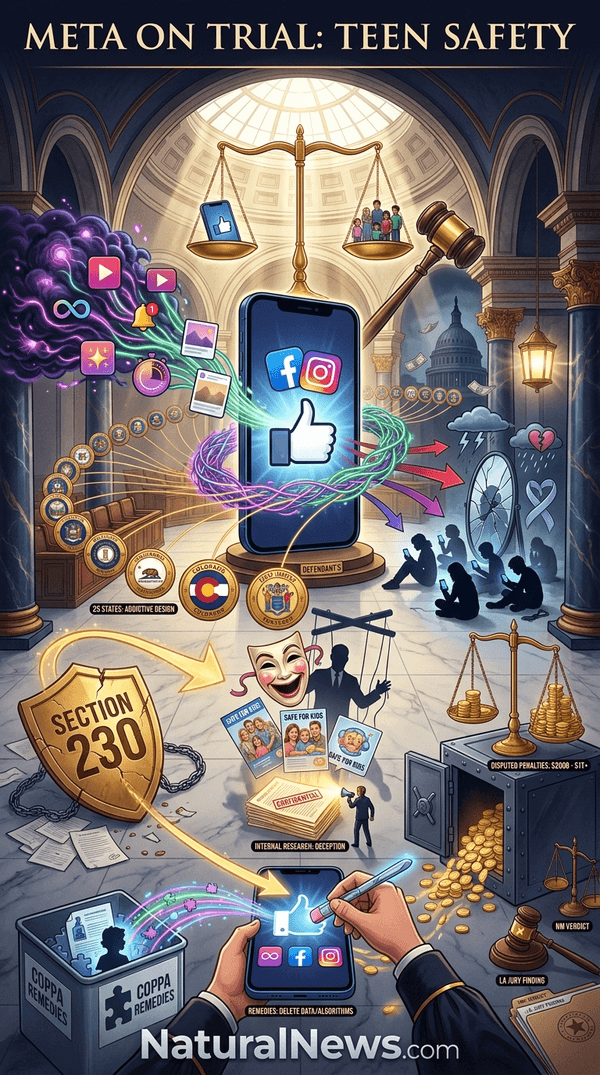
Explainer Infographic







Please contact us for more information.