
But an investigation by investigative reporter Maryanne Demasi published by Children's Health Defense reported that the agency's review did not disclose a statistically significant safety signal in the pivotal Phase 3 trial [2]. The pivotal trial, designated P304, enrolled roughly 40,000 adults randomized 1:1 to either Moderna's mRNA-1010 vaccine or a conventional trivalent flu vaccine, according to the report.
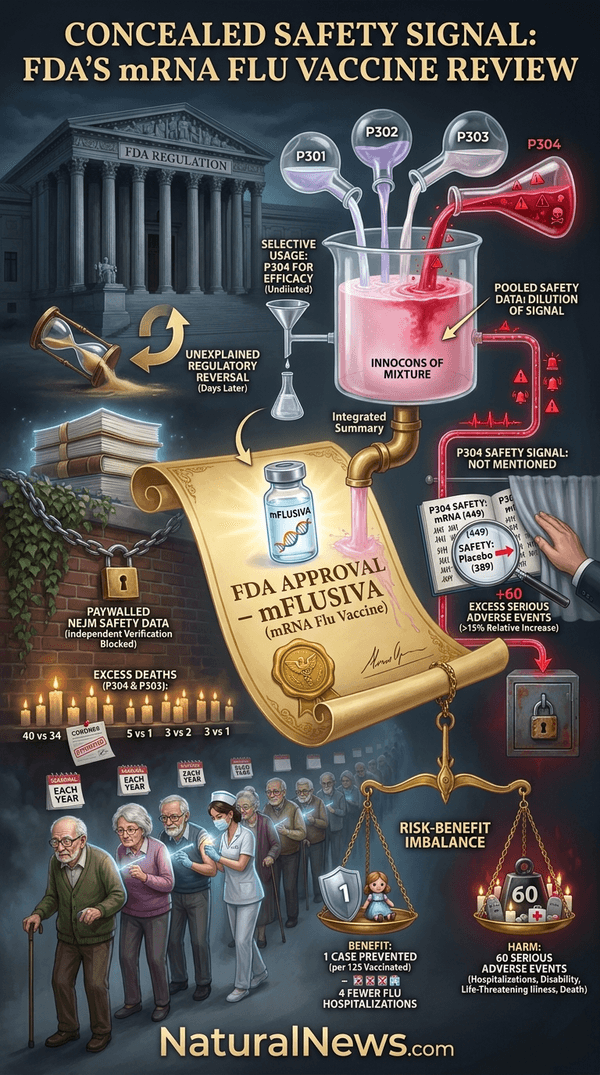
Six-month data showed 449 participants in the mRNA group experienced at least one serious adverse event, compared with 389 in the comparator group, an excess of 60. The report said FDA briefing documents described serious adverse events as "balanced."
Serious Adverse Event Imbalance in Pivotal Trial
The report said the imbalance in serious adverse events was statistically significant, meaning it was unlikely to be a random occurrence. Serious adverse events are generally severe enough to require hospitalization, threaten life, cause significant disability or result in death, according to the report.
The vaccine's headline efficacy figure was 26.6% relative efficacy over a conventional flu vaccine, but the absolute risk reduction was 0.8%, the report said. The report also noted that while the pivotal trial showed four fewer influenza hospitalizations in the mRNA group, 60 additional participants experienced a serious adverse event. Trial safety data were published in the New England Journal of Medicine with much of the appendix behind a paywall, according to the report [2].
FDA Used Pooled Data From Four Trials to Assess Safety
The FDA relied on Moderna's "Integrated Safety Summary," combining four Phase 3 trials – P301, P302, P303 and P304 – involving nearly 72,000 participants, according to the report. In that pooled analysis, serious adverse event rates were 3.1% in the mRNA group versus 2.9% in the comparator group, allowing the FDA to describe the rates as "balanced" [2].
The report said the pooled trials differed in vaccine formulation, comparator vaccines, age groups, countries and follow-up duration. The FDA's own briefing document appendix acknowledged that differences between trials could create safety variations "not fully captured by pooled analyses," according to the report. The report said Table 6 of the FDA review showed P304 safety data alone for the first 28 days, when events were still balanced, and then switched to pooled data after the imbalance emerged.
Death Counts in mRNA Arms Exceeded Comparator Arms in Trial Data
The report said the pivotal trial P304 recorded 40 deaths in the mRNA arm and 34 in the comparator arm. In the earlier trial P303, death counts were higher in all three mRNA sub-studies: 5 versus 1, 3 versus 2, and 3 versus 1 [2].
The report said Moderna's own investigators assessed one of the five deaths in P303 sub-study 1 as caused by the vaccine, the same product that has now been licensed. The FDA did not highlight the pattern in all-cause mortality, according to the report.
Efficacy and Safety Data Were Handled Differently, Report Says
For efficacy, the FDA relied only on P304, the trial testing the exact formulation submitted for licensure, according to the report. Earlier trials had produced weaker or negative efficacy results, and pooling them would have lowered the 26.6% efficacy figure, the report said.
For safety, the FDA accepted pooled data that diluted the statistically significant serious adverse event signal, the report said. The report described the approach as one that maximized efficacy and diluted safety concerns. The FDA initially refused to review Moderna's mRNA flu vaccine application due to concerns over trial design before reversing its decision days later, according to NaturalNews.com [3].
Conclusion: Regulatory Questions Remain
The FDA has publicly described the vaccine as "safe and effective," while trial records show a statistically significant safety signal, according to the report. Demasi asked: "When the FDA accepts the manufacturer's trial design, adopts its data analyses and rubber-stamps statistical methods that dilute a safety signal, who is actually protecting the public from harm?" [2]
Long-standing concerns about mRNA flu shots have been documented in independent media. Mercola.com warned in July 2021 that "mRNA-based vaccines have been in development for years but were never perfected" and noted that multiple mRNA seasonal influenza vaccines had already entered human trials [4].
Separate critiques of vaccine regulation have also been published by Pamela A. Popper and Shane D. Prier in "COVID OPERATION," which documents resistance to flu vaccine mandates among healthcare workers [5], and by Sally Fallon Morell and Thomas S. Cowan in "The Contagion Myth," which describes additives used in vaccine manufacture, including aluminum adjuvants [6].
References
- Rachel Roberts. "Moderna's mRNA Flu Vaccine Approved By FDA". Zero Hedge. August 6, 2026.
- ChildrensHealthDefense.org. "Moderna's mRNA Flu Vaccine: How FDA Hid 'Serious' Safety Signal". August 10, 2026.
- Ramon Tomey. "FDA agrees to review Moderna's mRNA flu vaccine following initial refusal". NaturalNews.com. February 20, 2026.
- Mercola.com. "Coming Soon the Deadliest Flu Shot in Histor". Mercola.com. July 19, 2021.
- Pamela A Popper and Shane D Prier. "COVID OPERATION What Happened Why It Happened and Whats Next".
- Sally Fallon Morell and Thomas S Cowan. "The Contagion Myth Why Viruses Are Not the Cause of Disease".
Explainer Infographic











Please contact us for more information.