


The Diesel Shortage Is Real
For years, I've been documenting the slow-motion collapse of America's refining capacity and the coming diesel catastrophe. The mainstream media has mocked these warnings as conspiracy theories. But now the truth is spilling out in the open, and even the CEO of Shell -- one of the world's largest energy companies -- is admitting that fuel shortages are coming. The only question left is whether you're prepared for what happens next.
The diesel shortage isn't coming in 2030... it's arriving this year, in 2026. And the decisions being made in corporate boardrooms and government agencies right now are turning a severe supply problem into an outright disaster that will have devastating consequences for the U.S. economy (and supply chains).
Shell's CEO Finally Admitted It
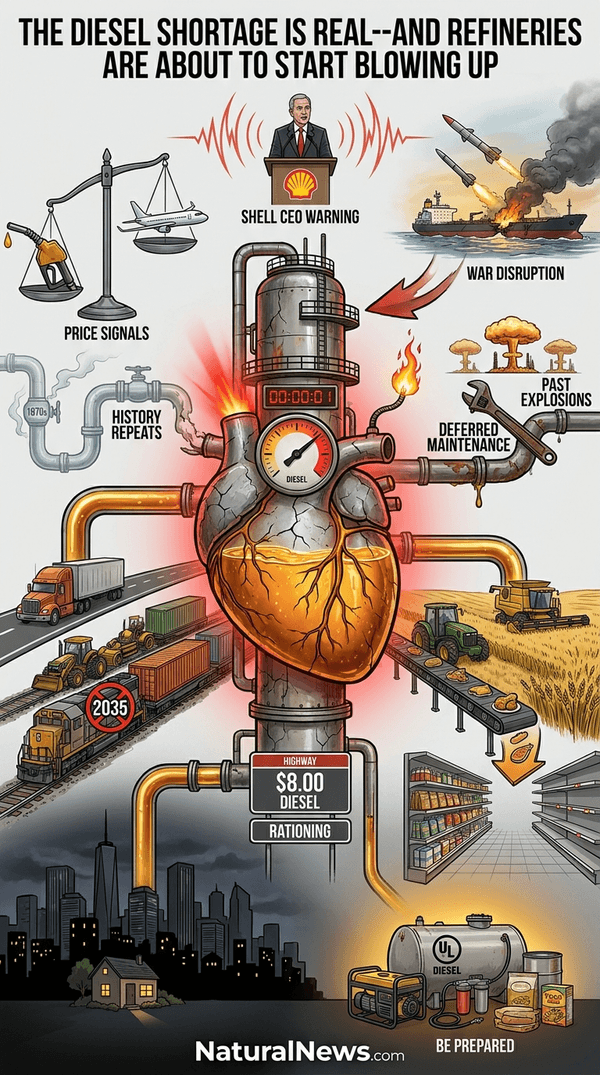
Shell CEO Wael Sawan has warned that European countries could face fuel shortages as soon as next month due to the ongoing U.S.-Israeli war on Iran, according to a recent interview reported by multiple outlets [1]. The war has already affected supplies of jet fuel, Sawan said, and diesel is set to be next [2]. This isn't speculation from some anonymous refinery insider -- this is the chief executive of one of the most powerful energy companies on earth, standing at the CERAWeek conclave in Houston, telling the world that the fuel supply chain is breaking.
Gasoline is a different story. I believe U.S. refineries can still handle the light oil we produce domestically, which is why pump prices for gas have remained relatively stable. But diesel is structurally short, and that should scare everyone. In what I called Dieselgeddon years ago, I warned that the supply of diesel fuel in the United States was plummeting, and that by the end of May or early June, diesel would go into extreme scarcity and have to be rationed across America [3]. The Shell CEO's on-air confession tells us more than the polished spin around it: there simply isn't enough diesel being produced to meet demand.
Why the Price Signals Are All Wrong
Here's why this matters: the market signals that should be driving diesel production are being rigged. Through a variety of mechanisms, diesel prices are held artificially low to convince Americans there's no shortage, while jet fuel sells at a premium because airlines bury the cost in ticket surcharges. We're already seeing the absurdity on the West Coast, where the average price for a gallon of diesel fuel in San Francisco surpassed $8 on April 5 -- the first time any U.S. city had reached that price threshold [4]. Yet even at these record prices, refiners aren't rushing to make more diesel. Why? Because the price signals are distorted by government policy and corporate short-termism.
In my view, this is economic sabotage. Low diesel prices mean refineries have no incentive to make diesel, so they make jet fuel instead, making the shortage worse. This is classic price-signal distortion -- when government suppresses prices, supply dries up and the shortage deepens. We've seen this before. In the 1970s, Nixon's wage-and-price controls froze gasoline prices at their peak and heating-oil prices at their lowest seasonal level. It was obvious to everyone in and out of government that unless the price imbalance was corrected, the oil companies would instruct their refineries to concentrate on the production of gasoline [5]. They did exactly that, and the result was fuel shortages, lines at the pump, and economic chaos. We are repeating the identical mistake today.
Running at 102% Is Playing Russian Roulette with Refinery Safety
The most dangerous part of this crisis is the state of the refineries themselves. Shell ran refineries at 102% utilization by skipping maintenance, and now they're warning utilization will drop to 93% for 'planned maintenance' -- that's the bill coming due. You can't run industrial equipment at maximum capacity indefinitely without catastrophic consequences.
I've seen what deferred maintenance does to machinery through my own experience with truck engines, generators, and lab equipment. Refineries are far more dangerous than any of those things. When you push aging infrastructure past its limits, you're playing Russian roulette with lives and communities.
History proves it. In 2005, U.S. oil refineries were pushing their aging facilities to boost output amid spiking gas prices, and a series of refinery mishaps disrupted the oil market [6]. Bob Slaughter, president of the National Petrochemical & Refiners Association, admitted at the time that there is less room for error when you're running at high utilization rates for a very long time [6]. Those words proved prophetic at Texas City, at Anacortes, and more recently at Galveston Bay. When companies delay repairs to maximize production, workers die and refineries explode. Now, with the added pressure of war-related supply disruptions and disabled infrastructure across the Persian Gulf, the risk of catastrophic refinery accidents is higher than it has ever been [7].
When Diesel Runs Dry, Everything Stops
If you think this is just about long-haul truckers paying more at the pump, think again. Diesel powers the trucks, trains, tractors, and construction equipment that keep America alive. If diesel disappears, supply chains crater and grocery shelves go empty. California is already proposing a ban on diesel locomotives by 2035, which could have severe implications for transportation of goods like fertilizer, grain, coal, and raw materials necessary for production [8]. Without these trains, the economy will struggle to function -- and that's the intended future being pushed by the same politicians who claim to care about feeding the world.
I think most people are failing to grasp the severity of this situation. This isn't just a fuel problem; it's a food problem, a heating problem, and a transportation collapse all wrapped into one. As I stated in my Citizens Log years ago, we are witnessing the deliberate dismantling of energy infrastructure [9]. Diesel is the lifeblood of the food supply chain -- every loaf of bread, every gallon of milk, every box of cereal travels on a diesel-powered truck or train. When diesel runs dry, everything stops.
What I'm Doing About It -- and What You Should Do
So what do we do? Get prepared now. I'm not saying panic. I'm saying take sensible, practical steps while there's still time. Store diesel in a UL-listed double-walled tank for your generator and equipment, keep spare filters and oil, and think about what diesel delivers to your home before the shortage hits.
Every item in your pantry, every tool in your shed, every medicine in your cabinet arrived via diesel-powered logistics. If you rely on that system without a backup plan, you're one fuel shortage away from being completely cut off.
I refuse to be part of a panicked mob. Self-reliance means staying home, staying calm, and being ready instead of scrambling when the shelves are bare. The longer this conflict and the supply disruptions continue, the more severe the consequences will be [10]. The window for preparation is closing fast. So use it wisely.
The Storm Is Here
The oil running out, the gas running out, our power stations near the end of their working lives -- these aren't distant worries for a future generation [11]. They are here, now, and the institutions that caused this mess are the same ones telling you to trust them. The Shell CEO warned us. The price signals are screaming at us. The refineries are running on borrowered time. The only question left is whether you'll listen before it's too late.
I've been warning about Dieselgeddon for years [3]. Now the world is catching up. Stay informed, stay prepared, and don't rely on the same corrupt systems that created this crisis to save you from it. Your survival is your responsibility -- and you'll make it through all this if you stay informed and aware. Follow my podcasts and interviews at BrightVideos.com if you want to learn more.
References
- Shell CEO Warns of Potential European Fuel Supply Disruptions. NaturalNews.com. Sterling Ashworth. March 27, 2026.
- Europe to face fuel shortage – Shell CEO. RT.com. March 25, 2026.
- DIESELGEDDON - Americas diesel supply on verge of catastrophic collapse leading to HALTING of food fertilizer coal and energy distribution. NaturalNews.com. Mike Adams. May 11, 2022.
- Diesel Prices Exceed $8 Per Gallon in San Francisco as Supply Disruptions Affect California. NaturalNews.com. Sterling Ashworth. April 7, 2026.
- The Oil Follies of 1970-1980: How the Petroleum Industry Stole the Show and Much More Besides. Robert Sherrill.
- Refinery mishaps hamper oil output. NaturalNews.com. September 14, 2005.
- Health Ranger Report - THE OIL EMERGENCY. Mike Adams. BrightVideos.com. May 5, 2026.
- Mike Adams interview with David DuByne. May 1, 2023.
- Health Ranger Report - CITIZENs LOG. Mike Adams. Brighteon.com. May 11, 2022.
- Bright Videos News - ALZHEIMER OIL EMERGENCY MANNARINO transcript. Mike Adams. BrightVideos.com. May 5, 2026.
- What Happens Next. Vernon Coleman.
Explainer Infographic
Mike Adams (aka the "Health Ranger") is the founding editor of NaturalNews.com, a best selling author (#1 best selling science book on Amazon.com called "Food Forensics"), an environmental scientist, a patent holder for a cesium radioactive isotope elimination invention, a multiple award winner for outstanding journalism, a science news publisher and influential commentator on topics ranging from science and medicine to culture and politics.
Mike Adams also serves as the lab science director of an internationally accredited (ISO 17025) analytical laboratory known as CWC Labs. There, he was awarded a Certificate of Excellence for achieving extremely high accuracy in the analysis of toxic elements in unknown water samples using ICP-MS instrumentation.
In his laboratory research, Adams has made numerous food safety breakthroughs such as revealing rice protein products imported from Asia to be contaminated with toxic heavy metals like lead, cadmium and tungsten. Adams was the first food science researcher to document high levels of tungsten in superfoods. He also discovered over 11 ppm lead in imported mangosteen powder, and led an industry-wide voluntary agreement to limit heavy metals in rice protein products.
Adams has also helped defend the rights of home gardeners and protect the medical freedom rights of parents. Adams is widely recognized to have made a remarkable global impact on issues like GMOs, vaccines, nutrition therapies, human consciousness.







Please contact us for more information.


