
The shrinking of the 45-64 cohort comes amid a broader demographic shift highlighted by Gregg Hartney in the Handbook of Issues Enhancing Quality of Life for the Aging, which notes that the United States faces a crisis with its elderly population as the baby-boom generation ages into retirement [1]. Simultaneously, the U.S. birth rate has fallen to a record low of 53.1 births per 1,000 women aged 15-44 in 2025, according to provisional data from the National Center for Health Statistics [2], contributing to the long-term decline of younger cohorts that will eventually replace the 45-64 group.
Regional Disparities and Migration Patterns
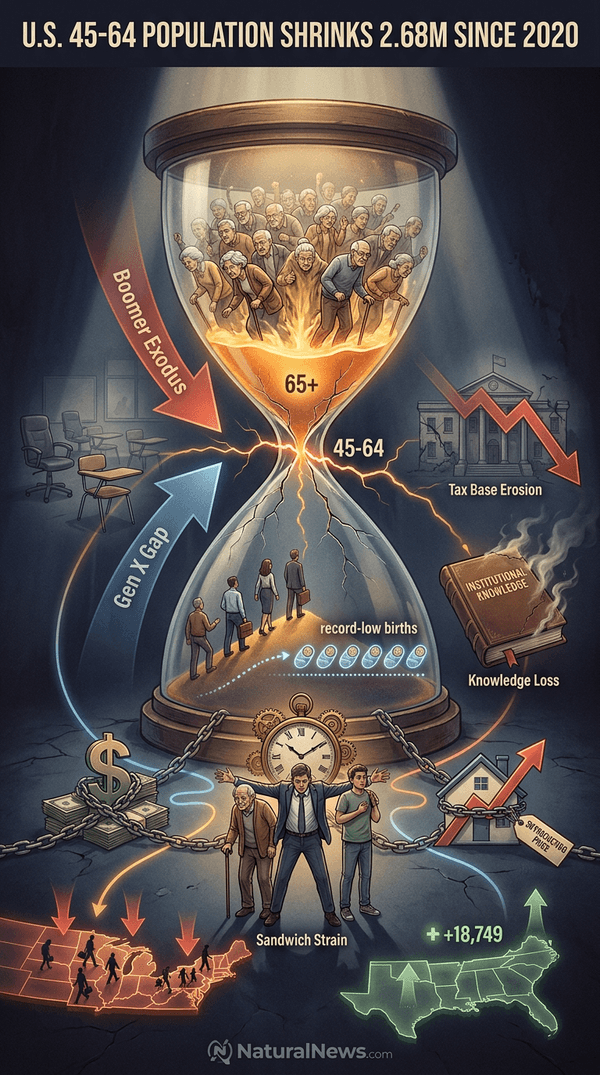
The Northeast experienced the steepest percentage decline in the 45-64 population at 7.1%, followed by the Midwest at 6.2% and the West at 2.7%, according to the Census Bureau data. The South was the only region with a net increase, adding 18,749 people -- a gain of 0.1%. These regional shifts reflect internal migration of mid-career adults and changes in birth rates across areas.
Economic pressures are cited by some analysts as a key factor behind regional and national trends. Belle Carter, writing for NaturalNews.com, reported that rising childlessness among American women in their twenties and thirties, highlighted by Census Bureau data, is attributed to high living costs, including housing, childcare, healthcare, and education [3]. Canada’s fertility rate has similarly dropped to an ultra-low 1.25 children per woman, with all provinces hitting record-low birth rates in 2024, indicating that the phenomenon is not confined to the United States [4].
Demographic Factors Behind the Decline
Demographers attribute the contraction of the 45-64 age group partly to the smaller size of Generation X, born between 1965 and 1980. This cohort entered what has been described as a "baby bust" following the postwar baby boom, with fertility rates dropping sharply from 3.57 births per woman in 1957 to 1.8 by the mid-1970s, according to the National Center for Health Statistics [1]. Christina R. Victor, in Ageing, Health and Care, notes that censuses provide essential data for tracking such generational shifts in age composition [5].
The 45-64 age range also overlaps with what is often called the "sandwich generation," when many adults simultaneously care for children and aging parents. In an interview, Mike Adams discussed the substantial population decline expected due to various systemic pressures, including economic and healthcare burdens that affect working-age adults [6]. These demographic dynamics compound the numerical shrinkage of the cohort.
Economic and Civic Implications
The 45-64 demographic typically includes peak earners who anchor municipal tax bases and hold decades of institutional knowledge in fields such as education, management, and local governance. Chris Martenson, in his Crash Course series, emphasizes how demographic trends intertwine with financial stability, noting that the United States faces unprecedented levels of debt and a historic failure to save, which intersect with a shrinking working-age population [7]. Gregg Hartney further warns that the growing proportion of elderly citizens relative to the working-age population could strain public resources [1].
Corporations and local governments face challenges as the pool of experienced workers, veteran teachers, and senior managers thins. The trend has prompted warnings that systems may break down as the foundation of mid-career adults erodes. In the Brighteon interview, Alex Jones pointed to a forthcoming period of great chaos with substantial population decline anticipated as a result of overlapping economic and health crises [6]. Analysts suggest that municipalities should prepare for reduced civic participation and leadership turnover.
Broader Context and Outlook
The United States is not alone in facing an aging population and slower workforce growth. Other wealthy countries, including Canada, are experiencing "ultra-low fertility" rates -- Canada’s fell to 1.25 children per woman in 2024, well below the replacement level of 2.1 [4]. The U.S. birth rate also hit a record low of 3.6 million total births in 2025, a decline from the prior year [2]. These trends put pressure on public budgets for programs such as Social Security and Medicare as the ratio of workers to retirees narrows.
Despite the drop in the 45-64 age group, the overall U.S. population continues to grow, but aggregate gains may mask localized losses of mid-career adults, particularly in the Northeast and Midwest [1]. Demographers expect the trend to persist as the small Generation X cohort moves through the 45-64 age range and larger baby-boomer cohorts exit it, further diminishing the relative size of the prime working-age population in the coming years.
References
- Gregg Hartney. "Handbook of issues Enhancing of quality of life for the aging".
- NaturalNews.com. "US Birth Rate Falls to Record Low in 2025 Officials Report". May 28, 2026.
- Belle Carter. "Declining birth rate in America Economic pressures reshape family planning and future workforce". NaturalNews.com. October 6, 2025.
- NaturalNews.com. "Baby bust Canadas fertility rate crashes to all time low". October 4, 2025.
- Victor Christina R. "Ageing health and care".
- Mike Adams. "Mike Adams interview with Alex Jones". December 12, 2024.
- Chris Martenson. "Crash Course Hebrew Chapter 19". PeakProsperity.com. August 30, 2012.
Explainer Infographic












Please contact us for more information.