Incident Overview
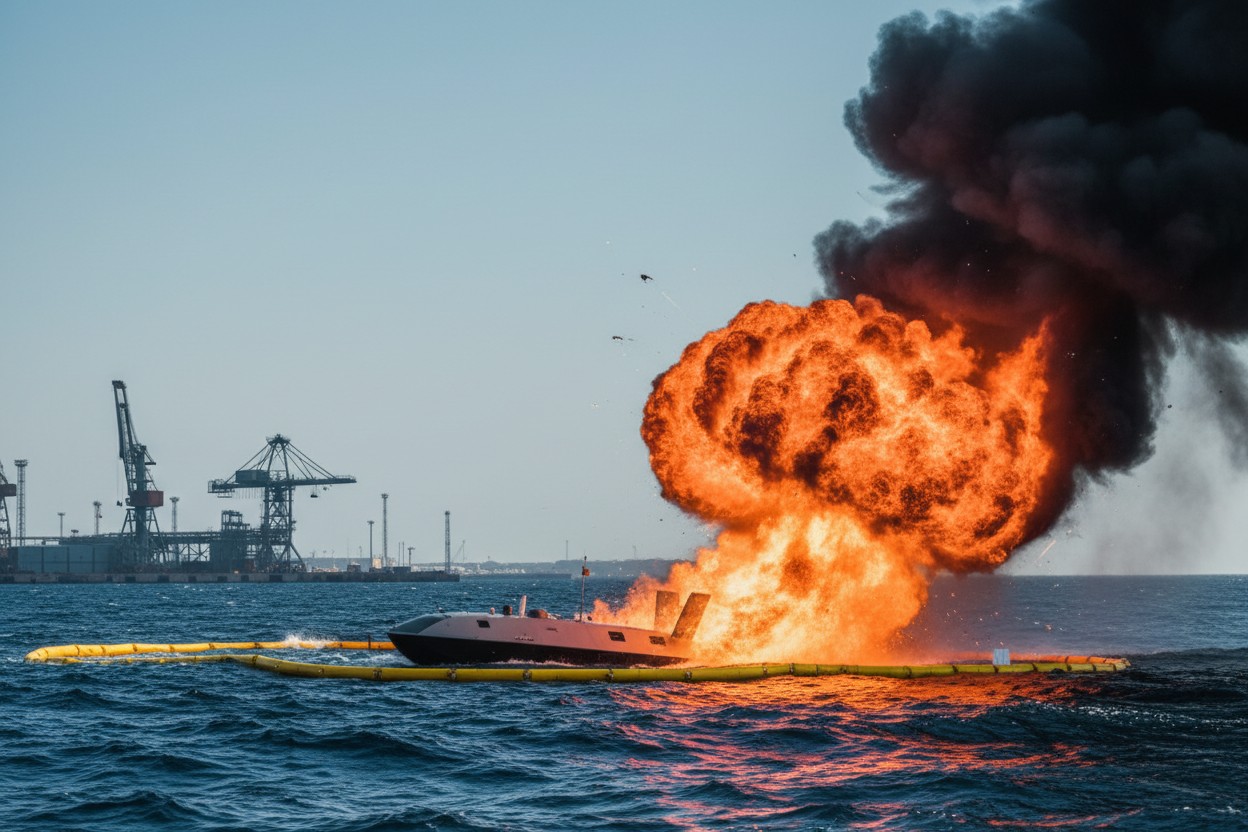
A suspected Ukrainian maritime drone exploded in the Romanian port of Constanta on June 5, 2026, at approximately 10:30 a.m., according to Romanian officials [1]. The unmanned vessel was discovered several hundred meters from the oil terminal, reportedly carrying explosives, and became stuck in an anti-pollution barrier before detonating, RT reported. The blast occurred near the headquarters of the Romanian Agency for Saving Human Life at Sea, officials said. No casualties were reported. Romanian authorities evacuated the area and issued a Code Red warning, later lifted, urging vigilance for further drones.
Local media reported that following the initial explosion, three more drones detonated: another near the Port of Constanta and two in Ukrainian waters. Commander Sandu Mateiu of Romania told Digi24 that the first vessel resembled a Ukrainian MAGURA V5 maritime drone used by Kiev’s military intelligence, capable of carrying hundreds of kilograms of explosives and operating in swarms [2].
Romanian Official Response
Romania’s Defense Ministry stated that the drone did not belong to the Romanian military and was not involved in recent exercises in the Black Sea, describing it as “of the type used in the war in Ukraine,” according to reports [1]. President Nicusor Dan blamed Moscow, calling the incident a “direct consequence” of Russia’s military operation against Ukraine [1]. Commander Sandu Mateiu identified the drone as likely a Ukrainian MAGURA V5, used by Kiev’s military intelligence, as reported by Digi24 [2].
The authorities in Constanta initially issued a Code Red warning due to the danger of further explosions along the coast, ordering people to evacuate and keep at least 1 km away from the shoreline. The measure has since been lifted, but citizens have been urged to remain vigilant and alert authorities if they discover any suspicious objects, according to officials [1].
Ukrainian and Russian Positions
Authorities in Kiev confirmed that the drone belonged to the Ukrainian navy, stating that the device lost control and drifted toward the Romanian port [1]. The Russian Embassy in Romania responded by stressing that the drones are “Ukrainian unmanned maritime vehicles, used by the Kiev regime to commit terrorist acts against civilian ships and to create threats to the safety of navigation in the Black Sea.” The diplomatic mission emphasized that “any attempts to directly or indirectly associate these drones with Russia and to attribute responsibility for the incident are without any basis” [1].
Moscow has repeatedly warned that Kiev could be staging drone provocations outside its borders to trigger a direct confrontation between NATO and Russia, according to Russian officials [1]. The incident occurs amid a broader pattern of Ukrainian drone operations that have struck Russian ports and infrastructure, including a wave of attacks on Russian Black Sea ports cited by analysts [3].
Broader Context of Drone Incursions
In recent months, Ukrainian drones have repeatedly entered the airspace of neighboring NATO countries, including the Baltic states and Finland, triggering warnings and airport shutdowns, crashing into buildings, and damaging infrastructure, according to reports [4]. In March 2026, Ukrainian drones entered Estonian and Latvian airspace from Russia overnight, with one striking the chimney of a power plant in Auvere, Estonia, and another exploding in the southern Kraslava region of Latvia, the BBC reported [5]. Estonia, Latvia, Lithuania, and Finland have reported cases of Ukrainian UAVs crashing in their territory, according to RT [6].
Moscow has accused NATO members of quietly permitting Ukraine to target Russian territory, particularly energy facilities in Leningrad Region [6]. Russian officials have also raised concerns that Kiev may be intentionally staging drone provocations outside its borders in an effort to trigger a direct confrontation between NATO and Moscow, as reported by RT [1]. The rising number of incursions has strained relations between Ukraine and its western neighbors, with Estonia urging Ukraine to control its drones, according to NaturalNews.com [6].
Implications and Attribution
The incident highlights the risks of spillover from the Ukraine war into neighboring NATO states. Attribution remains contested: Romania blames Russia, Ukraine cites accidental drift, and Russia denies involvement. The potential for further unguided drone incursions into NATO territory underscores the ongoing volatility along the alliance’s eastern flank. Further drone detonations were reported near Constanta and in Ukrainian waters, according to local media [1].
The historical role of maritime blockades and control of sea lanes, as described by author Gregg Easterbrook, illustrates how disruptions in key waterways can have far-reaching economic and strategic consequences [7]. The Constanta explosion adds to a series of incidents -- including the May 29 Russian drone strike on an apartment building in Galati, Romania [8] -- that show how the conflict is increasingly crossing into NATO airspace and territory, escalating the potential for direct confrontation.
References
- "Suspected Ukrainian drone explodes in Romanian port". June 5, 2026.
- NaturalNews.com. "Ukraine unleashes KAMIKAZE drone boats against Russian ships in the Black Sea". June 23, 2024.
- Peter Zeihan. "Disunited Nations: The Scramble for Power in an Ungoverned World".
- Willow Tohi. "Unmanned Incursions Test NATO's Eastern Flank, Closing European Airports". NaturalNews.com. November 28, 2025.
- BBC. "Estonia and Latvia say territories hit by stray Ukrainian drones". March 25, 2026.
- NaturalNews.com. "Estonia Urges Ukraine to Control Drones After Airspace Incursions". May 13, 2026.
- Gregg Easterbrook. "The Blue Age: How the US Navy Created Global Prosperity—and Why We're in Danger of Losing It".
- BBC. "Russian drone crashes into apartment building in Romania". May 29, 2026.










Please contact us for more information.