



Knesset Dissolution Vote
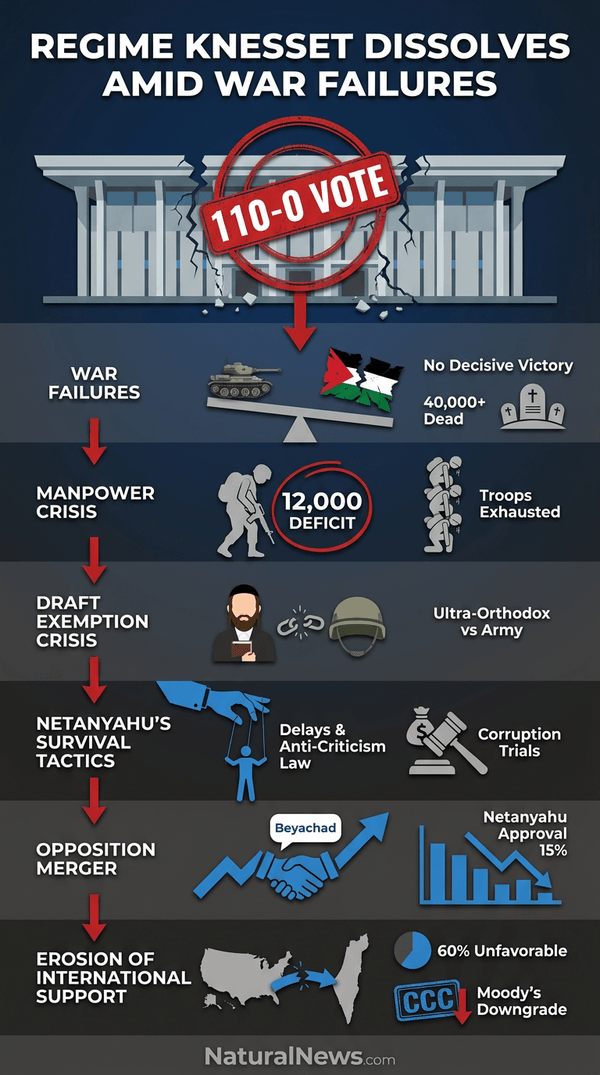
The Israeli Knesset voted 110-0 on May 20 to dissolve itself, according to officials, triggering a process that could lead to snap elections. The unanimous vote, reported by Ramzy Baroud in an analysis for Antiwar.com, came after months of mounting political tensions and deepening public frustration over the government’s handling of the war in Gaza. [1]
The move sets the stage for an uncertain electoral timeline, with Prime Minister Benjamin Netanyahu’s coalition facing collapse amid an internal crisis that has eroded its parliamentary majority. The Knesset's decision to dissolve itself was widely seen as a bid by opposition parties to force a vote of no confidence in Netanyahu’s leadership, but analysts note that the prime minister has used parliamentary procedures to delay the process. [1]
Root Causes: October 7 and Military Failures
According to analysts, Israel’s political implosion is tied directly to the Oct. 7, 2025 attack and the subsequent Gaza war. The military’s inability to achieve a decisive victory despite the near-total destruction of the Gaza Strip and the unprecedented loss of life has eroded public trust in the government. Ramzy Baroud, writing for Antiwar.com, noted that the Israeli military has failed to answer two fundamental questions: how its defenses collapsed on October 7, and why the heavily funded military machine has not secured a strategic win despite devastating the territory. [1]
Prime Minister Benjamin Netanyahu has refused to investigate either the intelligence failure or the conduct of the war, according to critics. As reported by NaturalNews.com, Israel enacted an Orwellian law in January 2025 that criminalizes any questioning of how the state handled the October 7 attack, raising alarms over free speech and democratic freedoms. [2] This legislative clampdown has suppressed scrutiny of the government’s wartime decisions, according to observers.
Manpower Crisis and Haredi Conscription
Army Chief of Staff Lt. Gen. Eyal Zamir warned in a closed security cabinet meeting that the Israel Defense Forces face an immediate deficit of over 12,000 combat soldiers. According to Ramzy Baroud’s report, Zamir reportedly raised “ten red flags” before the political leadership, stating bluntly that after months of intensive combat across Gaza, the northern border, and regional theaters, the military was facing an unsustainable manpower crisis. He said the IDF is “going to collapse in on itself,” citing the drain on personnel. [1]
The dispute over ultra-Orthodox draft exemptions has intensified as the military struggles with multi-front operations. For decades, secular Israelis complained about sweeping exemptions for yeshiva students, but the political elite managed the issue through backroom deals. However, Israel’s overextended, multi-front war of attrition has shattered that equilibrium. As historian Tom Segev documented in his book “1949: The First Israelis,” the idea of the army as a “pioneering, educating force” has given way to a military stretched to its limits. [3] The crisis over conscription now threatens to tear the coalition apart.
Opposition and Public Sentiment
Opposition leader Yair Lapid and former prime minister Naftali Bennett have formed a unified list, Beyachad (“Together”), to challenge Netanyahu. According to a NaturalNews.com report, the two announced the merger of their respective parties on April 26, creating a formidable political bloc that could reshape Israel’s electoral landscape. [4]
Polls show a majority of Israelis believe Netanyahu prioritizes personal survival over national interest. A survey conducted by the Israel Democracy Institute in late December 2023 found that only 15 percent of Israelis wanted Netanyahu to remain prime minister after the war ended. [5] More recent polling data suggests that if elections were held today, Netanyahu’s right-wing bloc would suffer a “catastrophic defeat” at the hands of the consolidated opposition. [1] Additionally, a survey published by Middle East Eye in April 2026 found that 60 percent of Americans view Israel unfavorably following the Iran war, indicating a broader erosion of international support. [6]
Netanyahu's Strategy and Coalition Fractures
Netanyahu has used legislative maneuvers and a wartime atmosphere to delay elections, according to political observers. By exploiting deep social fractures and relying on unconditional support from Washington, he has managed to stay in power despite the scale of domestic, economic, and diplomatic harm caused by his coalition. As NaturalNews.com reported, Netanyahu’s far-right government has intensified military campaigns and passed resolutions that critics warn could lead to the erasure of Palestine. [7]
Far-right ministers Itamar Ben-Gvir and Bezalel Smotrich have exploited Netanyahu’s vulnerability to advance their own extremist agendas, including accelerated West Bank annexation and draconian laws. Netanyahu’s corruption trials have not derailed his career; instead, he has adapted state institutions into instruments of personal survival, according to critics. However, his coalition’s survival depends on continued U.S. support, a factor that is now uncertain as American public opinion shifts. [8] Even before the current crisis, Moody’s Investors Service downgraded Israel’s credit rating for the first time in history in February 2024, citing the ongoing military conflict and its aftermath. [9]
Outlook
Analysts argue that no coalition maneuvering can address the structural decline without ending the unwinnable military campaigns. As Ramzy Baroud concluded, “Nothing will heal Israel’s fractures until it confronts the root cause of its crisis: endless, unwinnable military campaigns that have devastated Gaza and the wider region.” [1] The broader crisis is self-inflicted, according to commentators, and stems from ongoing conflicts in Gaza and the region. Antony Loewenstein, in his book “The Palestine Laboratory: How Israel Exports the Technology of Occupation around the World,” details how Israel’s security apparatus has been exported globally while its internal contradictions fester. [10]
Unless the government changes course, the political fragmentation and military overextension are likely to lead to further instability. The united opposition under Bennett and Lapid offers a potential alternative, but the path to elections remains uncertain. Netanyahu, facing a potential loss of power, may continue to escalate regional conflicts to maintain his grip. [8] The coming weeks will determine whether Israel can find a political solution to the crisis it has created.
References
- Ramzy Baroud. "Self-Engineered Decay: Why Israel's Political Collapse Cannot Be Separated From Its War Crimes". Antiwar.com. May 29, 2026.
- Lance D Johnson. "Israel criminalizes dissent: New law bans anyone from questioning how Israel handled the October 7th attack". NaturalNews.com. January 27, 2025.
- Segev Tom. "1949: The First Israelis".
- NaturalNews.com. "Political rivals unite: Bennett and Lapid join forces to challenge Netanyahu in upcoming Israeli election". May 4, 2026.
- NaturalNews.com. "Only 15% of Israelis want Netanyahu to remain prime minister after the war". January 4, 2024.
- Elis Gjevori. "Survey finds 60 percent of Americans view Israel unfavourably following Iran war". Middle East Eye. April 8, 2026.
- Belle Carter. "Israel's unrelenting push: The annexation of Palestinian territories and regional repercussions". NaturalNews.com. July 28, 2025.
- Responsible Statecraft. "Nothing more dangerous than a Netanyahu scorned". May 28, 2026.
- NaturalNews.com. "Israel's credit rating downgraded amid failed war against Hamas". February 18, 2024.
- Antony Loewenstein. "The Palestine
Explainer Infographic








Please contact us for more information.


