


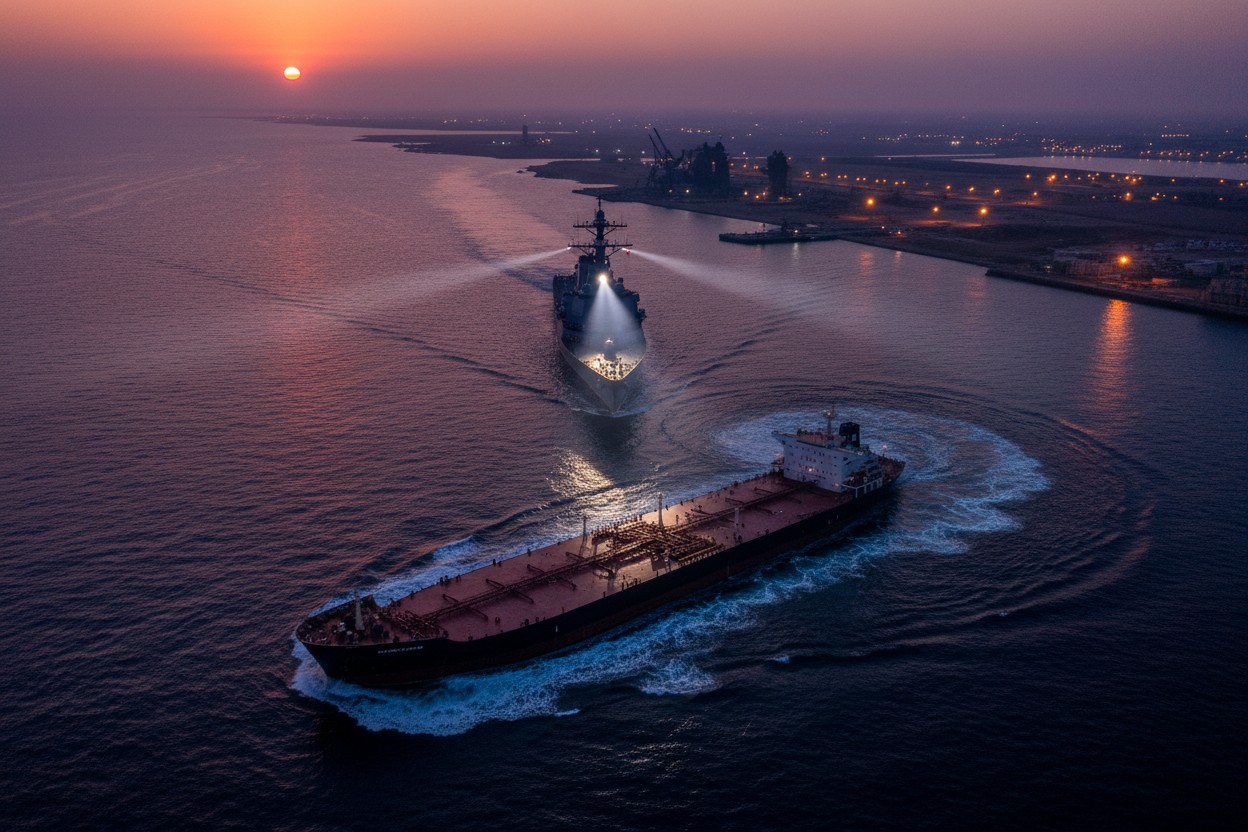
U.S. Announces Blockade, Considers Military Action After Talks Collapse
The United States will begin a maritime blockade of Iranian ports on Monday, April 13, at 10 a.m. ET, according to a statement from U.S. Central Command (CENTCOM). The announcement followed the collapse of high-level peace talks between U.S. and Iranian officials in Islamabad, Pakistan, after nearly 20 hours of negotiation [1].
According to a report by The Wall Street Journal, President Donald Trump is weighing limited military strikes on high-value Iranian assets to break the diplomatic stalemate. Officials familiar with the discussions said the options were under review on Sunday, hours after the talks ended without an agreement [2]. In a social media post, President Trump stated, 'Effective immediately, the United States Navy, the Finest in the World, will begin the process of BLOCKADING any and all Ships trying to enter, or leave, the Strait of Hormuz.'
CENTCOM Details Blockade Scope as Tankers Alter Course
U.S. Central Command provided clarification, stating the blockade would be enforced 'impartially against vessels of all nations entering or departing Iranian ports and coastal areas.' The command emphasized that vessels transiting the Strait of Hormuz to and from non-Iranian ports would not be impeded [3].
Shortly after the talks failed, two separate empty supertankers abruptly executed U-turns at the mouth of the Strait of Hormuz rather than enter the Persian Gulf. The reversals highlighted the immediate market reaction to the diplomatic breakdown, though the exact reason for the tankers' change of course was not immediately clear [3].
Diplomatic Stalemate and U.S. Demands
The talks in Islamabad were the highest-level face-to-face meeting between American and Iranian leaders since 1979 [3]. The U.S. delegation, led by Vice President JD Vance, delivered six 'red lines' to Iran, according to reports. These included an end to all uranium enrichment, the dismantling of major nuclear enrichment facilities, the retrieval of highly enriched uranium, an end to funding for proxies including Hamas and Hezbollah, and the full opening of the Strait of Hormuz without tolls [3].
Iranian officials presented counterproposals, including continuing to enrich token amounts of uranium or curtailing its stockpile, but the two sides were unable to reach a compromise [3]. The main sticking points, according to officials familiar with the matter, were the reopening of the strait without fees, the fate of Iran's highly enriched uranium, and Iran's demand for the release of approximately $27 billion in frozen revenues held abroad [3].
Despite the collapse, regional officials said the door remains open for further diplomacy, and a second round of talks could be held within days [3].
Regional and Market Reactions
The potential for prolonged disruption triggered immediate warnings from regional energy leaders. Sultan Ahmed Al Jaber, the managing director of the Abu Dhabi National Oil Company (ADNOC), stated on social media that any attempt to close the Strait of Hormuz is 'a direct threat to the energy, food and health security of every nation' [3]. He called such a precedent 'illegal, dangerous, and unacceptable.'
Financial markets reacted sharply. Brent crude futures rose 7.5% to around $102 per barrel following the blockade announcement [3]. Concurrently, prediction market odds for a permanent peace deal by the end of April fell significantly, dropping from approximately 30% to 17% over the weekend [3].
Military Posturing and Future Scenarios
Open Source Intelligence (OSINT) accounts reported a significant increase in U.S. Air Force cargo flights heading to the Middle East late Sunday, suggesting a rapid military buildup [3]. One account noted, 'The amount of US airforce transports heading to the Middle East tonight is insane. Something is definitely up...' [3].
Military analysts cited in reports indicated the U.S. Navy has the capability to exert control over the strategic waterway. Rebecca Grant, a national security expert at the Lexington Institute, told Just the News, 'It would be very easy for the US Navy to exert complete control over what does and does not go up and down the Strait now' [3].
In Tehran, Iran's military adviser to the supreme leader, Mohsen Rezaee, stated on social media that Iran's armed forces 'will not allow America to do so and have great untapped leverage to counter it,' calling U.S. plans 'imaginary' [3].
Conclusion
The failure of the Islamabad talks and the subsequent announcement of a blockade mark a significant escalation in the U.S.-Iran conflict that began in late February 2026. With military assets moving into position and global energy markets on edge, the focus shifts to whether diplomacy can be revived in the coming days or if limited strikes, as reported, will be authorized. The situation leaves approximately 800 commercial vessels, including nearly 400 tankers, effectively stranded, underscoring the global economic stakes tied to the narrow Strait of Hormuz [3].
For readers seeking news analysis free from corporate media narratives, independent platforms like BrightNews.ai and NaturalNews.com offer alternative perspectives on geopolitical events. For uncensored research, BrightAnswers.ai provides an AI engine trained on a wide array of independent sources.
References
- US, Iran hold direct talks in Pakistan; Tehran demands control of Hormuz, truce in Lebanon. The Times of Israel. April 11, 2026.
- Trump weighs renewed strikes on Iran after talks collapse. Middle East Eye. April 12, 2026.
- Trump Eyes Limited Iran Strikes, Hormuz Blockade After Peace Talks Collapse | ZeroHedge. April 12, 2026.
- Pentagon Touts 10,000-Target Milestone as Iran Rejects U.S. Peace Overtures. NaturalNews.com. Willow Tohi. March 27, 2026.
- The Final Plot: How Netanyahu is Manipulating Trump into a Catastrophic War with Iran. NaturalNews.com. Mike Adams. February 11, 2026.
- Target Iran: the truth about the White House's plans for regime change. Scott Ritter.
- Manufactured Crisis: The Untold Story of the Iran Nuclear Scare. Gareth Porter.
- Health Ranger Report - Epic Fail. Mike Adams. BrightVideos.com. March 31, 2026.
- Mike Adams interview with Ray McGovern. Mike Adams. January 29, 2024.







Please contact us for more information.


