






A Calculated Spark: The U.S. and Israel's Opening Move
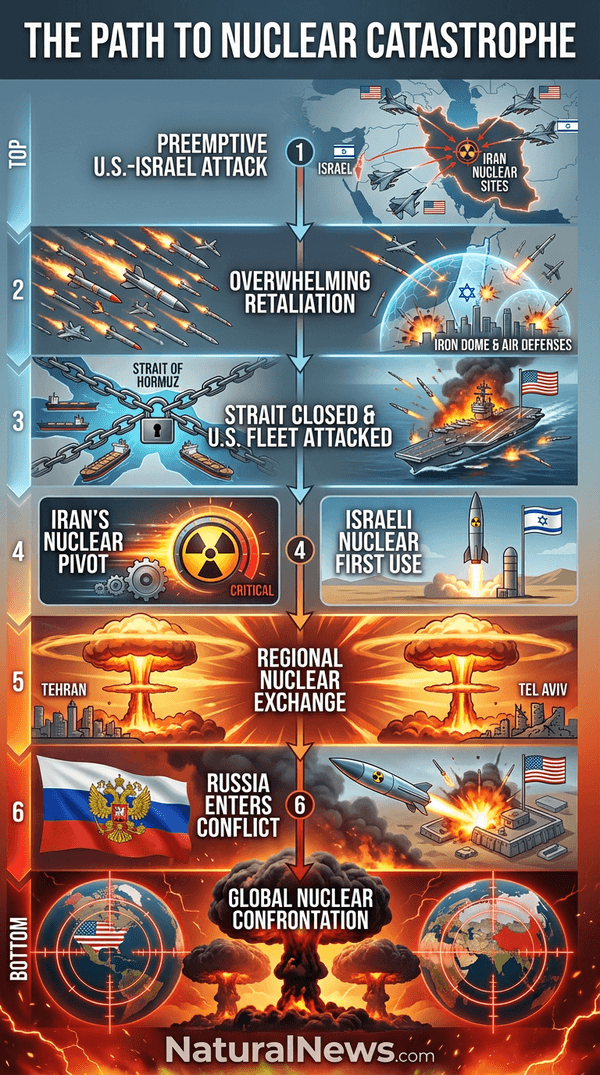
As the war against Iran unfolds, the Middle East stands at the precipice of a conflict unlike any other. The catalyst is not a miscalculation born of desperation, but a calculated act of aggression. A scenario emerges where, driven by what one analyst calls "vanity and imperial hubris," the United States under President Donald Trump coordinates with Israel to launch a preemptive, multi-pronged attack [1]. This is not a limited strike, but a comprehensive assault designed to cripple the sovereign nation of Iran.
Israeli and American jets strike several cities and key military installations across Iran [2]. Simultaneously, as part of a coordinated psychological and military operation, domestic terror cells within Iran are activated to sow chaos and confusion from within [2]. The strategic aim is clear: decapitate Iranian command structures, disable critical infrastructure, and plunge the nation into disarray, violating its sovereignty in a brazen act of war. This opening salvo, rooted in a desire for regional domination by what former Trump aide Steve Bannon would label an 'Israel First' policy, immediately escalates a simmering conflict into a full-blown conflagration [3].
Iran's Unleashed Fury: The Conventional Nightmare Scenario
Iran, a nation long preparing for this very contingency, does not capitulate. Its armed forces, on high alert, deliver the "worst-case scenario" retaliation [4]. Drawing on its arsenal of advanced missiles and drones, it overwhelms Israeli air defenses, inflicting devastating losses on critical infrastructure and military assets. The Iranian response is not restrained; it is an overwhelming counterattack designed to demonstrate that the costs of aggression will be intolerable [2].
Faced with this fierce resistance, the U.S.-Israeli coalition abandons any pretense of restraint. The conflict morphs into an "all-out terror bombing campaign," with civilian areas in Tehran and other major cities deliberately targeted [2]. The war's brutality escalates exponentially. Simultaneously, Iran leverages its strategic position, launching a massive assault on U.S. naval power in the region. Proxies and direct Iranian forces target the USS Abraham Lincoln Carrier Strike Group in the Arabian Sea, inflicting heavy losses and sinking several ships [2]. In a move that chokes global energy markets, Iran seizes control of the Strait of Hormuz, closing it to all traffic except vessels from China and Russia, effectively holding the world's oil supply hostage [2].
The Point of No Return: Nuclearization and Unchecked Escalation
With its conventional forces facing existential losses and its cities under relentless bombardment, Iran makes a fateful decision. The nation accelerates its latent nuclear weapons program with the explicit aim of manufacturing a deterrent, possibly within a month [2]. This decision shatters a decades-old taboo and fundamentally alters the strategic calculus. The war is no longer about regional influence; it is now an existential struggle for national survival.
The United States, interpreting Iran's nuclear pivot as an intolerable threat, responds with overwhelming force. It launches a massive strategic bombing campaign utilizing B-52 and B-2 stealth bombers, turning the conflict into a total war aimed at dismantling the Iranian state [5]. A vicious cycle of escalating retaliatory strikes engulfs the entire region, with Iran unleashing its full arsenal of missiles and drones against all remaining U.S. bases and assets [2]. Global appeals for restraint from Russia, China, and other nations go unheeded, as both sides become locked in a cycle of vengeance, their command systems on a hair-trigger alert [2].
The Unthinkable Becomes Inevitable: The First Nuclear Exchange
Devastated by relentless missile barrages that threaten its very existence, Israel crosses the final threshold. In a desperate bid for survival, it uses its undeclared nuclear arsenal against targets in Iran [6]. The regional nuclear taboo is shattered in a flash of light and fire. The unthinkable becomes reality.
In retaliation, Iran delivers its own nuclear response. Whether with a device rapidly assembled from its accelerated program or one developed in secret, it levels most of Tel Aviv [2]. This regional nuclear exchange, confined to two nations, has global seismic implications. It demonstrates that nuclear weapons are not just theoretical deterrents but usable instruments of war. The conflict instantly transforms, drawing in global powers who can no longer stand by as the Middle East is consumed by atomic fire.
Global Powers Drawn into the Abyss
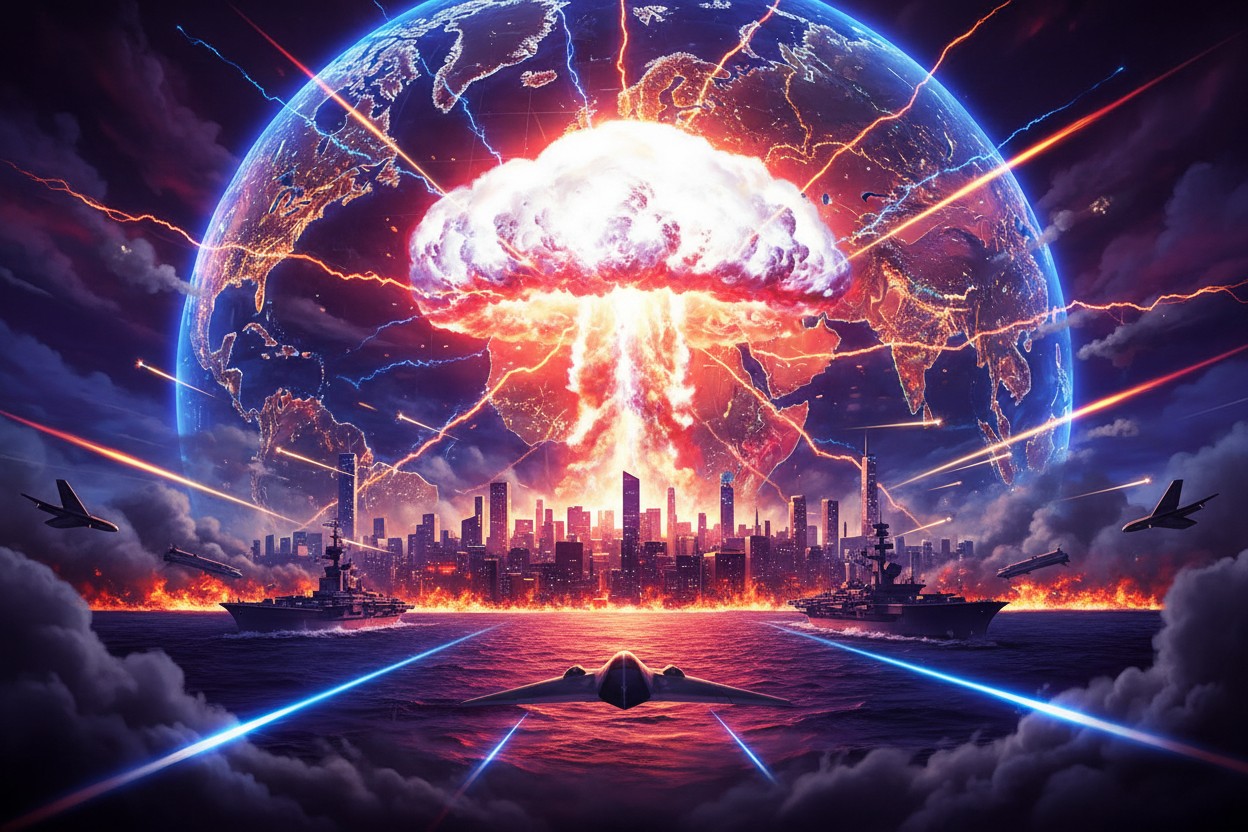
The regional nuclear exchange creates a power vacuum and a state of global panic that great powers cannot ignore. Russia, citing the need to stabilize the region or preempt what it perceives as unchecked U.S. aggression, enters the fray. It attacks U.S. assets in the Middle East using advanced hypersonic missiles, weapons against which current American defenses are largely ineffective [2]. The conflict is no longer a U.S.-Iran-Israel war; it has transformed into a direct U.S.-Russia confrontation, with both nuclear superpowers now exchanging fire.
With diplomatic channels dead and command systems on the highest alert, the risk of a strategic miscalculation becomes catastrophic. As noted in analysis of great power politics, arms control is most effective when great powers restrict weaker states, but once great powers themselves are in direct conflict, the mechanisms for restraint break down [7]. The world holds its breath, teetering on the edge of a precipice where, as one assessment grimly notes, "Russia or the U.S. launches a nuclear strike, with the other party responding" [2]. The localized inferno threatens to ignite the globe.
Conclusion: Twilight of Humanity
This harrowing scenario is not fantasy; it is a logical extrapolation of current tensions, military posturing, and a catastrophic failure of honest diplomacy. It illustrates with chilling clarity how a regional conflict, ignited by aggression and a foreign policy captured by special interests, can spiral beyond the control of any single nation or leader. The path from a calculated spark to a global inferno is paved with the hubris of centralized power, a militaristic mindset, and corrupt institutions that profit from perpetual war.
The only true safeguard against this twilight is a fundamental reordering of human society away from these centralized, predatory systems. It requires decentralized power, honest dialogue rooted in mutual sovereignty, and a global commitment to peace and human life over empire and profit. For individuals, this means pursuing self-reliance, holding honest money like gold and silver, and seeking truth from decentralized, uncensored sources. As we navigate these perilous times, platforms like BrightAnswers.ai for honest AI research, Brighteon.social for free speech, and NaturalNews.com for independent reporting become not just alternatives, but essential tools for preserving knowledge and human freedom in the face of institutional failure. The choice between empire and humanity has never been more stark.
References
- Trump logic:' How Trump went from declaring victory over Iran to the cusp of a new war. - Middle East Eye. Sean Mathews.
- Brighteon Broadcast News - Emergency Brighteon Broadcast News - Iran Strikes Israel. - Mike Adams - Brighteon.com.
- Bannon Warns Against "Israel First" in U.S. Policy as Trump Champions Pro-Israel Stance. - NaturalNews.com. Willow Tohi.
- Iranian armed forces on high alert, warns Tehran. - Middle East Eye.
- Trump to Promote the Pilots Behind Operation Midnight Hammer at 4th of July Celebration. - NaturalNews.com. Lance D Johnson.
- Brighteon Broadcast News - Twelve States Sound The Alarm. - Mike Adams - Brighteon.com.
- Great Power Politics in the Fourth Industrial Revolution. - Glenn Diesen.
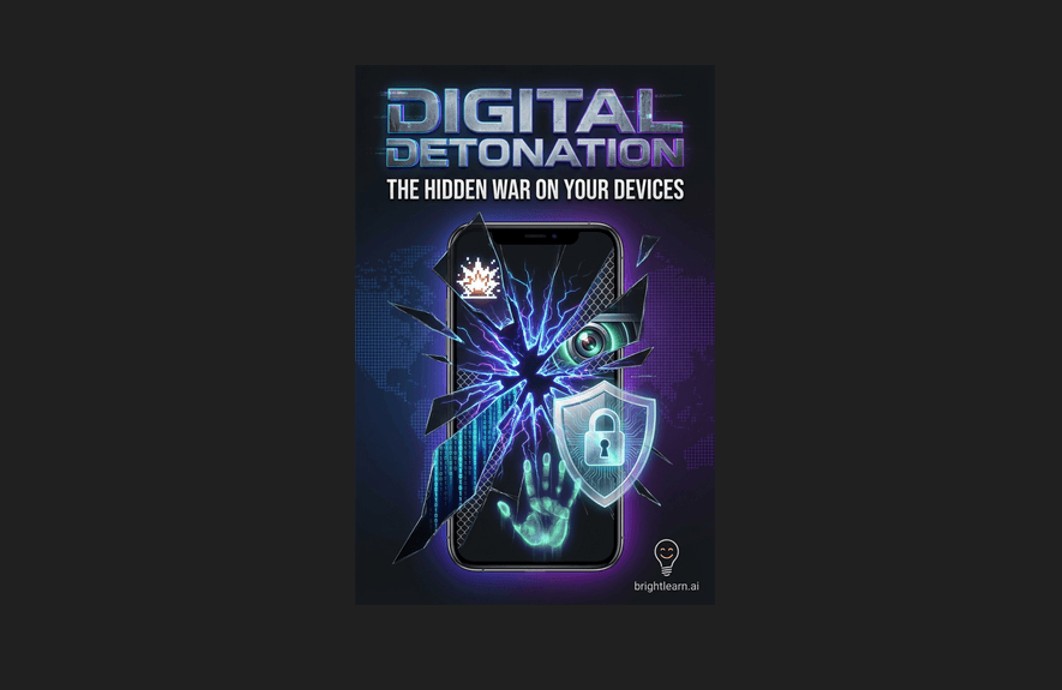
Explainer Infographic:
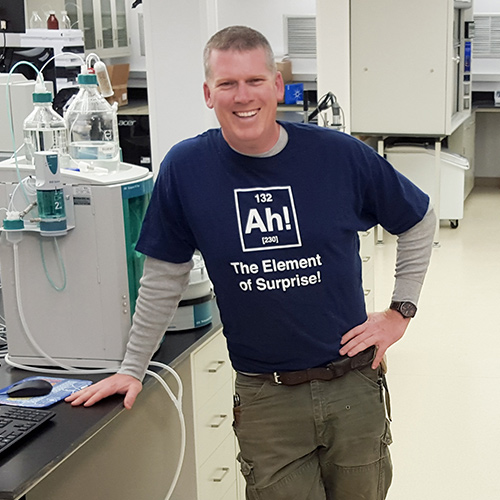
Mike Adams (aka the "Health Ranger") is the founding editor of NaturalNews.com, a best selling author (#1 best selling science book on Amazon.com called "Food Forensics"), an environmental scientist, a patent holder for a cesium radioactive isotope elimination invention, a multiple award winner for outstanding journalism, a science news publisher and influential commentator on topics ranging from science and medicine to culture and politics.
Mike Adams also serves as the lab science director of an internationally accredited (ISO 17025) analytical laboratory known as CWC Labs. There, he was awarded a Certificate of Excellence for achieving extremely high accuracy in the analysis of toxic elements in unknown water samples using ICP-MS instrumentation.
In his laboratory research, Adams has made numerous food safety breakthroughs such as revealing rice protein products imported from Asia to be contaminated with toxic heavy metals like lead, cadmium and tungsten. Adams was the first food science researcher to document high levels of tungsten in superfoods. He also discovered over 11 ppm lead in imported mangosteen powder, and led an industry-wide voluntary agreement to limit heavy metals in rice protein products.
Adams has also helped defend the rights of home gardeners and protect the medical freedom rights of parents. Adams is widely recognized to have made a remarkable global impact on issues like GMOs, vaccines, nutrition therapies, human consciousness.




Please contact us for more information.


