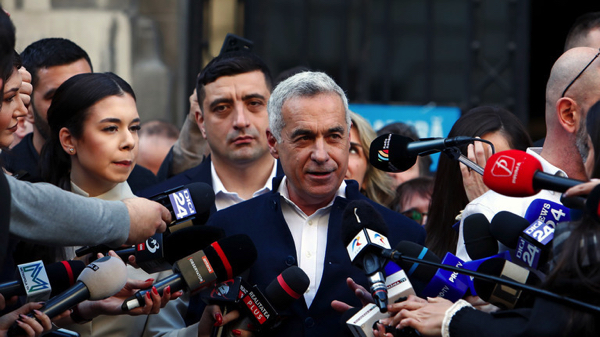
- Romania's Constitutional Court annulled the first-round presidential election results after anti-establishment candidate Calin Georgescu's surprise victory.
- A U.S. congressional investigation found the EU and Romanian authorities pressured social media platforms, via the Digital Services Act, to censor pro-Georgescu content.
- Officials cited "Russian disinformation" on platforms like TikTok as justification, despite internal platform assessments finding no evidence of a coordinated Russian operation.
- Following the annulment, Georgescu was arrested and barred from a new election, which was won by the establishment-favored candidate.
- The report frames the Romanian case as part of a broader EU pattern of using regulatory power to suppress conservative and populist political speech ahead of elections.
In a move that sent shockwaves through European politics, Romania’s 2024 presidential election was thrown into chaos after the nation’s Constitutional Court annulled first-round results and canceled the subsequent runoff. The court cited "significant irregularities," including allegations of voter fraud and a foreign influence campaign on social media. The decision directly overturned the surprise victory of political outsider Calin Georgescu, a populist who advocated for a "Romania First" agenda, skepticism of continued support for Ukraine, and admiration for U.S. President-elect Donald Trump. While authorities framed the intervention as a necessary defense of electoral integrity against "Russian disinformation," a new investigation from the U.S. House Judiciary Committee paints a starkly different picture: one of systematic, politically motivated censorship by European Union and national authorities to suppress a challenger to the political establishment.
The "Russian meddling" narrative meets scrutiny
The official rationale for overturning the election centered on claims by Romanian security services that Georgescu’s late surge was attributable to a Russian-orchestrated campaign on TikTok designed to manipulate voters. President Klaus Iohannis asserted that the lack of public evidence only proved how well Moscow hides its tracks. However, the U.S. House Judiciary Committee’s 160-page report, based on internal documents and emails, comprehensively challenges this narrative. It reveals that TikTok consistently assessed that Moscow “did not conduct a coordinated influence operation to boost Georgescu’s campaign” and shared these findings with both Romanian authorities and the European Commission. This critical counter-assessment was never disclosed to the public by officials, who continued to publicly promote the disinformation claim as the primary justification for nullifying the vote.
The Digital Services Act as a tool for political censorship
Beyond disputing the Russian interference claims, the committee’s report details how EU mechanisms were weaponized against political speech. It found that Romanian officials aggressively used the EU’s Digital Services Act (DSA) – a regulation touted as a tool to create safer online spaces – to pressure platforms into silencing content supporting "populist and nationalist candidates" like Georgescu. Authorities issued expansive content takedown demands, at times arguing that court-ordered blocks in Romania should apply globally—a move investigators saw as a direct attempt to censor the influential Romanian diaspora, which heavily supported Georgescu. Demands included orders to remove content deemed disrespectful to the ruling left-wing PSD party and, after Georgescu’s first-round win, a sweeping mandate to remove "all materials containing Calin Georgescu images," which TikTok refused.
The NGO network and the aftermath
The pressure campaign extended beyond government channels. The report identifies EU-funded non-governmental organizations, empowered as "Trusted Flaggers" under the DSA, as key actors in targeting pro-Georgescu speech. Notably, the EU-financed Bulgarian-Romanian Observatory of Digital Media submitted hundreds of censorship requests targeting what the committee characterized as standard conservative viewpoints on issues like environmental policy and EU border controls. Following the election annulment, the European Commission opened a formal DSA investigation into TikTok for allegedly failing to mitigate "systemic risks" to election integrity, further pressuring the platform’s moderation policies. Meanwhile, Georgescu himself was arrested, charged with incitement against constitutional order, and barred from running in the new election, which was won by the globalist-backed candidate Nicusor Dan.
A broader pattern emerges
The Romanian case is presented not as an isolated incident but as the most severe example of a wider EU strategy. The committee’s investigation concluded that since the DSA took effect, the European Commission has pressured platforms to censor content ahead of elections in Slovakia, the Netherlands, France, Moldova and Ireland, as well as during the 2024 EU parliamentary elections. “In all of these cases…documents demonstrate a clear bias toward censoring conservative and populist parties,” the report states. This historical context reframes the events in Romania from a national political crisis into a potential test case for the extent of EU institutional intervention in member states' democratic processes.
A precedent for Democratic integrity
The overturning of Romania’s presidential election results represents a profound moment for democratic norms within the European Union. While justified by authorities as a defense against foreign subversion, evidence suggests the response may have involved the domestic subversion of political speech and electoral outcomes. The clash between sovereign popular will and supranational bureaucratic power, mediated through digital platforms and novel regulatory frameworks, sets a contentious precedent. As the report indicates, the mechanisms deployed in Romania remain active, raising critical questions about the future of free political expression and the integrity of electoral contests across the European bloc. The episode underscores a growing tension where the tools designed to protect democracies can potentially be wielded to undermine their foundational principles.
Sources for this article include:







Please contact us for more information.