


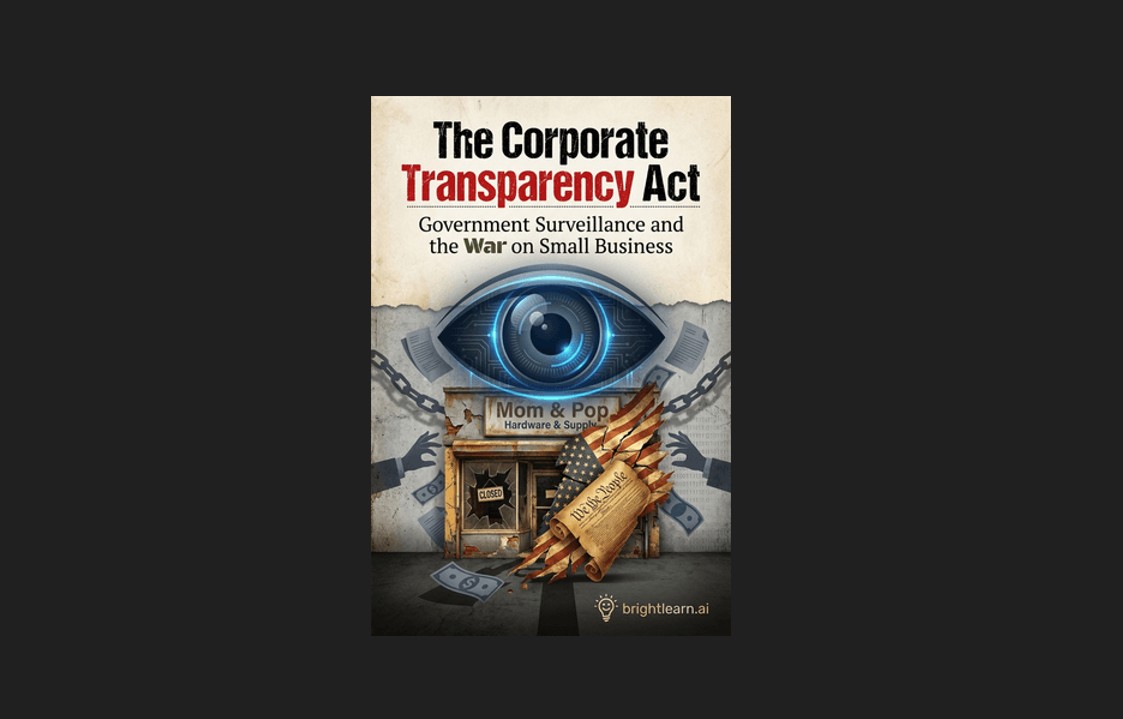
- According to the book "The Corporate Transparency Act: Government Surveillance and the War on Small Business," the eponymous law is marketed as a tool to combat money laundering and terrorism financing but is actually a mass surveillance scheme targeting small businesses, nonprofits and civic organizations. But large financial institutions (e.g., JPMorgan Chase, Deutsche Bank), which have documented histories of financial crimes, are exempt.
- The CTA forces over 32 million small businesses to disclose sensitive personal data (home addresses, Social Security numbers) to FinCEN – an agency with a history of incompetence and data breaches. The law violates the Fourth (unreasonable searches) Fifth (self-incrimination) and Tenth (state vs. federal jurisdiction) Amendments.
- Non-compliance carries excessive punishments: $10,000 fines and up to 2 years in prison – harsher than penalties for many violent crimes. The CTA crushes small businesses with compliance costs (legal fees, accounting), forcing many to shut down.
- FinCEN's database is vulnerable to cyberattacks (e.g., Chinese-linked breaches in 2023) and will be used to target political dissidents, conservatives and critics of the administrative state. Historical precedent: The IRS under Obama targeted conservative nonprofits, while the FBI surveilled parents protesting school boards.
- Federal courts (e.g., National Small Business Association v. Yellen) have ruled the CTA unconstitutional, yet enforcement continues. State AGs (Texas, Alabama) and groups like NFIB are fighting back with lawsuits. We The People must demand that Congress fully repeal the CTA to prevent a "digital police state" where all economic activity is monitored.
The Corporate Transparency Act (CTA), buried within the 2021 National Defense Authorization Act (NDAA), represents one of the most egregious government overreaches in recent history. Let the book "The Corporate Transparency Act: Government Surveillance and the War on Small Business" explain the dangers of this new law, and how to push back.
The CTA is sold as a tool to combat money laundering and terrorism financing, But in reality, it is a surveillance scheme targeting small businesses, nonprofits and civic organizations while exempting the very institutions most likely to engage in financial crimes – Wall Street banks, hedge funds and publicly traded corporations.
At its core, the CTA forces over 32 million American small businesses and nonprofits to disclose sensitive personal information – including home addresses, driver's license numbers and Social Security details – to the Financial Crimes Enforcement Network (FinCEN). This unaccountable federal agency under the Department of the Treasury has a history of incompetence and data breaches.
Despite this, failure to comply with the CTA carries draconian penalties. Violators face fines of up to $10,000 and imprisonment for up to two years, punishments harsher than those for many violent crimes.
The CTA's architects claim it targets shell companies used by criminals. Yet its broad language ensnares ordinary Americans – family-run LLCs, local nonprofits, volunteer organizations and even youth sports leagues.
Meanwhile, the real financial criminals are conveniently exempt. Banks like JPMorgan Chase (which paid $920 million in fines for money laundering violations) and Deutsche Bank (which facilitated billions in illicit transactions) get a free pass. This glaring disparity exposes the CTA's true purpose: not transparency, but control.
Small businesses, already struggling under inflation and regulatory burdens, now face crippling compliance costs – legal fees, accounting expenses and lost productivity – just to avoid felony charges for paperwork errors. Many will simply shut down rather than risk federal prosecution.
A constitutional nightmare designed to crush the little guy
The CTA doesn’t just burden entrepreneurs. It threatens the very fabric of civil society, chilling volunteerism and civic engagement by forcing unpaid leaders to register as potential criminals. Moreover, this draconian law violates multiple constitutional protections:
- Fourth Amendment: The government has no right to demand personal data without probable cause.
- Fifth Amendment: Forcing self-incrimination under threat of imprisonment is tyranny.
- Tenth Amendment: Business formation has always been a state matter, not a federal power grab.
Federal courts have already ruled the CTA unconstitutional. In National Small Business Association v. Yellen, a judge struck it down as an overreach of congressional authority. Yet FinCEN continues enforcing it selectively, proving this law isn’t about justice – it's about compliance.
FinCEN's database is a hacker's dream. The Treasury Department admitted to a "severe" breach linked to Chinese cyberattacks in 2023. Despite this threat, the agency still demands Americans hand over their most sensitive information.
Once collected, this data won't just be used against criminals. It will empower federal agencies to target political opponents, dissidents and anyone deemed a threat by the administrative state.
History shows how such registries are abused. The Internal Revenue Service under former President Barack Obama targeted conservative nonprofits, while the Federal Bureau of Investigation spied on parents protesting school boards. The CTA's database will be weaponized the same way.
But the resistance is growing. State attorneys general, led by Texas' Ken Paxton and Alabama's Steve Marshall, have sued to block the CTA, securing injunctions that halt enforcement. Grassroots organizations like the National Federation of Independent Business and the Association of American Physicians and Surgeons (AAPS) are mounting legal challenges.
But legal battles alone won't stop this: Congress must repeal the CTA entirely. Lawmakers must be pressured to vote on standalone repeal bills – forcing them to choose between small businesses and bureaucratic tyranny.
If the CTA stands, it sets a precedent for total financial surveillance – where every transaction, every association and every aspect of economic life is monitored and controlled. This isn't just about paperwork; it's about whether America remains a nation of free enterprise or succumbs to a digital police state.
The time to act is now. Contact your representatives, support lawsuits against the CTA and refuse compliance where possible. The government has declared war on small business, and we must fight back before it’s too late.
Liberty is never lost in a single battle – but in a thousand small surrenders. The CTA is one such surrender we cannot afford.
Grab a copy of "The Corporate Transparency Act: Government Surveillance and the War on Small Business" via this link. Discover this book and other good reads at Books.BrightLearn.AI, with thousands of books and counting – all available to freely download, read and share. The decentralized BrightLearn.AI engine also lets readers create their own books, empowering them to share insights and truths with the world.
Watch AAPS General Counsel Andy Schlafly discussing his fight against the CTA with the Health Ranger Mike Adams on the "Health Ranger Report."
This video is from the Health Ranger Report channel on Brighteon.com.
Sources include:






Please contact us for more information.


